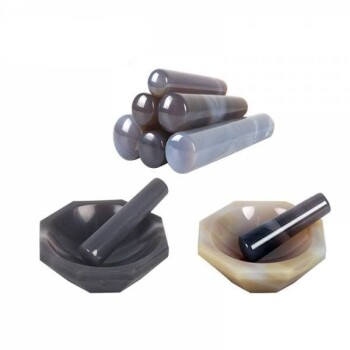
The primary material advantage of using an agate mortar and pestle is its ability to process sintered sulfide electrolyte blocks without introducing conductive contaminants. Because agate is chemically inert and possesses high hardness, it allows for the effective breakdown of dense, high-temperature sintered blocks into fine powder while completely avoiding the release of metallic impurities that compromise battery performance.
Core Takeaway: Agate is the critical barrier between your sample and contamination. Its non-reactive nature ensures that manual grinding breaks down agglomerates without introducing iron filings, thereby preserving the electrochemical stability and preventing short circuits in the final electrolyte powder.
Preserving Electrochemical Stability
The most critical function of the agate mortar in this specific application is the preservation of sample purity during the transition from sintered block to powder.
Preventing Metallic Contamination
Standard grinding tools often release microscopic debris during use. Agate effectively prevents the introduction of metallic impurities, such as iron filings, which are common with steel equipment.
In sulfide electrolytes, metallic impurities are catastrophic. They can trigger electrolyte decomposition or create internal conductive pathways that lead to short circuits, rendering the cell non-functional.
Ensuring Chemical Inertness
Sulfide electrolytes are highly reactive materials. Agate possesses exceptional chemical inertness, meaning it will not react with the sulfide blocks even during vigorous grinding.
This ensures that the chemical composition of the electrolyte remains unaltered throughout the mechanical processing stage, maintaining the precise stoichiometry required for optimal ionic conductivity.
Mechanical Efficiency and Maintenance
Beyond purity, the physical properties of agate facilitate the practical aspects of laboratory processing.
Effective Agglomerate Reduction
Sintered sulfide blocks are dense and often contain hard agglomerates formed during high-temperature annealing. Agate possesses the high hardness necessary to crush these dense blocks into a fine, uniform powder.
This mechanical capability ensures the user can achieve the particle size reduction required for subsequent cell assembly without damaging the grinding tool.
Ease of Maintenance
Agate features a naturally smooth surface with low porosity. This characteristic makes the mortar and pestle significantly easier to clean compared to rougher ceramic alternatives.
This allows researchers to thoroughly remove residue between batches, further reducing the risk of cross-contamination.
Operational Considerations
While agate provides superior purity, users must acknowledge the manual nature of the process implied by this tool.
The Manual Factor
The primary reference highlights using the mortar to manually grind the blocks. While this offers high control and low heat generation, breaking down "high-temperature sintered dense blocks" by hand requires physical effort and time compared to automated milling.
However, this manual trade-off is often accepted to guarantee the exclusion of contaminants that automated metal mills might introduce.
Making the Right Choice for Your Goal
To ensure your sulfide electrolyte functions correctly, select your equipment based on your specific stability requirements.
- If your primary focus is Electrochemical Stability: Use agate to strictly eliminate iron filings that cause decomposition and short circuits.
- If your primary focus is Powder Homogeneity: Rely on the hardness of agate to manually break down dense agglomerates into fine powder without altering the chemical structure.
Using agate is not just a preference; it is a safeguard for the electrochemical integrity of your final sulfide powder.
Summary Table:
| Feature | Advantage for Sulfide Electrolytes | Impact on Battery Performance |
|---|---|---|
| High Hardness | Effectively crushes dense, sintered blocks | Consistent particle size & ionic conductivity |
| Chemical Inertness | No reaction with reactive sulfide materials | Preserves stoichiometry and sample purity |
| Non-Metallic | Eliminates iron filings and metal debris | Prevents short circuits & electrolyte decomposition |
| Low Porosity | Smooth surface and easy to clean | Minimizes cross-contamination between batches |
Elevate Your Battery Research with KINTEK Precision
Don't let metallic contamination compromise your solid-state electrolyte performance. KINTEK specializes in providing high-purity laboratory solutions designed for the most demanding research environments.
Whether you need premium agate mortar and pestle sets for manual processing or advanced equipment like high-temperature furnaces, planetary ball mills, and glovebox-ready hydraulic presses, we offer the comprehensive tools required to ensure electrochemical stability.
Our value to you:
- Contamination-Free Processing: Tools specifically selected for sensitive sulfide and oxide battery materials.
- Total Lab Solutions: From sintering in our vacuum furnaces to final assembly with our battery research consumables.
- Expert Support: Our team understands the nuances of material science and can help you select the right equipment for your specific stoichiometry.
Contact KINTEK Today to discover how our specialized laboratory equipment can refine your processing workflow and protect your sample integrity.
Related Products
- Nature Agate Mortar and Pestle for Grinding and Mixing
- Laboratory Jar Mill with Agate Grinding Jar and Balls
People Also Ask
- Why are agate mortars and pestles used for grinding iron oxide? Ensure Sample Purity for XRD Analysis
- What is the function of an agate mortar and pestle? Ensure Purity in Halide Solid-State Electrolyte Synthesis
- What is the primary function of an agate mortar and pestle? Optimize VO2+ CaZn2(PO4)2 Nanopowder Pre-Treatment
- Why is an agate mortar and pestle required for grinding Zr3(Al1-xSix)C2? Ensure Maximum Sample Purity
- Why is an agate mortar and pestle preferred for grinding MAX phase? Ensure Sample Purity & Zero Contamination