To synthesize carbon nanotubes, engineers and researchers primarily use three established methods: arc discharge, laser ablation, and chemical vapor deposition (CVD). While the first two are foundational techniques used to produce high-quality material, CVD has become the dominant method for commercial-scale production due to its superior control, efficiency, and scalability.
The choice of a synthesis method is not about finding a single "best" technique, but about balancing critical trade-offs. While Chemical Vapor Deposition (CVD) offers the greatest scalability, success hinges on precisely controlling key process parameters like temperature, carbon source, and catalyst interaction.
The Three Core Synthesis Methods
Understanding the fundamental production techniques provides context for why the industry has standardized around one particular process. Each method has a distinct profile of cost, quality, and yield.
Arc Discharge: The Original Method
This was one of the first techniques used to produce CNTs. It involves creating a high-temperature plasma arc between two carbon electrodes in the presence of an inert gas.
The intense heat vaporizes the carbon, which then condenses to form nanotubes. While capable of producing high-quality CNTs, the process offers little control over the final structure and is difficult to scale.
Laser Ablation: High Purity, High Cost
In this method, a high-power laser is aimed at a graphite target that is mixed with a metal catalyst. The process takes place in a high-temperature furnace.
The laser vaporizes the target, creating a plume of carbon atoms that self-assemble into nanotubes as they cool. This technique is known for producing very high-purity CNTs but is expensive and has a low production rate, making it unsuitable for most commercial applications.
Chemical Vapor Deposition (CVD): The Commercial Standard
CVD is the most widely used method for industrial CNT production. It involves flowing a hydrocarbon gas (the carbon source) over a substrate coated with metal catalyst particles at elevated temperatures.
The catalyst breaks down the hydrocarbon molecules, and the carbon atoms then assemble on the catalyst particles, growing into nanotubes. The superior control over growth parameters and scalability make CVD the clear choice for commercial applications.
Critical Parameters That Dictate Success
Simply choosing a method is not enough. The quality, structure, and yield of the final carbon nanotubes are dictated by a sensitive interplay of process variables.
The Role of Temperature
Temperature is a critical operating parameter. It must be high enough to activate the catalyst and decompose the carbon source, but not so high that it damages the catalyst or forms unwanted carbon by-products like amorphous carbon.
Choosing Your Carbon Source
The choice of hydrocarbon gas significantly impacts energy consumption and efficiency. Some sources are more easily converted into nanotubes than others.
For example, acetylene can be a direct carbon nanotube precursor, requiring less energy to initiate growth. In contrast, methane and ethylene require higher energy for thermal conversion before they can contribute to nanotube formation.
Optimizing Residence Time
Residence time is the duration the carbon source spends in the reaction zone. This must be carefully balanced.
If the residence time is too low, the carbon source is wasted as it passes through without reacting. If it is too high, it can lead to the accumulation of by-products and limit the replenishment of the carbon source, stifling growth.
Understanding the Trade-offs
Every decision in CNT synthesis involves a trade-off. Recognizing these compromises is key to optimizing a process for a specific goal.
Growth Rate vs. Energy Consumption
Increasing the concentration of the carbon source or hydrogen can lead to higher growth rates. However, this comes at the cost of significantly increased energy consumption. This balance between speed and efficiency is a core challenge.
Purity vs. Scalability
The foundational methods, arc discharge and laser ablation, can produce CNTs with very high purity. This benefit is overshadowed by their extremely low yield and high cost, limiting them to lab-scale research.
CVD, while highly scalable, often requires post-processing purification steps to remove residual catalyst and amorphous carbon, adding complexity to the overall process.
Cost vs. Process Simplicity
Using a simple carbon source like methane may seem cost-effective, but it requires more energy for thermal conversion. A more reactive gas like acetylene might be more expensive upfront but can lead to a more energy-efficient and simpler overall process.
Making the Right Choice for Your Goal
Your application will determine which synthesis method and parameters are most appropriate. Base your decision on your primary objective.
- If your primary focus is high-purity samples for fundamental research: Arc discharge or laser ablation are your most reliable options, despite their low yield.
- If your primary focus is large-scale commercial production: Chemical Vapor Deposition (CVD) is the industry standard, offering the best balance of scalability and process control.
- If your primary focus is process optimization and cost reduction: Focus on tuning CVD parameters, particularly by choosing an energy-efficient carbon source and precisely controlling residence time.
- If your primary focus is sustainability: Investigate emerging methods that utilize waste feedstocks like captured carbon dioxide or pyrolysis of methane.
Ultimately, mastering carbon nanotube synthesis lies in understanding and controlling the interplay of these fundamental variables to meet a specific outcome.
Summary Table:
| Method | Primary Use | Key Advantage | Key Limitation |
|---|---|---|---|
| Arc Discharge | Foundational Research | High-Quality Material | Low Yield, Difficult to Scale |
| Laser Ablation | High-Purity Research | Exceptional Purity | High Cost, Low Production Rate |
| Chemical Vapor Deposition (CVD) | Commercial Production | Superior Scalability & Control | Often Requires Post-Processing |
Ready to Integrate Carbon Nanotubes into Your Research or Production?
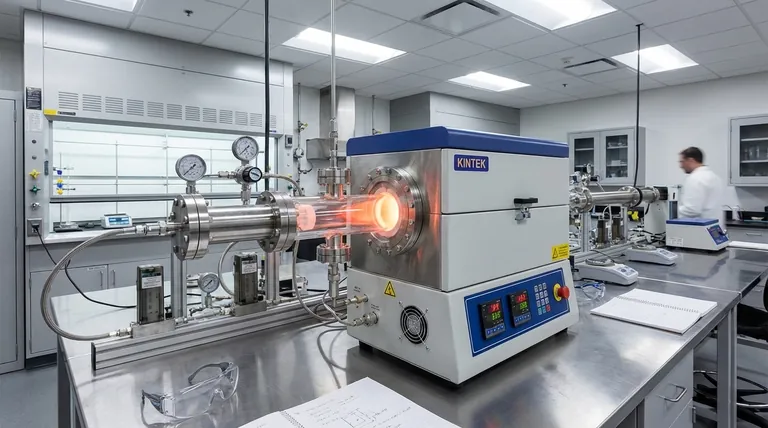
Navigating the complexities of CNT synthesis is the first step. Implementing it requires the right equipment and expertise. KINTEK specializes in advanced laboratory equipment, including Chemical Vapor Deposition (CVD) systems, to help you achieve precise control over your carbon nanotube production.
Whether your goal is fundamental research or scaling up for commercial applications, our solutions are designed to help you optimize critical parameters like temperature, carbon source, and residence time for superior results.
Contact us today to discuss your specific needs and discover how KINTEK's lab equipment and consumables can accelerate your innovation.
Visual Guide

Related Products
- Customer Made Versatile CVD Tube Furnace Chemical Vapor Deposition Chamber System Equipment
- Split Chamber CVD Tube Furnace with Vacuum Station Chemical Vapor Deposition System Equipment Machine
- Customizable Laboratory High Temperature High Pressure Reactors for Diverse Scientific Applications
- High Pressure Laboratory Autoclave Reactor for Hydrothermal Synthesis
- Multi Heating Zones CVD Tube Furnace Machine Chemical Vapor Deposition Chamber System Equipment
People Also Ask
- What is the substrate for CVD process? Choosing the Right Foundation for Your Thin Film
- What is a CVD tube furnace? A Complete Guide to Thin-Film Deposition
- What is chemical vapor deposition for CNT? The Leading Method for Scalable Carbon Nanotube Synthesis
- What is the difference between hot wall CVD and cold wall CVD? Choose the Right System for Your Process
- What is the function of a high-temperature CVD tube furnace in 3D graphene foam prep? Master 3D Nanomaterial Growth