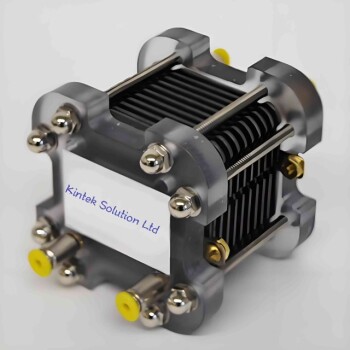
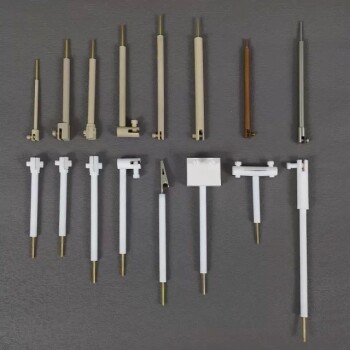
The design of a precision electrochemical test cell relies on two fundamental pillars: establishing a standardized flow structure and securing a robust electrode assembly environment. To generate valid data, the cell must ensure that reactant gases or electrolytes are distributed with absolute uniformity across the electrode surface while maintaining a mechanical seal that prevents any leakage.
The test cell is not merely a holder for your sample; it is a precision instrument designed to eliminate environmental variables. Its primary goal is to provide a stable, repeatable platform so that performance data reflects the true properties of the electrocatalyst or membrane, rather than inconsistencies in the hardware.
Optimizing Reactant Distribution
Standardized Flow Channels
The core function of the test cell is to deliver reactants—such as hydrogen and oxygen—to the active sites of the electrode.
The design must incorporate a standardized flow channel structure. This ensures that the flow dynamics are predictable and reproducible from one experiment to the next.
Achieving Uniformity
Simply delivering the gas is not enough; it must be spread evenly.
The cell design must guarantee that reactants or electrolytes are distributed uniformly across the entire electrode surface. Without this, you will create localized "hot spots" or dead zones that skew polarization curves and mask the true performance of the material.
Mechanical Integrity and Sealing
Robust Fastening Systems
A precision test cell requires a robust mechanical fastening structure. This is the physical skeleton that holds the sandwich of components together under pressure.
This structure allows for the evaluation of long-term stability by maintaining consistent contact pressure over time, which is critical when testing membrane materials under realistic operating conditions.
Preventing Leakage
The most immediate failure mode in electrochemical testing is the escape of reactants.
The design must absolutely prevent gas or liquid leakage. A compromised seal not only creates safety hazards but also invalidates the measurement of current efficiency and concentration gradients.
Enabling Advanced Characterization
A Platform for Polarization
The physical design of the cell dictates the quality of your polarization data.
By providing a stable environment, the cell serves as a reliable physical platform for evaluating polarization curves. This allows you to map the voltage-current relationship without interference from fluctuating contact resistance.
Cyclic Voltammetry (CV) Support
For detailed kinetic studies, the cell must support dynamic electrical loads.
The assembly environment enables accurate cyclic voltammetry (CV) characteristics to be recorded. This is essential for determining the electrochemical active surface area (ECSA) of your catalysts.
Understanding the Trade-offs
Compression vs. Integrity
A common design challenge is balancing the "robust mechanical fastening" with the fragility of the test materials.
While you need high pressure to prevent leakage and lower contact resistance, excessive force can crush porous diffusion layers or puncture membranes. A precision cell design often includes fixed-stop mechanisms or torque specifications to ensure the seal is reliable without being destructive.
Making the Right Choice for Your Goal
To select or design the right test cell, you must align the hardware features with your specific research objectives.
- If your primary focus is Electrocatalyst Screening: Prioritize a cell with a quick-release assembly environment to facilitate the rapid exchange of multiple samples for cyclic voltammetry.
- If your primary focus is System Durability: Prioritize a cell with an exceptionally robust mechanical fastening structure to ensure leak-free operation during long-term stability testing.
Ultimately, a well-designed test cell fades into the background, allowing the true chemistry of your materials to take center stage.
Summary Table:
| Design Consideration | Key Function | Impact on Characterization |
|---|---|---|
| Standardized Flow | Uniform reactant distribution | Eliminates localized hot spots & dead zones |
| Mechanical Fastening | Consistent contact pressure | Ensures repeatable long-term stability data |
| Sealing Integrity | Prevents gas/liquid leakage | Protects current efficiency & lab safety |
| Hardware Stability | Lowers contact resistance | Provides accurate polarization & CV curves |
Elevate Your Electrochemical Research with KINTEK
Precision data starts with superior hardware. KINTEK specializes in advanced laboratory solutions designed for the most demanding research environments. From high-performance electrolytic cells and electrodes to specialized high-temperature reactors, our equipment provides the stability and uniformity required for accurate fuel cell and electrolyzer characterization.
Whether you are performing cyclic voltammetry (CV) for catalyst screening or long-term polarization studies, our robust designs minimize environmental variables so your material properties can truly shine. Explore our comprehensive range of battery research tools, crushing systems, and cooling solutions tailored for modern material science.
Ready to optimize your testing accuracy? Contact KINTEK today to discuss how our precision laboratory equipment can enhance your research outcomes.
References
- John R. Varcoe, Lin Zhuang. Anion-exchange membranes in electrochemical energy systems. DOI: 10.1039/c4ee01303d
This article is also based on technical information from Kintek Solution Knowledge Base .
Related Products
- Customizable Swagelok Type Test Cells for Advanced Battery Research Electrochemical Analysis
- Electrolytic Electrochemical Cell for Coating Evaluation
- PTFE Electrolytic Cell Electrochemical Cell Corrosion-Resistant Sealed and Non-Sealed
- Sample Support Body for Electrochemical Tests
- Flat Corrosion Electrolytic Electrochemical Cell
People Also Ask
- How does a standardized electrochemical test cell assist in MOx/CNTf electrode screening? Optimize Material Ratios
- Why is a dedicated electrochemical test cell necessary for carbon steel? Ensure Precise Geothermal Corrosion Data
- What is the difference between a voltaic cell and an electrochemical cell? Understand the Two Types of Energy Conversion
- How do the electrochemical cell and three-electrode testing system collaborate? Optimize Zinc Anode Deposition Control
- Why must the electrochemical cell be continuously purged with nitrogen? Ensure Precision in Ni-Cr Corrosion Tests