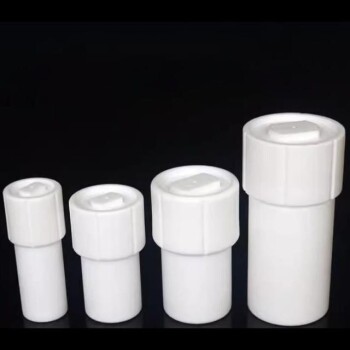
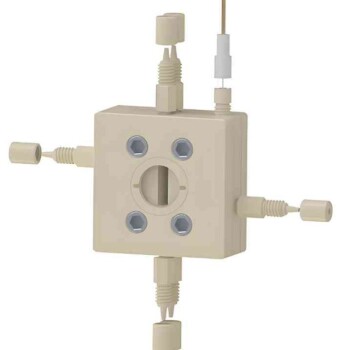
The primary functions of a custom Teflon electrochemical cell are to provide superior chemical resistance against organic electrolytes and to enforce a precise, reproducible experimental geometry. By strictly defining the effective exposure area of the silicon working electrode, the cell ensures that derived metrics like current density and light intensity are calculated with high accuracy. Additionally, it provides a stable mounting platform for reference and counter electrodes, enabling consistent results across advanced analytical techniques such as cyclic voltammetry (CV) and electrochemical impedance spectroscopy (EIS).
The custom Teflon cell serves as a foundational tool for data reliability in photoelectrochemical (PEC) studies. Its design eliminates geometric variables and chemical interference, ensuring that observed performance changes are due to the functionalized silicon itself, not artifacts of the experimental setup.
Ensuring Precision in Measurement
Defining the Effective Exposure Area
One of the most critical roles of this custom cell is strictly limiting the surface area of the silicon electrode exposed to the electrolyte.
This boundary is essential because photoelectrochemical performance is often reported in current density (current per unit area).
If the exposed area varies or is ill-defined, calculations of current density become unreliable, rendering the data useless for comparative analysis.
Accurate Light Intensity Calculations
The precise definition of the electrode area also directly impacts optical measurements.
To accurately correlate the amount of photon energy converting to electrical energy, you must know the exact light intensity hitting the active surface.
The custom cell design aligns the exposure window to match the light source, ensuring that light intensity calculations are mathematically sound.
Material Compatibility and Stability
Chemical Inertness in Organic Environments
Functionalized silicon electrodes are often tested in diverse environments, including organic electrolytes that can degrade standard materials.
Teflon is utilized specifically for its excellent chemical inertness.
It withstands aggressive organic solvents without dissolving or reacting, preventing contamination of the electrolyte that could skew electrochemical readings.
Creating a Repeatable Geometry
Reliable science requires reproducibility, which this cell facilitates by providing rigid mounting points for the counter and reference electrodes.
This fixed geometry ensures that the distance and orientation between electrodes remain constant across every experiment.
Such consistency is vital for sensitive analyses like cyclic voltammetry and electrochemical impedance spectroscopy, where geometric variations can alter resistance and impedance profiles.
Understanding the Trade-offs
Design Rigidity
While a fixed geometry is excellent for repeatability, it can be a limitation if your sample sizes vary significantly.
The custom cell typically requires the silicon samples to be cut to specific dimensions to fit the mounting aperture properly.
This means you must commit to a standardized sample preparation protocol, reducing flexibility for testing oddly shaped or irregular fragments.
Material Opacity
Unlike glass or quartz, Teflon is opaque.
This requires the design to include a specific window or open aperture for light illumination.
You must ensure this aperture allows for unobstructed light paths without creating shadowing effects that could obscure parts of the working electrode.
Making the Right Choice for Your Goal
To maximize the utility of a custom Teflon cell in your specific application, consider your primary analytical objectives:
- If your primary focus is quantitative comparison: Prioritize the precise definition of the aperture area to ensure your current density and light intensity calculations are unimpeachable.
- If your primary focus is electrolyte versatility: Leverage the chemical inertness of the Teflon body to explore a wide range of organic solvents without fear of cell degradation.
By controlling the geometry and chemistry of the environment, you transform your setup from a variable into a constant.
Summary Table:
| Key Function | Technical Benefit | Scientific Impact |
|---|---|---|
| Chemical Inertness | High resistance to organic electrolytes | Prevents contamination and experimental artifacts |
| Precise Aperture | Defines exact exposure area | Ensures accurate current density & light intensity |
| Fixed Geometry | Consistent electrode positioning | Reliable results for CV and EIS analysis |
| Stable Mounting | Rigid reference/counter platform | High reproducibility across multiple test cycles |
Optimize Your Photoelectrochemical Research with KINTEK
Precision is the foundation of scientific breakthrough. KINTEK specializes in high-performance laboratory equipment and consumables designed to meet the rigorous demands of material science. Our expertise extends to a comprehensive range of electrolytic cells and electrodes, ensuring your functionalized silicon studies are supported by superior chemical resistance and geometric accuracy.
Beyond electrochemical solutions, our portfolio features:
- High-temperature furnaces (Muffle, Vacuum, CVD/PECVD) and crushing/milling systems.
- Hydraulic presses (Pellet, Hot, Isostatic) and battery research tools.
- High-temperature high-pressure reactors and specialized consumables like PTFE products, ceramics, and crucibles.
Don't let experimental variables compromise your data. Contact KINTEK today to discover how our customized equipment can enhance your laboratory’s efficiency and accuracy!
References
- Brittany L. Huffman, Jillian L. Dempsey. Surface Immobilization of a Re(I) Tricarbonyl Phenanthroline Complex to Si(111) through Sonochemical Hydrosilylation. DOI: 10.17615/bnne-wd96
This article is also based on technical information from Kintek Solution Knowledge Base .
Related Products
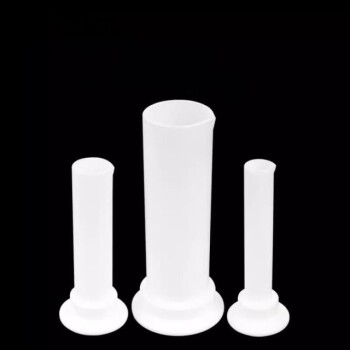
- Custom PTFE Teflon Parts Manufacturer for PTFE Measuring Cylinder 10/50/100ml
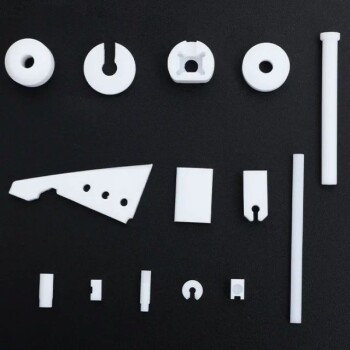
- Custom PTFE Teflon Parts Manufacturer for Non-Standard Insulator Customization
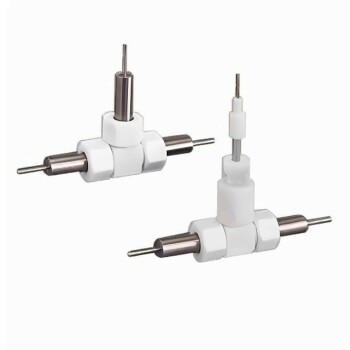
- Customizable Swagelok Type Test Cells for Advanced Battery Research Electrochemical Analysis
- PTFE Electrolytic Cell Electrochemical Cell Corrosion-Resistant Sealed and Non-Sealed
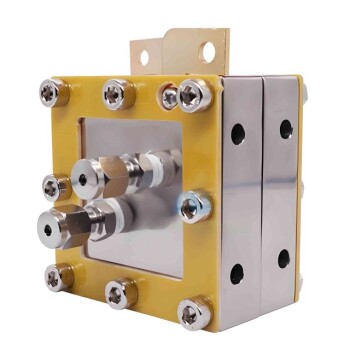
- Customizable PEM Electrolysis Cells for Diverse Research Applications
People Also Ask
- What are the specific applications of PTFE in micro-batch slug flow systems? Enhance Your Microfluidic Reaction Purity
- Is PTFE corrosion resistant? Discover the Ultimate Chemical Resistance for Your Lab
- How is PTFE utilized for insulation in Alloy 22 corrosion setups? Ensure Signal Purity & Accuracy
- What chemicals are used in heat treatment? Master the Quenching Process for Optimal Metal Properties
- What role do standard pyrometric cones (PCE Cones) play during refractoriness testing? Ensure High-Temp Stability