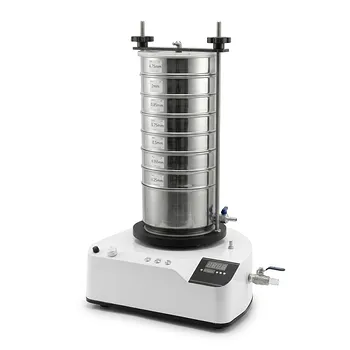
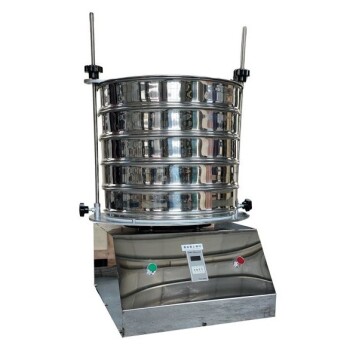
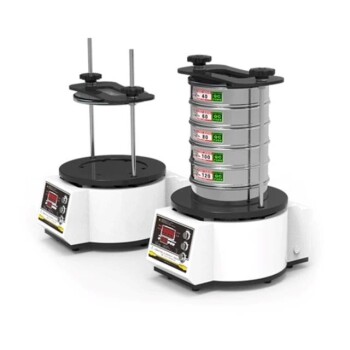
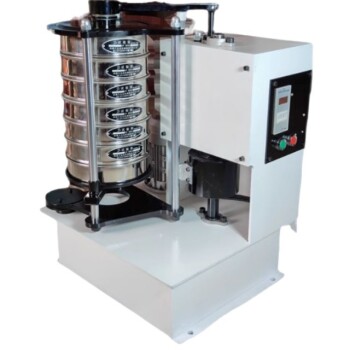
Sieving is a cornerstone of industrial quality control, with critical applications in pharmaceuticals for ensuring dose consistency, in food processing for guaranteeing product texture and safety, and in mining and aggregates for producing foundational construction materials. These processes rely on sieving to separate particles by size, transforming raw materials into precisely graded, high-value products.
Beyond simply sorting materials, industrial sieving is a critical control point that directly impacts final product quality, process efficiency, and even consumer safety. Understanding the goal of the separation—whether for purity, consistency, or performance—is key to grasping its industrial significance.
The Core Principle: Separation by Size
Sieving, also known as sifting or screening, is one of the oldest and most fundamental mechanical separation techniques. The principle is straightforward, but its industrial application is highly engineered.
How a Sieve Works
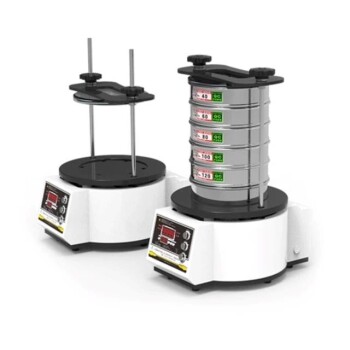
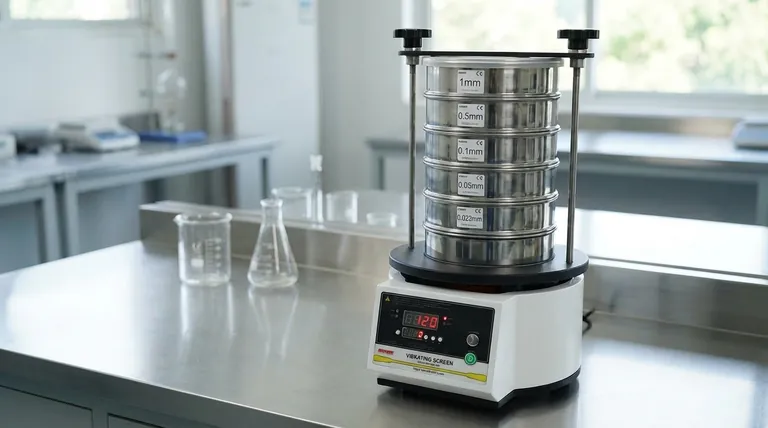
A sieve is essentially a screen or mesh with precisely sized apertures (openings). When a mixture of particles is passed over this screen, often with the aid of vibration or rotation, smaller particles fall through while larger particles are retained.
The Goal: A Target Particle Size Distribution
The purpose is not just to separate "big" from "small." The goal is to achieve a specific particle size distribution (PSD). This means controlling the range and proportion of particle sizes in the final product, which is critical for its performance.
Key Industrial Applications in Detail
While the principle is universal, the application and required precision vary dramatically across industries. Here are three prominent examples.
1. Pharmaceuticals: The Mandate for Precision
In pharmaceutical manufacturing, sieving is not optional; it is a regulatory requirement for quality control. The size of active pharmaceutical ingredient (API) particles directly affects how quickly a drug dissolves in the body and, therefore, its bioavailability.
Sieving ensures that granules used to make tablets are uniform. Non-uniform granules can lead to tablets with inconsistent weight, hardness, and dosage, posing a direct risk to patient safety.
2. Food and Beverage: Ensuring Quality and Safety
Sieving is essential for the quality and safety of countless food products. Flour is sifted not only to remove lumps and foreign contaminants but also to aerate it, which is crucial for baking.
Similarly, sugar crystals, salt, and spices are sieved to create specific grades (e.g., "fine" or "coarse") that determine texture and dissolution properties. It also serves as a critical safety check to remove any potential foreign material before packaging.
3. Mining and Aggregates: The Foundation of Construction
On a much larger and more rugged scale, the construction industry relies entirely on sieving, often called screening. Aggregate materials like sand, gravel, and crushed rock must be sorted into specific size grades.
The structural integrity of concrete and asphalt depends on a precise recipe of these different-sized aggregates. Using the wrong grade can lead to structural failure, making accurate, high-volume screening a fundamental process for infrastructure development.
Understanding the Trade-offs
Industrial sieving is an engineered process with inherent challenges and compromises that must be managed.
The Problem of Blinding and Pegging
Blinding occurs when fine, damp, or static-charged particles stick to the mesh, blocking the apertures. Pegging is when near-size particles become wedged in the openings. Both issues drastically reduce efficiency and require the process to be stopped for cleaning.
Material Properties Matter
A sieve that works perfectly for dry, round sand may fail completely with a moist, sticky, or statically charged powder. The flowability, shape, and moisture content of the material are just as important as the mechanics of the sieve itself.
Throughput vs. Accuracy
There is a constant trade-off between speed and precision. Forcing material through a sieve too quickly can reduce separation accuracy, as some smaller particles may not get a chance to pass through the mesh. Engineers must balance the need for high throughput with the required level of separation quality.
Making the Right Choice for Your Goal
The "best" sieving strategy is entirely dependent on the desired outcome for the final product.
- If your primary focus is product purity and safety (e.g., Pharmaceuticals): Your main concern is removing all contaminants and achieving a very narrow particle size distribution, even at the cost of lower throughput.
- If your primary focus is product consistency and consumer experience (e.g., Food Powders): You need reliable separation to ensure texture and performance, balancing quality control with efficient production speeds.
- If your primary focus is high-volume classification (e.g., Aggregates): The goal is maximizing throughput to sort massive quantities of material into specific grades, where the durability of the equipment is paramount.
Ultimately, effective industrial sieving transforms a raw, variable material into a predictable and valuable final product.
Summary Table:
| Industry | Primary Goal of Sieving | Key Benefit |
|---|---|---|
| Pharmaceuticals | Ensure dose consistency and bioavailability | Patient safety and regulatory compliance |
| Food & Beverage | Guarantee texture, purity, and safety | Product quality and consumer experience |
| Mining & Aggregates | Produce specific material grades for construction | Structural integrity and high-volume efficiency |
Ready to achieve precise particle separation and enhance your product quality?
KINTEK specializes in high-performance lab equipment and consumables for all your sieving and particle analysis needs. Whether you're in pharmaceuticals, food processing, or materials science, our solutions ensure accuracy, efficiency, and compliance.
Contact us today to discuss how we can support your laboratory's goals!
Visual Guide

Related Products
- Three-dimensional electromagnetic sieving instrument
- Laboratory Vibratory Sieve Shaker Machine for Dry and Wet Three-Dimensional Sieving
- Laboratory Test Sieves and Sieving Machines
- Laboratory Test Sieves and Vibratory Sieve Shaker Machine
- Laboratory Wet Three-Dimensional Vibratory Sieve Shaker Machine
People Also Ask
- Why is sieving equipment necessary for processing powder prior to hot extrusion of PEO? Ensure Cathode Film Uniformity
- What are the precautions for sieving method? Ensure Accurate Particle Size Analysis
- What are advantages and disadvantages of sieving method? A Guide to Reliable & Cost-Effective Particle Sizing
- How is sieving important? The Critical Role of Particle Size Analysis in Quality Control
- What are the limitations of sieving? Understanding the Constraints of Particle Size Analysis