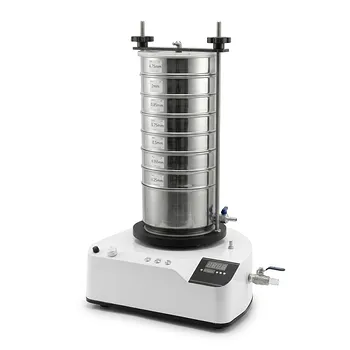
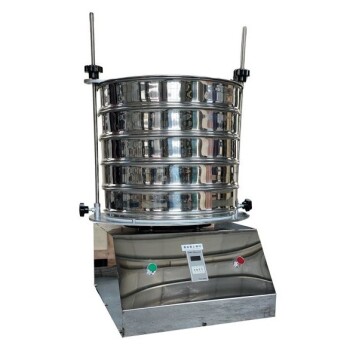
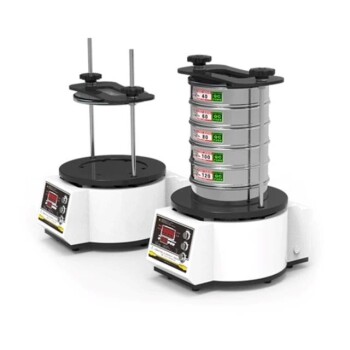
Sieving equipment acts as a vital pre-processing safeguard that prepares dried active materials, conductive carbon, and polymer electrolyte powders for hot extrusion. By physically breaking down large-scale agglomerates formed during the drying phase, sieving ensures the raw material feed has a uniform particle size distribution, which is a prerequisite for successful extrusion.
Core Takeaway Drying powder components inevitably creates hardened clumps that can disrupt the manufacturing process. Sieving is the only way to guarantee a homogeneous feedstock, directly resulting in the structural stability and uniformity required for high-performance composite cathode thin films.
The Challenge of Powder Preparation
Counteracting Drying Effects
The process of drying active materials and PEO (Polymer Electrolyte Oxide) often causes individual particles to bind together. These bonds create large-scale agglomerates that do not break down easily during simple mixing.
Mechanical Breakdown of Clumps
Sieving equipment is not merely for filtration; it serves a mechanical function. It applies necessary force to pulverize these agglomerates, returning the material to a fine, workable powder state.
Standardizing Particle Size
For hot extrusion to work effectively, the input material must be consistent. Sieving acts as a quality gate, ensuring that the powder entering the extruder possesses a uniform particle size distribution.
Impact on Final Product Quality
Achieving Homogeneity
A consistent powder feed is essential for the chemical uniformity of the cathode. Removing large chunks ensures that conductive carbon and active materials are evenly dispersed throughout the polymer matrix during extrusion.
Ensuring Structural Stability
PEO-based composite cathodes are typically formed as thin films. If large agglomerates remain in the mix, they can cause physical defects or weak points, compromising the structural integrity of the final film.
Common Pitfalls to Avoid
Relying Solely on Extruder Shear
A common error is assuming the shear force of the hot extruder is sufficient to break down all agglomerates. Hardened dried clumps often survive the extrusion process intact if not sieved first.
Ignoring Film Thickness Constraints
If the particle agglomerates are larger than the target thickness of the cathode film, they will protrude from the surface or cause tears. Sieving eliminates this risk by setting a maximum particle size limit.
Making the Right Choice for Your Goal
To maximize the performance of your PEO-based cathodes, ensure your process flow prioritizes the condition of the feedstock.
- If your primary focus is Film Integrity: Prioritize sieving to eliminate large particles that create stress concentrations and physical defects in thin films.
- If your primary focus is Electrochemical Performance: Use sieving to guarantee the homogeneity of the mix, ensuring uniform conductivity and ion transport throughout the cathode.
Uniform input materials are the single most important factor in achieving predictable, high-quality extrusion results.
Summary Table:
| Aspect | Impact of Sieving on PEO Processing | Benefit to Final Product |
|---|---|---|
| Particle Size | Breaks down hardened clumps/agglomerates | Ensures smooth, defect-free thin films |
| Feedstock | Standardizes particle size distribution | Stabilizes the hot extrusion process |
| Homogeneity | Evenly disperses carbon and active materials | Optimizes electrochemical performance |
| Structural Integrity | Removes particles larger than film thickness | Prevents surface tears and physical weak points |
Elevate Your Battery Research with KINTEK Precision
Don't let powder agglomerates compromise your solid-state battery performance. KINTEK specializes in high-performance laboratory equipment designed for the rigorous demands of material science. From advanced sieving equipment and crushing systems to ensure perfect feedstock, to high-temperature furnaces and hydraulic presses for final component fabrication, we provide the tools you need for success.
Whether you are developing PEO-based cathodes or exploring next-generation energy storage, our comprehensive range of battery research tools, vacuum furnaces, and PTFE consumables ensures your lab achieves superior results with every batch.
Ready to optimize your production process? Contact our technical experts today to find the perfect solution for your lab!
Related Products
- Three-dimensional electromagnetic sieving instrument
- Laboratory Vibratory Sieve Shaker Machine for Dry and Wet Three-Dimensional Sieving
- Laboratory Test Sieves and Sieving Machines
- Laboratory Wet Three-Dimensional Vibratory Sieve Shaker Machine
- Laboratory Test Sieves and Vibratory Sieve Shaker Machine
People Also Ask
- Why is sieving equipment essential for the classification of processed bio-activated carbon? Optimize Performance
- What are the limitations of sieving? Understanding the Constraints of Particle Size Analysis
- What are advantages and disadvantages of sieving method? A Guide to Reliable & Cost-Effective Particle Sizing
- How is sieving important? The Critical Role of Particle Size Analysis in Quality Control
- What is sieving and how does it work? A Guide to Accurate Particle Size Analysis