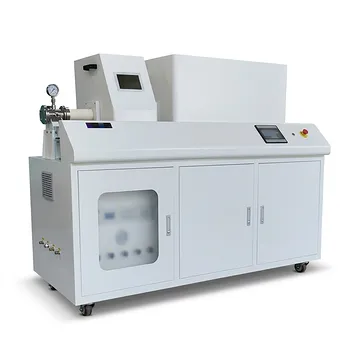
A stainless steel bubbler serves as the precise delivery mechanism within the RF-PECVD system, specifically engineered to house and volatilize liquid hexamethyldisiloxane (HMDSO). By guiding a carrier gas—most commonly oxygen—through the liquid, the bubbler converts the precursor into a vapor state, transporting it directly into the reaction chamber for deposition.
The bubbler bridges the gap between liquid storage and vapor deposition, ensuring a stable, continuous flow of monomers essential for uniform siloxane coatings.
The Mechanics of Precursor Delivery
Housing the HMDSO
The fundamental role of the stainless steel bubbler is to act as a robust reservoir.
It is specifically designed to contain hexamethyldisiloxane (HMDSO), the liquid precursor used to create siloxane coatings. This component ensures the chemical source is isolated and ready for the vaporization process.
The Volatilization Process
The transition from liquid to gas occurs physically within the bubbler.
A carrier gas, such as oxygen, is introduced into the vessel. As this gas moves through the liquid HMDSO, it causes the liquid to volatilize. This interaction creates the vapor necessary for the chemical vapor deposition (CVD) process.
Transporting the Reactants
Once volatilized, the precursor does not move on its own.
The carrier gas acts as a transport vehicle, carrying the newly formed HMDSO vapor out of the bubbler and into the reaction chamber. This creates a direct link between the fuel source (the bubbler) and the deposition zone (the chamber).
Ensuring Deposition Consistency
Establishing a Stable Supply
Uniform coatings require a steady stream of ingredients.
The bubbler is critical because it ensures a stable supply of reaction monomers. Without this controlled release mechanism, the introduction of monomers into the plasma would be erratic.
Continuous Operation
The design facilitates a continuous process rather than a batch delivery.
By maintaining a constant flow of carrier gas through the bubbler, the system achieves a continuous feed of reactants. This continuity is vital for maintaining the integrity and thickness of the coating over time.
Operational Considerations
Reliance on Carrier Gas Interaction
The efficiency of the bubbler is entirely dependent on the carrier gas.
If the flow of oxygen (or the chosen carrier) fluctuates, the amount of precursor delivered will also fluctuate. The system relies on the dynamic interaction between the gas and the liquid to maintain the process.
Management of Liquid Precursors
While effective, the bubbler system handles a physical state change.
The system is limited by the presence of the liquid precursor; the process can only continue as long as the HMDSO supply in the bubbler is sufficient to be volatilized by the passing gas.
Optimizing Your Deposition Strategy
To ensure the highest quality siloxane coatings, you must align the bubbler's function with your specific processing goals.
- If your primary focus is Coating Uniformity: Ensure the carrier gas flow rate through the bubbler is strictly regulated to maintain a constant supply of HMDSO vapor.
- If your primary focus is Process Stability: Monitor the liquid levels within the stainless steel bubbler to prevent interruptions in the continuous monomer stream.
The stainless steel bubbler is not just a container; it is the active regulator that dictates the consistency of your chemical vapor deposition.
Summary Table:
| Feature | Function in RF-PECVD Process |
|---|---|
| Reservoir Housing | Securely contains liquid HMDSO precursors |
| Volatilization | Converts liquid monomer to vapor using oxygen carrier gas |
| Transport | Moves reactive vapor directly into the deposition chamber |
| Flow Regulation | Ensures a continuous, stable stream of monomers |
| Process Impact | Directly dictates coating uniformity and thickness |
Optimize Your PECVD Precision with KINTEK
Achieving uniform siloxane coatings requires flawless precursor delivery. KINTEK specializes in high-performance laboratory equipment, providing the advanced CVD and PECVD systems, stainless steel bubblers, and specialized high-temperature furnaces needed for precision material research.
Whether you are scaling battery research, optimizing high-pressure reactors, or refining crushing and milling workflows, our expert team is here to support your lab's specific requirements.
Ready to elevate your deposition consistency? Contact KINTEK today to discover how our comprehensive range of high-temperature solutions and lab consumables can drive your next breakthrough.
References
- Y. Abd EL-Moaz, Nabil A. Abdel Ghany. Fabrication, Characterization, and Corrosion Protection of Siloxane Coating on an Oxygen Plasma Pre-treated Silver-Copper Alloy. DOI: 10.1007/s11665-023-07990-7
This article is also based on technical information from Kintek Solution Knowledge Base .
Related Products
- RF PECVD System Radio Frequency Plasma-Enhanced Chemical Vapor Deposition RF PECVD
- Inclined Rotary Plasma Enhanced Chemical Vapor Deposition PECVD Equipment Tube Furnace Machine
- Chemical Vapor Deposition CVD Equipment System Chamber Slide PECVD Tube Furnace with Liquid Gasifier PECVD Machine
- Inclined Rotary Plasma Enhanced Chemical Vapor Deposition PECVD Equipment Tube Furnace Machine
People Also Ask
- What is plasma enhanced chemical vapour deposition PECVD used for? Enable Low-Temp Thin Films for Electronics & Solar
- What is an example of PECVD? RF-PECVD for High-Quality Thin Film Deposition
- What is the role of RF-PECVD in VFG preparation? Mastering Vertical Growth and Surface Functionality
- What is plasma enhanced chemical Vapour deposition process used for fabrication of? A Guide to Low-Temperature Thin Films
- What is plasma CVD? Unlock Low-Temperature Thin Film Deposition for Sensitive Materials