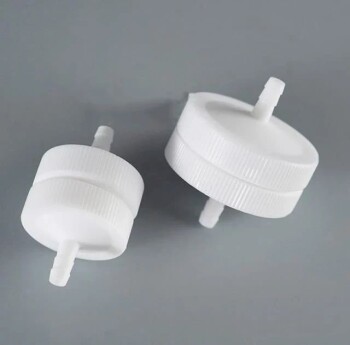
The primary function of a 0.45 μm syringe filter when processing Chlorendic Acid reaction samples is to mechanically remove solid particulates, specifically Zero-Valent Iron (ZVI) and iron oxides. This step is essential for physically separating the solid reducing agents from the liquid solution, effectively halting the chemical process at a precise moment.
The use of a 0.45 μm filter serves a dual purpose: it acts as a "stop button" for the chemical reaction by removing the ZVI reducing agent, and it functions as a critical safety barrier for sensitive downstream analytical instruments.
The Mechanism of Reaction Termination
Removing the Reducing Agent
In experiments involving Chlorendic Acid, Zero-Valent Iron (ZVI) often acts as the reducing agent driving the reaction.
To measure reaction kinetics accurately, you must know exactly what the concentration of the compound was at the specific time of sampling.
By forcing the sample through a 0.45 μm filter, you physically strip the ZVI particles from the liquid. This immediately deprives the reaction of its fuel, "freezing" the chemical state of the sample for accurate analysis.
Eliminating Byproducts
During the reaction, iron oxides may form as precipitates.
These solids are suspended in the solution and can interfere with the clarity and composition of the sample.
The syringe filter traps these precipitated iron oxides, ensuring that the liquid collected is a true representation of the dissolved phase only.
Protecting Analytical Integrity
Safeguarding HPLC Columns
Samples containing Chlorendic Acid are frequently analyzed using High-Performance Liquid Chromatography (HPLC).
HPLC columns are packed with extremely fine stationary phase materials that are highly susceptible to clogging.
Injecting a sample containing even microscopic ZVI particles or iron oxides can permanently damage the column, leading to high back-pressure and expensive equipment failure.
Ensuring System Stability
Beyond the column, particulates can foul the injectors and detectors within the analytical system.
Filtration ensures that the analytical equipment operates within its stable baseline parameters.
This prevents mechanical drift or noise in the data caused by physical obstructions in the flow path.
Operational Considerations and Risks
The Consequence of Inadequate Filtration
Skipping this filtration step or using a filter with a larger pore size allows reactive particles to remain in the vial.
If ZVI remains in the sample vial after collection, the degradation of Chlorendic Acid will continue while the sample sits in the autosampler queue.
This results in data that reflects the time of injection rather than the time of sampling, rendering kinetic calculations scientifically invalid.
Pore Size Precision
The specific choice of 0.45 μm is an industry standard for HPLC preparation.
It provides a balance between removing the vast majority of problematic particulates and allowing for reasonable flow rates during manual syringing.
Ensuring Experimental Accuracy
To maximize the reliability of your Chlorendic Acid data, apply the filtration step with the following goals in mind:
- If your primary focus is Reaction Kinetics: Filter the sample immediately upon withdrawal to achieve rapid termination and preserve the exact concentration at that time point.
- If your primary focus is Equipment Maintenance: Ensure every single sample is filtered to 0.45 μm or smaller to prevent particulate accumulation in your HPLC columns and flow lines.
By rigorously applying this filtration step, you transform a volatile, reacting mixture into a stable, instrument-ready solution.
Summary Table:
| Function Type | Role of 0.45 μm Filtration | Impact on Results |
|---|---|---|
| Reaction Control | Removes Zero-Valent Iron (ZVI) | Halts chemical reaction immediately for accurate kinetic data |
| Sample Purity | Traps precipitated iron oxides | Ensures liquid represents dissolved phase only |
| Equipment Safety | Filters microscopic particulates | Prevents HPLC column clogging and high back-pressure |
| Data Integrity | Stabilizes sample state | Eliminates degradation during autosampler wait times |
Optimize Your Analytical Precision with KINTEK
Don't let residual particulates compromise your research data or damage expensive analytical equipment. KINTEK specializes in high-quality laboratory essentials designed for demanding chemical environments. Whether you are conducting complex Chlorendic Acid studies or routine material synthesis, our comprehensive range of laboratory equipment and consumables—including precision PTFE products, ceramics, and crucibles—ensures your lab operates at peak performance.
From high-temperature reaction systems to essential filtration tools, we provide the reliability your science deserves. Contact KINTEK today to discover how our tailored solutions can enhance your laboratory workflow and protect your sensitive instrumentation.
References
- Min Sik Kim, Anh Le‐Tuan Pham. Reduction of chlorendic acid by zero-valent iron: Kinetics, products, and pathways. DOI: 10.1016/j.jhazmat.2019.121269
This article is also based on technical information from Kintek Solution Knowledge Base .
Related Products
- Custom PTFE Teflon Parts Manufacturer for PTFE Mesh F4 Sieve
- Hydraulic Diaphragm Lab Filter Press for Laboratory Filtration
- Custom PTFE Teflon Parts Manufacturer for Sampling Filters
- Reference Electrode Calomel Silver Chloride Mercury Sulfate for Laboratory Use
- Shortpass Filters for Optical Applications
People Also Ask
- What are the primary reasons for selecting PTFE as a matrix? Enhance Composites with Carbon Nanotube Reinforcement
- How is PTFE utilized for insulation in Alloy 22 corrosion setups? Ensure Signal Purity & Accuracy
- Is PTFE corrosion resistant? Discover the Ultimate Chemical Resistance for Your Lab
- What are the specific applications of PTFE in micro-batch slug flow systems? Enhance Your Microfluidic Reaction Purity
- What is the mesh size of a sieve? A Guide to Particle Size and Sieve Selection