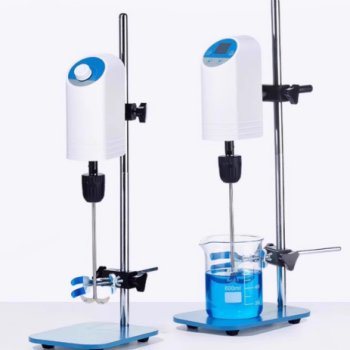
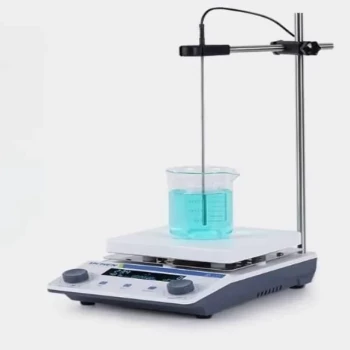
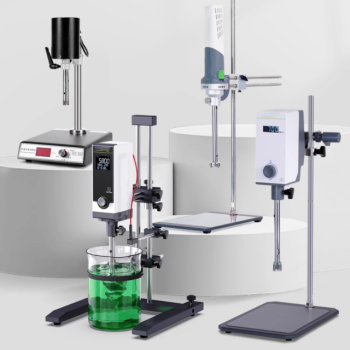
High-pressure reactors with mechanical stirring act as kinetic accelerators during the synthesis of Xonotlite. By using stirring blades to force slurry circulation within a constant saturated steam environment at 200–220 °C, these systems actively prevent suspension sedimentation. This mechanical intervention ensures a uniform reaction zone that is critical for efficient phase transformation.
The primary value of this equipment lies in overcoming mass transfer limitations; by breaking up agglomerates and accelerating solute transport, it significantly shortens the synthesis cycle and enhances product crystallinity.
Enhancing Reaction Kinetics
Forcing Slurry Circulation
The fundamental function of the mechanical stirring mechanism is to force the circulation of the slurry.
Without this active movement, solids within the reactor would settle due to gravity. The stirring blades continuously agitate the mixture, maintaining a homogeneous suspension throughout the vessel.
Accelerating Solute Transport
Mechanical agitation does more than simply move fluid; it accelerates solute transport.
By increasing the velocity of the fluid relative to the solid particles, the system enhances mass transfer rates. This ensures that the chemical components necessary for the reaction are available at the particle surface much faster than in static conditions.
Improving Product Quality
Breaking Particle Agglomerates
During synthesis, particles have a natural tendency to clump together, or agglomerate.
The mechanical shear force provided by the stirring blades physically breaks these agglomerates apart. This exposes more surface area to the reaction environment, preventing the formation of inconsistent or fused clusters.
Driving the Phase Transformation
The ultimate goal of this process is the kinetic transformation of the intermediate phase, Tobermorite, into the final product, Xonotlite.
The combination of high temperature (200–220 °C) and rigorous mixing significantly speeds up this specific transformation. The result is a more efficient conversion process that yields Xonotlite with superior crystallinity.
Critical Operational Dependencies
The Necessity of Active Agitation
The benefits of this system are entirely dependent on the continuity of the mechanical stirring.
If the stirring blades fail to force circulation, the system reverts to a static state where suspension sedimentation is inevitable. This would immediately degrade the reaction kinetics and potentially stall the transformation process.
Adherence to Thermal Parameters
Mechanical stirring alone is insufficient; it must occur within a specific thermal window.
The reactor must maintain a constant saturated steam environment at typically 200–220 °C. It is the synergy between this high-temperature environment and the mechanical energy that drives the rapid synthesis cycle.
Making the Right Choice for Your Goal
When evaluating synthesis methods for Xonotlite, consider your specific production priorities:
- If your primary focus is Production Efficiency: Utilize mechanical stirring to accelerate solute transport and shorten the overall synthesis cycle time.
- If your primary focus is Material Quality: Rely on the shear forces of the reactor to break agglomerates, ensuring higher crystallinity in the final product.
By integrating mechanical stirring with high-pressure thermal control, you transform a slow, static process into a rapid, high-quality production system.
Summary Table:
| Function | Mechanism | Impact on Synthesis |
|---|---|---|
| Kinetic Acceleration | Forced slurry circulation | Prevents sedimentation and maintains homogeneity |
| Mass Transfer | Enhanced solute transport | Shortens synthesis cycle times significantly |
| Agglomerate Control | Mechanical shear force | Breaks clumps to expose surface area for reaction |
| Phase Transformation | High-temp synergy (200-220°C) | Drives rapid Tobermorite to Xonotlite conversion |
Elevate Your Material Research with KINTEK Precision
Unlock the full potential of your hydrothermal synthesis with KINTEK’s high-temperature high-pressure reactors and autoclaves. Specifically designed to handle the rigorous demands of Xonotlite production, our reactors offer precise thermal control and powerful mechanical stirring to eliminate mass transfer limitations and ensure superior product crystallinity.
From advanced crushing and milling systems to specialized PTFE and ceramic consumables, KINTEK provides a comprehensive ecosystem for laboratory excellence. Whether you are focusing on battery research, dental materials, or industrial phase transformations, our engineering expertise ensures your lab operates at peak efficiency.
Ready to optimize your synthesis cycle? Contact our technical experts today to find the perfect high-pressure solution for your laboratory.
References
- R. Šiaučiūnas, Edita Prichockiene. Synthesis of High Crystallinity 1.13 nm Tobermorite and Xonotlite from Natural Rocks, Their Properties and Application for Heat-Resistant Products. DOI: 10.3390/ma15103474
This article is also based on technical information from Kintek Solution Knowledge Base .
Related Products
- High Pressure Laboratory Autoclave Reactor for Hydrothermal Synthesis
- Customizable Laboratory High Temperature High Pressure Reactors for Diverse Scientific Applications
- Stainless High Pressure Autoclave Reactor Laboratory Pressure Reactor
- Mini SS High Pressure Autoclave Reactor for Laboratory Use
- Customizable High Pressure Reactors for Advanced Scientific and Industrial Applications
People Also Ask
- What role does a high-pressure reactor (autoclave) play in the synthesis of NiCuFe-LDH? Master Hydrothermal Growth
- What Role Does a High-Pressure Reactor or Autoclave Play in HA Catalyst Synthesis? Achieve High Surface Area Materials
- What equipment is required for hydrothermal synthesis of Ga0.25Zn4.67S5.08? Optimize Your Semiconductor Production
- What is the function of a high-pressure reactor in the hydrothermal synthesis of boehmite? Expert Process Insights
- What role does an autoclave play in the synthesis of MnO2 nanofibers? Mastering Hydrothermal Growth