There is no single alternative to FTIR; instead, the best alternative is determined by the specific question you are trying to answer about your material. Fourier-Transform Infrared (FTIR) spectroscopy is a powerful technique for identifying chemical functional groups by measuring their absorption of infrared light. However, other methods like Raman Spectroscopy, NMR, and Mass Spectrometry provide different, often complementary, views of a sample's chemical nature.
While FTIR excels at providing a rapid "fingerprint" based on molecular vibrations, choosing an alternative is not about finding a replacement, but about selecting the right tool for the job. The best choice depends on whether you need to understand atomic connectivity, molecular weight, crystalline structure, or vibrational behavior under different conditions.
Why Look for an Alternative to FTIR?
FTIR is a foundational technique in materials science, but it has inherent limitations. Understanding these boundaries is the first step toward choosing a more suitable or complementary method for your specific analytical challenge.
Key Limitations of FTIR
FTIR measures the absorption of IR light, which excites molecular vibrations like stretching and bending. This process is most effective for bonds with a strong dipole moment (e.g., C=O, O-H).
Bonds that are symmetrical and have a weak or zero dipole moment (e.g., C-C in an alkene or S-S in a disulfide) are very poor absorbers of IR light. Consequently, they may be weak or entirely invisible in an FTIR spectrum.
Furthermore, water is a very strong IR absorber and its broad signals can easily overwhelm the spectrum, making FTIR difficult to use for samples in aqueous solutions without special techniques.
The Need for Complementary Data
No single analytical technique can reveal everything about a material. A complete characterization often requires a multi-technique approach.
While FTIR can tell you that a carbonyl group (C=O) is present, it cannot tell you how that group is connected to the rest of the molecule. For that, you need a structural technique like NMR. Similarly, FTIR cannot determine the exact mass or elemental formula of your molecule, which is the primary strength of Mass Spectrometry.
Key Alternatives and Their Strengths
Each alternative technique offers a unique window into the properties of a material, answering questions that FTIR cannot.
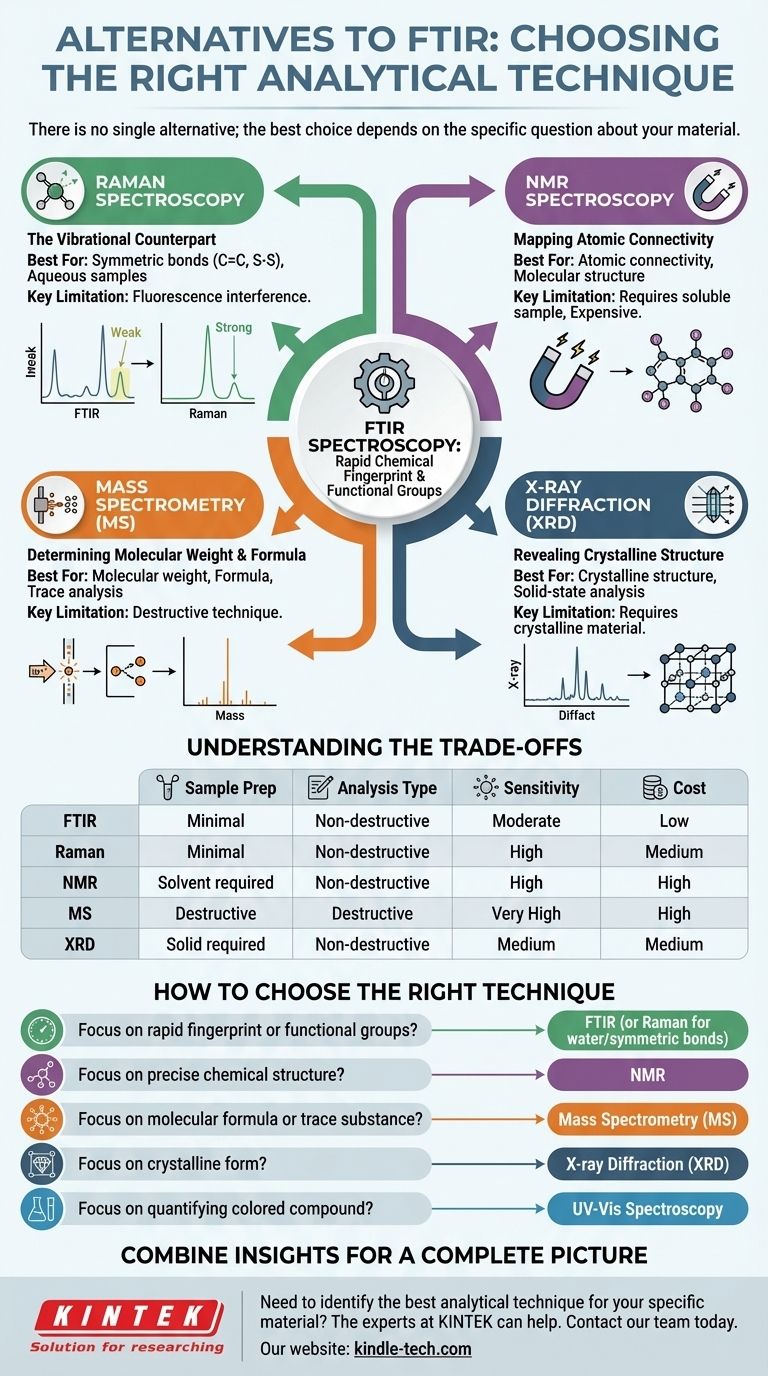
Raman Spectroscopy: The Vibrational Counterpart
Raman spectroscopy is the most direct alternative to FTIR as it also measures molecular vibrations. However, it does so by analyzing light that is inelastically scattered by the molecule, not absorbed.
This fundamental difference makes Raman highly effective for the very bonds that are weak in FTIR, such as C-C, C=C, and S-S bonds. It is also insensitive to water, making it an excellent choice for analyzing samples in aqueous environments.
Nuclear Magnetic Resonance (NMR): Mapping Atomic Connectivity
NMR spectroscopy provides an unparalleled, detailed map of a molecule's atomic structure. It works by probing the magnetic properties of atomic nuclei (most commonly ¹H and ¹³C) within a strong magnetic field.
The resulting spectrum reveals the chemical environment of each atom, their proximity to one another, and their connectivity through chemical bonds. While FTIR can suggest the presence of functional groups, NMR shows how they are pieced together, making it the gold standard for elucidating the precise structure of new organic compounds.
Mass Spectrometry (MS): Determining Molecular Weight and Formula
Mass Spectrometry is a destructive technique that measures the mass-to-charge ratio of ionized molecules. Its primary strength is its ability to determine the precise molecular weight of a compound with incredible accuracy.
This data allows for the confident determination of a molecule's elemental formula. MS is also exceptionally sensitive, capable of detecting substances at trace levels far below the detection limits of FTIR or NMR, making it ideal for contaminant analysis.
X-ray Diffraction (XRD): Revealing Crystalline Structure
For solid materials, the arrangement of molecules relative to each other is as important as their internal structure. XRD is the definitive technique for analyzing this long-range order.
It works by passing X-rays through a crystalline sample and analyzing the resulting diffraction pattern. This allows for the unambiguous identification of a material's crystal structure, the differentiation between polymorphs (different crystalline forms of the same compound), and the determination of sample purity.
Understanding the Trade-offs
Choosing a technique involves practical considerations beyond its theoretical strengths. Factors like sample requirements, cost, and speed are critical in a real-world lab setting.
Sample Preparation and State
FTIR is highly versatile, capable of analyzing solids, liquids, and gases with minimal preparation. In contrast, NMR typically requires dissolving the sample in an expensive deuterated solvent, and XRD is only useful for solid, crystalline materials.
Destructive vs. Non-Destructive Analysis
FTIR and Raman are generally non-destructive, meaning you can recover your sample after analysis. Mass Spectrometry, by its nature, is a destructive technique as the sample is ionized and fragmented.
Sensitivity and Information Depth
MS offers the highest sensitivity, while NMR provides the greatest structural detail for molecules in solution. FTIR offers a rapid, reliable fingerprint but with less structural depth.
Cost and Accessibility
FTIR instruments are common, relatively inexpensive, and fast, making them accessible workhorses in most labs. NMR and high-resolution MS systems represent a significant investment in both cost and operator expertise, while XRD falls somewhere in between.
How to Choose the Right Analytical Technique
Begin by defining your central question. The goal is to match the question to the technique that provides the most direct answer.
- If your primary focus is a rapid chemical fingerprint or identifying functional groups: FTIR remains the best starting point, but consider Raman if your sample is in water or contains symmetric bonds.
- If your primary focus is determining the precise chemical structure of a molecule: NMR is the indispensable tool for mapping atomic connectivity.
- If your primary focus is confirming a molecular formula or detecting a trace-level substance: Mass Spectrometry provides the necessary mass accuracy and sensitivity.
- If your primary focus is analyzing the solid-state form of a drug or material: X-ray Diffraction (XRD) is the definitive technique for crystalline structure.
- If your primary focus is quantifying a colored compound or one with conjugated pi-systems: UV-Vis Spectroscopy is a simple and effective method.
Ultimately, the most powerful analysis comes from combining the insights of multiple techniques to build a complete and unambiguous picture of your material.
Summary Table:
| Technique | Best For | Key Limitation |
|---|---|---|
| Raman Spectroscopy | Symmetric bonds (C=C, S-S), aqueous samples | Fluorescence interference |
| NMR Spectroscopy | Atomic connectivity, molecular structure | Requires soluble sample, expensive |
| Mass Spectrometry (MS) | Molecular weight, formula, trace analysis | Destructive technique |
| X-ray Diffraction (XRD) | Crystalline structure, solid-state analysis | Requires crystalline material |
Need to identify the best analytical technique for your specific material? The experts at KINTEK can help. We specialize in laboratory equipment and consumables, offering the tools and expertise to ensure you get accurate, reliable results. Whether you're working with polymers, pharmaceuticals, or new materials, we can guide you to the right solution. Contact our team today to discuss your application and find the perfect instrument for your lab's needs.
Visual Guide
Related Products
- High Temperature Muffle Oven Furnace for Laboratory Debinding and Pre Sintering
- Reference Electrode Calomel Silver Chloride Mercury Sulfate for Laboratory Use
- Filter Testing Machine FPV for Dispersion Properties of Polymers and Pigments
- Vertical Laboratory Tube Furnace
- 5L Heating Chilling Circulator Cooling Water Bath Circulator for High and Low Temperature Constant Temperature Reaction
People Also Ask
- What is the significance of integrating a high-temperature muffle furnace into an impact wear testing system?
- What is the role of a muffle furnace in magnetite pellet roasting? Optimize Mineral Phase & Compressive Strength
- What are the main components of a high-temperature muffle furnace? A Guide to the Core Systems
- Why is the annealing treatment in a high-temperature muffle furnace critical for the preparation of an Sb-SnO2 interlayer?
- What role does a calcination furnace play in preparing hollow core-shell particles? Achieve Perfect Nano-Structures