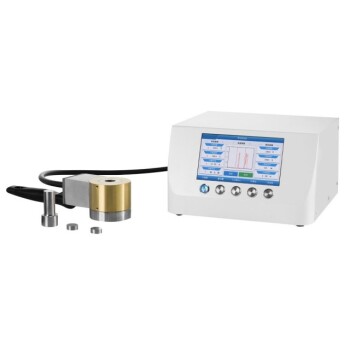
The critical function of hot pressing is to transform purified thallium bromide (TlBr) powder into dense, structurally uniform crystals suitable for high-performance radiation detection. By applying a constant pressure of approximately 30 kN within a precise temperature window of 455-465 °C, this process consolidates the raw material while strictly controlling its physical properties.
Hot pressing serves as the definitive shaping stage that simultaneously maximizes material density and aligns crystal orientation. This thermomechanical coupling is essential for eliminating internal stresses and ensuring the semiconductor achieves the high gamma-ray attenuation and charge collection efficiency required for detector-grade performance.
The Mechanics of Material Transformation
Precision Thermomechanical Coupling
The process relies on a specific combination of heat and mechanical force. A hydraulic system applies constant axial pressure (approx. 30 kN) while the material is held at temperatures between 455 °C and 465 °C.
Inducing Plastic Flow
The simultaneous application of heat and pressure promotes plastic flow among the thallium bromide particles. This mechanism forces the particles to bond effectively, transforming a loose powder into a cohesive, high-density bulk solid.
Solid-Phase Molding
Unlike simple melting, this is a solid-phase molding process. It shapes the material into specific dimensions without compromising its chemical purity, creating a dense structure that is physically robust.
Optimizing Internal Structure
Controlling Crystal Orientation
A primary objective of hot pressing is to dictate the crystalline orientation of the final product. By maintaining specific thermomechanical conditions, the process induces specific lattice orientations that are favorable for electronic transport.
Eliminating Residual Stresses
Raw crystal growth often results in internal stresses that hamper performance. The sustained high temperature and stable pressure during hot pressing act as a treatment to anneal and eliminate these residual stresses, ensuring structural consistency throughout the crystal's depth.
Reducing Internal Defects
The high-temperature treatment inherent in the process helps reduce internal structural defects. Minimizing these imperfections is critical for preventing charge trapping, which degrades detector signal quality.
Direct Impact on Detector Performance
Superior Gamma-Ray Attenuation
By achieving maximum density through compression, the resulting TlBr crystal becomes a more effective barrier against radiation. This directly improves the material's gamma-ray attenuation coefficient, allowing it to stop and detect high-energy photons more efficiently.
Enhanced Charge Collection
The alignment of the crystal lattice and the reduction of defects facilitate the movement of charge carriers. This leads to high charge collection efficiency, which is vital for the detector to produce accurate and clear signals.
Improved Energy Resolution
The structural uniformity achieved through hot pressing contributes to better energy resolution. This allows the final detector to distinguish between radiation sources of varying energies with greater precision, such as achieving superior peak spectra at 662 keV.
Understanding the Critical Parameters
The Importance of the Temperature Window
The process requires adhering to a narrow temperature range of 455-465 °C. Deviating from this range can compromise the crystal's structural integrity or fail to induce the necessary plastic flow for proper bonding.
The Necessity of Sustained Pressure
Applying 30 kN of pressure is not instantaneous; it must be held for several hours (typically around 2 hours). This duration is necessary to ensure the material fully densifies and that the internal stresses are completely resolved.
Making the Right Choice for Your Goal
When evaluating the preparation of TlBr semiconductors, the hot pressing stage is the variable that determines the final structural quality of the device.
- If your primary focus is fabrication consistency: Ensure your equipment can maintain the strict 455-465 °C window under 30 kN load to guarantee reproducible crystal density and orientation.
- If your primary focus is detector sensitivity: Prioritize the duration of the press to fully eliminate internal stresses, as this directly correlates to improved charge collection efficiency and energy resolution.
Ultimately, hot pressing is not merely a shaping step, but a critical purification and alignment process that defines the electronic capability of the final radiation detector.
Summary Table:
| Parameter | Target Value | Function & Impact |
|---|---|---|
| Temperature Window | 455 - 465 °C | Induces plastic flow and ensures solid-phase molding |
| Applied Pressure | Approx. 30 kN | Maximizes material density and eliminates internal voids |
| Process Duration | ~2 Hours | Resolves internal stresses and aligns crystal orientation |
| Key Outcome | High-Density Bulk Solid | Enhances gamma-ray attenuation and charge collection efficiency |
Elevate Your Semiconductor Research with KINTEK Precision
Achieving the perfect crystal structure for radiation detectors requires uncompromising control over temperature and pressure. KINTEK specializes in advanced laboratory equipment, offering high-performance hydraulic presses (pellet, hot, and isostatic) and high-temperature furnaces designed to meet the rigorous demands of thallium bromide (TlBr) fabrication.
Whether you are focusing on high-energy physics or medical imaging, our cutting-edge solutions—including vacuum furnaces, PTFE consumables, and crushing systems—ensure your materials achieve maximum density and superior energy resolution.
Ready to optimize your fabrication consistency and detector sensitivity?
Contact KINTEK today to find the perfect equipment for your lab!
References
- Aleksandr Sergeev, M. V. Suyasova. Lutetium endometallofullerenes: preparation and properties. DOI: 10.21175/rad.abstr.book.2023.45.6
This article is also based on technical information from Kintek Solution Knowledge Base .
Related Products
- 24T 30T 60T Heated Hydraulic Press Machine with Heated Plates for Laboratory Hot Press
- Automatic Laboratory Heat Press Machine
- 30T 40T Split Automatic Heated Hydraulic Press Machine with Heated Plates for Laboratory Hot Press
- Manual Heated Hydraulic Press Machine with Heated Plates for Laboratory Hot Press
- Automatic Heated Hydraulic Press Machine with Heated Plates for Laboratory Hot Press
People Also Ask
- What role does a heated hydraulic press play in Cold Sintering (CSP)? Enhancing LATP-Halide Densification
- Why is the heating function of a laboratory hydraulic press essential for MEA assembly in DEFC? Optimize Cell Bonding
- What technical conditions does a heated hydraulic press provide for PEO batteries? Optimize Solid-State Interfaces
- How is a heated hydraulic press used for Li-LLZO batteries? Optimize Interfacial Bonding with Thermal-Pressure
- What is the core function of a laboratory heated hydraulic press in CSP? Revolutionize Low-Temp Ceramic Sintering