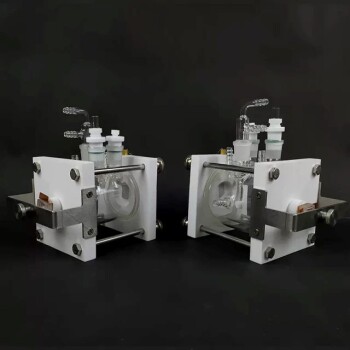
The H-type glass electrolytic cell is a critical visualization tool used to simulate and validate the suppression of the polysulfide shuttle effect in lithium-sulfur batteries. It allows researchers to physically witness the diffusion of polysulfides through a modified separator by monitoring color changes in a dual-chamber system. This setup provides immediate, qualitative, and quantitative proof of a coating's ability to intercept or adsorb soluble lithium polysulfides before they reach the opposing electrode.
The H-type cell transforms an abstract electrochemical process into a visible demonstration of barrier efficiency. It acts as a bridge between theoretical material science and practical battery performance by isolating the separator's role in a controlled, observable environment.
Simulating the Shuttle Effect in Real-Time
The Dual-Chamber Configuration
The cell consists of two glass chambers joined by a middle flange, where the test separator is securely clamped. One chamber is filled with a concentrated polysulfide solution, while the other contains a pure solvent, effectively creating a concentration gradient that mimics the environment inside a discharging lithium-sulfur battery.
Visualizing Diffusion Dynamics
By observing the "clear" side of the cell, researchers can track how long it takes for the electrolyte to change color. A high-performance separator coating, such as NbN/C, will keep the second chamber clear for an extended period, providing direct visual evidence of successful shuttle inhibition.
Validating Material Functionality
Physical Interception and Chemical Adsorption
The H-type cell distinguishes between different protective mechanisms. It allows researchers to evaluate how effectively a coating provides a physical barrier (blocking large molecules) versus chemical adsorption (binding polysulfides to the coating surface) through observation of the interface.
Benchmarking Modified Separators
This setup is the standard for comparing various separator treatments. By running parallel tests with different coatings, researchers can rank the interception efficiency of materials under identical concentration and environmental conditions.
Technical Precision and Environmental Control
Managing Atmospheric and Thermal Variables
To ensure accuracy, the experiment must control for external factors like temperature and humidity. Using a thermostatic water bath maintains consistent thermal energy, while nitrogen gas cylinders can be used to provide an inert atmosphere, preventing the oxidation of sensitive sulfur species.
Monitoring Real-Time Fluctuations
Precision requires active monitoring of the cell's working state. Researchers look for bubble generation on electrode surfaces or sudden voltage and current shifts to identify potential side reactions or leaks that could invalidate the diffusion data.
Understanding the Trade-offs
Qualitative vs. Quantitative Limits
While the H-type cell is excellent for visual validation, it is primarily a qualitative or semi-quantitative tool. It does not perfectly replicate the extreme pressure and tight spatial constraints of a coin cell or pouch cell, meaning results should always be paired with galvanostatic cycling data.
Structural Fragility and Safety
The glass construction makes these cells fragile and susceptible to breakage under thermal stress or physical mishandling. Additionally, the manual nature of the setup means that clamping pressure on the separator must be perfectly uniform to prevent "edge leaking," which can be mistaken for separator failure.
How to Leverage H-Type Testing in Research
Applying Results to Your Project
- If your primary focus is rapid material screening: Use the H-type cell to quickly eliminate coatings that show immediate color leakage, saving time on long-term battery cycling.
- If your primary focus is mechanistic understanding: Combine visual H-type data with post-experiment spectroscopy of the separator to prove chemical adsorption.
- If your primary focus is industrial scalability: Focus on the "time-to-leakage" metric to establish a baseline for the minimum coating thickness required for effective inhibition.
By integrating the H-type cell into your validation pipeline, you provide the transparent, visual proof necessary to confirm that your separator modification effectively addresses the core challenges of polysulfide migration.
Summary Table:
| Feature | Function in Polysulfide Shuttle Research | Key Benefit |
|---|---|---|
| Dual-Chamber Setup | Separates polysulfide solution from pure solvent using a test separator. | Mimics concentration gradients in Li-S batteries. |
| Visual Transparency | Allows real-time monitoring of color changes and electrolyte diffusion. | Provides immediate qualitative proof of barrier efficiency. |
| Controlled Environment | Supports integration with nitrogen gas and thermostatic water baths. | Ensures accuracy by managing oxidation and thermal variables. |
| Interception Benchmarking | Ranks different separator coatings under identical conditions. | Enables rapid material screening and mechanistic understanding. |
Elevate Your Battery Research with KINTEK Precision
Take your lithium-sulfur battery studies to the next level with KINTEK’s industry-leading laboratory equipment. Whether you are validating separator efficiency using our specialized electrolytic cells and electrodes or synthesizing advanced materials in our high-temperature high-pressure reactors and autoclaves, we provide the tools you need for precise, repeatable results.
Our comprehensive portfolio includes:
- Battery Research Tools: Specialized cells, electrodes, and high-performance consumables.
- Thermal Processing: Muffle, tube, and vacuum furnaces for material carbonization.
- Sample Preparation: Hydraulic presses, crushing systems, and precision milling tools.
- Cooling & Stabilization: ULT freezers, freeze dryers, and high-purity ceramic crucibles.
Ready to optimize your experimental workflow? Contact us today to discover how KINTEK can support your research with reliable equipment and expert technical support!
References
- Chuanzhong Lai, Chilin Li. Scissor g-C3N4 for high-density loading of catalyst domains in mesoporous thin-layer conductive network for durable Li-S batteries. DOI: 10.20517/energymater.2023.02
This article is also based on technical information from Kintek Solution Knowledge Base .
Related Products
- H-Type Double-Layer Optical Electrolytic Electrochemical Cell with Water Bath
- H Type Electrolytic Cell Triple Electrochemical Cell
- Side Window Optical Electrolytic Electrochemical Cell
- Thin-Layer Spectral Electrolysis Electrochemical Cell
- Optical Water Bath Electrolytic Electrochemical Cell
People Also Ask
- What is the overall structure of the H-type double-layer optical water bath electrolytic cell? Precision Design for Controlled Experiments
- How is the electrolyte managed in H-type electrolytic cells for specific reactions? Achieve Precise Control and High Purity
- What checks should be performed on the H-type electrolytic cell before use? Ensure Accurate Electrochemical Data
- What is important regarding temperature control for the H-type electrolytic cell? Ensure Precision and Data Integrity
- What is the overall structure of the H-type electrolytic cell? Understanding Dual-Chamber Electrochemical Designs