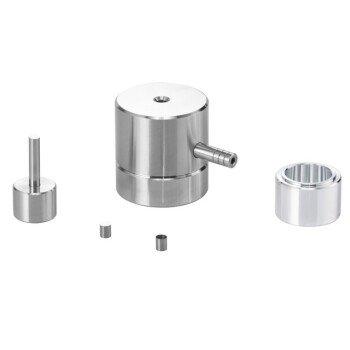
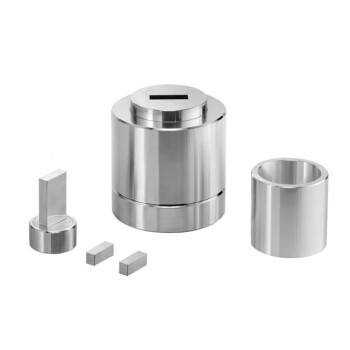
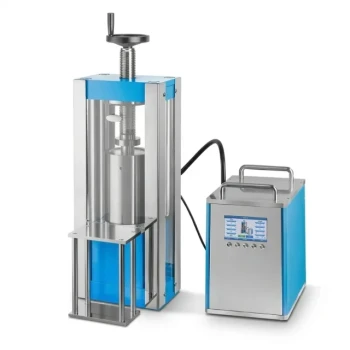
A customized pressure test cell functions as a specialized mechanical fixture designed to apply continuous, regulated external stack pressure to an all-solid-state battery throughout its testing lifecycle.
By utilizing mechanisms such as torque wrenches or pressurized molds, these cells ensure the solid electrodes and electrolytes remain in intimate physical contact, compensating for the dynamic volume changes that occur during electrochemical cycling.
The Core Insight: Unlike liquid electrolytes that naturally "wet" surfaces to maintain connection, solid-state components are rigid and prone to separation. The test cell acts as an external skeleton, mechanically forcing the internal layers together to prevent the battery from failing due to internal physical gaps.
The Mechanics of Solid-State Testing
Establishing the Solid-Solid Interface
In conventional batteries, liquid electrolytes flow into porous electrodes to create ionic pathways. In solid-state batteries, this "wetting" action does not exist.
A customized test cell applies mechanical force—often ranging from 1.5 MPa to over 17 MPa—to physically press the solid electrolyte against the electrode particles.
This pressure is the only mechanism ensuring that lithium ions can bridge the gap between materials.
Reducing Interfacial Impedance
When solid components are merely placed next to each other, the microscopic contact area is poor, leading to high electrical resistance (impedance).
The pressure applied by the test cell compresses these layers, maximizing the active contact area.
This reduction in impedance is critical for obtaining accurate performance data regarding the battery's true capacity and power.
Handling Dynamic Material Changes
Compensating for Volume Expansion
Active materials, particularly high-nickel cathodes and lithium metal anodes, undergo significant physical changes during operation.
As the battery charges and discharges, these materials expand and contract (often anisotropically, or in specific directions).
The test cell utilizes components like springs or torque-controlled fixtures to accommodate this "breathing" while maintaining constant pressure.
Preventing Delamination and Cracking
Without the constraint of the test cell, the expansion and contraction of materials would push the layers apart.
This separation creates voids (delamination) where ions can no longer travel, causing the battery to stop functioning.
By maintaining compression, the test cell prevents these voids from forming and inhibits crack propagation within the brittle solid electrolyte.
Understanding the Trade-offs
The Risk of Inconsistent Pressure
A major pitfall in testing is applying pressure that is non-uniform or unquantified.
If the pressure is too low (e.g., using a standard unpressurized coin cell), the interface will separate, leading to false negative results where the chemistry looks bad, but the mechanical setup was actually at fault.
The Complexity of Pressure Ranges
Applying pressure is not a "more is better" scenario; it requires precision.
Excessive pressure can crack delicate ceramic electrolytes or cause short circuits, while insufficient pressure fails to facilitate ion transport.
The customized cell allows researchers to dial in the exact torque or force required for specific chemistries, avoiding these extremes.
Making the Right Choice for Your Goal
When selecting or designing a pressure test cell for your evaluation, consider your specific testing objectives:
- If your primary focus is Cycle Life Stability: Prioritize a cell design with active compliance (like calibrated springs) that can maintain constant pressure (e.g., 8 MPa) despite repeated volume expansion and contraction.
- If your primary focus is Fundamental Material Analysis: Use a cell with adjustable torque settings to test the material's performance across a range of pressures (e.g., 1.5 MPa to 17 MPa) to identify the optimal operating window.
To validate the true potential of solid-state chemistry, you must control the mechanical environment as strictly as the electrochemical one.
Summary Table:
| Feature | Function in Solid-State Testing | Impact on Performance |
|---|---|---|
| Mechanical Compression | Forces intimate contact between electrodes and electrolytes | Reduces interfacial impedance and enables ion transport |
| Volume Compensation | Accommodates expansion/contraction during cycling | Prevents delamination and internal void formation |
| Regulated Pressure | Provides quantifiable force (e.g., 1.5 MPa to 17 MPa) | Ensures reproducible data and prevents ceramic cracking |
| Structural Support | Acts as an external skeleton for rigid components | Inhibits crack propagation and extends cycle life stability |
Elevate Your Solid-State Research with KINTEK Precision
To unlock the true potential of all-solid-state chemistries, precise mechanical control is non-negotiable. KINTEK specializes in advanced laboratory solutions, offering a comprehensive range of battery research tools and consumables, including high-performance electrolytic cells and electrodes designed for rigorous pressure testing.
Whether you are managing high-nickel cathode expansion or optimizing lithium metal interfaces, our engineering expertise ensures your materials are tested under perfect conditions. From high-temperature furnaces for material synthesis to hydraulic presses and specialized test cells, we provide the tools necessary for breakthrough energy storage development.
Ready to stabilize your battery interfaces? Contact KINTEK today to discover our customized testing solutions!
Related Products
- Customizable Swagelok Type Test Cells for Advanced Battery Research Electrochemical Analysis
- Electrolytic Electrochemical Cell for Coating Evaluation
- Custom Ion Conductivity Test Fixtures for Fuel Cell Research
- Flat Corrosion Electrolytic Electrochemical Cell
- Sample Support Body for Electrochemical Tests
People Also Ask
- How does a standardized electrochemical test cell assist in MOx/CNTf electrode screening? Optimize Material Ratios
- Why is a dedicated electrochemical test cell necessary for carbon steel? Ensure Precise Geothermal Corrosion Data
- What is the difference between a voltaic cell and an electrochemical cell? Understand the Two Types of Energy Conversion
- How do the electrochemical cell and three-electrode testing system collaborate? Optimize Zinc Anode Deposition Control
- Why must the electrochemical cell be continuously purged with nitrogen? Ensure Precision in Ni-Cr Corrosion Tests