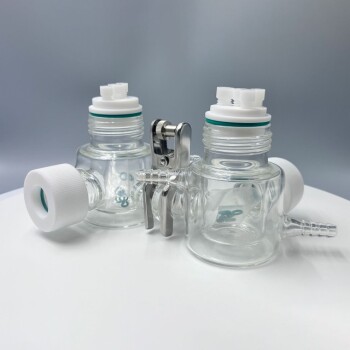
The Devanathan-Stachurski double-chamber electrolytic cell functions by mechanically and electrochemically isolating hydrogen uptake from hydrogen detection. By clamping a martensitic sample between two distinct compartments, the cell forces atomic hydrogen to permeate through the material lattice. This setup allows for the real-time measurement of hydrogen flux, enabling the precise calculation of kinetic parameters such as the apparent diffusion coefficient ($D_{app}$).
By decoupling the generation of hydrogen from its measurement, this apparatus provides the controlled environment necessary to quantify how a material's microstructure retards or facilitates hydrogen movement.
The Mechanics of the Double-Chamber Setup
The Charging Chamber (Cathode)
The first chamber, known as the charging or cathode side, contains an electrolyte solution—often acidic—designed to generate hydrogen.
Through galvanostatic polarization, a constant current is applied to the sample surface facing this chamber.
This electrochemical reaction reduces protons in the solution to atomic hydrogen on the metal surface. While some hydrogen atoms recombine to form gas, a significant portion adsorbs onto the surface and diffuses into the martensitic matrix.
The Detection Chamber (Anode)
The second chamber, located on the opposite side of the membrane, is the detection or anode side.
This chamber typically utilizes an alkaline solution and maintains a specific potential via anodic polarization.
As hydrogen atoms traverse the thickness of the sample and emerge on this side, they are immediately oxidized. This oxidation process generates an electric current that is directly proportional to the hydrogen flux leaving the material.
Characterizing Diffusion in Martensite
Measuring Time-Dependent Flux
The core output of the Devanathan-Stachurski cell is a permeation transient—a curve plotting current density against time.
In a martensitic matrix, which is characterized by high dislocation density and lattice distortion, hydrogen movement is often non-linear.
The cell captures the "breakthrough time" (how long it takes for hydrogen to appear) and the steady-state flux (the equilibrium flow rate).
Calculating Kinetic Parameters
Using the data from the anodic current, researchers can calculate the apparent diffusion coefficient ($D_{app}$).
This parameter is critical for martensite because it reflects not just simple lattice diffusion, but the interaction of hydrogen with microstructural "traps."
By comparing the theoretical diffusion rate with the measured rate, the cell helps quantify the hydrogen trapping efficiency of the martensitic structure.
Understanding the Trade-offs
Surface Condition Sensitivity
The accuracy of the Devanathan-Stachurski cell relies heavily on the surface state of the sample.
If oxides or contaminants are present on the detection side, they can block hydrogen exit, leading to an artificially low diffusion coefficient.
The Influence of Trapping
It is vital to distinguish between lattice diffusion and apparent diffusion.
In martensite, deep traps (like grain boundaries or carbide interfaces) can significantly delay hydrogen transport. The resulting $D_{app}$ is an "effective" value that averages these trapping effects, rather than a measure of pure lattice migration speed.
Making the Right Choice for Your Goal
To effectively utilize a Devanathan-Stachurski cell for your specific characterization needs, consider the following focus areas:
- If your primary focus is comparing material susceptibility: Use the calculated $D_{app}$ to rank different heat treatments; a lower diffusion coefficient generally indicates higher trapping capacity, which can correlate with embrittlement risks.
- If your primary focus is evaluating barrier coatings: Monitor the reduction in steady-state current density to determine the hydrogen blocking efficiency of the composite layer compared to the bare substrate.
The Devanathan-Stachurski cell transforms the invisible threat of hydrogen embrittlement into quantifiable, actionable data.
Summary Table:
| Component/Parameter | Function/Definition in DS Cell |
|---|---|
| Charging Chamber | Generates atomic hydrogen via galvanostatic polarization on the cathode side. |
| Detection Chamber | Oxidizes emerging hydrogen via anodic polarization to measure current flux. |
| Apparent Diffusion ($D_{app}$) | The calculated rate reflecting lattice movement and microstructural trapping effects. |
| Steady-State Flux | The equilibrium flow rate of hydrogen through the sample thickness. |
| Martensitic Matrix | The sample material, where lattice distortions and traps influence hydrogen kinetics. |
Optimize Your Hydrogen Permeation Studies with KINTEK
Precise characterization of hydrogen diffusion is critical for mitigating embrittlement risks in high-strength materials. KINTEK specializes in advanced laboratory solutions, providing the high-performance electrolytic cells and electrodes necessary for Devanathan-Stachurski setups.
Our comprehensive portfolio supports researchers and engineers with:
- Specialized Electrolytic Cells: Designed for reliable isolation and precise flux measurement.
- Thermal Processing: High-temperature muffle and vacuum furnaces for precise martensitic heat treatments.
- Sample Preparation: Crushing, milling, and hydraulic presses for consistent membrane fabrication.
Ready to elevate your material science research? Contact KINTEK today to discover how our high-precision equipment can provide the quantifiable data you need to ensure material integrity.
References
- L. Latu‐Romain, E.F. Rauch. Hydrogen Embrittlement Characterization of 1.4614 and 1.4543 Martensitic Precipitation Hardened Stainless Steels. DOI: 10.3390/met14020218
This article is also based on technical information from Kintek Solution Knowledge Base .
Related Products
- Double Layer Five-Port Water Bath Electrolytic Electrochemical Cell
- Double-Layer Water Bath Electrolytic Electrochemical Cell
- H-Type Double-Layer Optical Electrolytic Electrochemical Cell with Water Bath
- Electrolytic Electrochemical Cell with Five-Port
- Multifunctional Electrolytic Electrochemical Cell Water Bath Single Layer Double Layer
People Also Ask
- What does the routine maintenance of a double-layer water-bath electrolytic cell involve? A Guide to Ensuring Precision and Longevity
- When is professional repair required for a double-layer water-bath electrolytic cell? Protect Your Lab's Precision and Safety
- What are the key features of a double-layer water-bath electrolytic cell? Achieve Precise Temperature Control for Your Experiments
- What is the typical experimental system used with a double-layer water-bath electrolytic cell? Achieve Precise Electrochemical Control
- What are the procedures for after using a double-layer water-bath electrolytic cell? Ensure Equipment Longevity and Data Accuracy