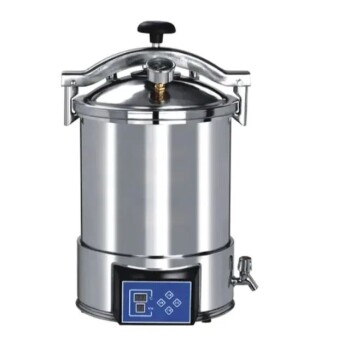
The high-pressure reactor, or autoclave, is the critical vessel that enables the non-hydrolytic sol-gel process by providing a sealed, high-temperature environment necessary for chemical transformation.
In the synthesis of aluminosilicate xerogels, it maintains a constant temperature—typically around 160°C—which allows the acetamide elimination reaction to proceed continuously. This pressurized environment ensures that silicon and aluminum atoms are mixed with molecular-level uniformity, resulting in a highly homogeneous and porous aluminosilicate matrix.
The autoclave serves as a pressurized thermal chamber that facilitates the specific non-hydrolytic reactions required to bond silicon and aluminum. By suppressing solvent evaporation and maintaining precise thermal conditions, it ensures a uniform atomic distribution that is impossible to achieve under standard atmospheric conditions.
Enabling High-Temperature Reaction Pathways
Driving Acetamide Elimination
Non-hydrolytic sol-gel (NHSG) synthesis often relies on specific condensation reactions, such as acetamide elimination, to form the inorganic network.
These reactions require sustained temperatures that far exceed the ambient boiling point of common solvents like dichloromethane.
The sealed autoclave prevents the solvent from boiling away, keeping it in a liquid state to act as a reactive medium for the precursors.
Achieving Molecular Homogeneity
The uniform distribution of Si and Al atoms is the primary goal for high-quality aluminosilicate xerogels.
The high-pressure environment facilitates the simultaneous reaction of different precursors, preventing the premature precipitation of one component over the other.
This results in a chemically integrated network rather than a heterogeneous mixture of separate silica and alumina phases.
The Role of Autogenous Pressure
Increasing Precursor Solubility
High-pressure conditions significantly enhance the solubility of metal-organic precursors within the organic solvent.
Better solubility leads to a more uniform precursor solution before the gelation process begins.
This ensures that the final xerogel possesses a consistent pore structure and chemical composition throughout its entire bulk.
Controlling Network Architecture
Pressure influences the rate of nucleation and the subsequent growth of the gel network.
In a sealed system, the autogenous pressure helps stabilize the growing aluminosilicate framework as it forms.
This is essential for maintaining the desired mesoporous structure during the critical transition from liquid precursors to a solid gel.
Understanding the Trade-offs
Safety and Complexity vs. Control
Operating high-pressure reactors requires specialized equipment and rigorous safety protocols to manage the internal pressure.
While this method provides superior chemical uniformity, it is more energy-intensive and complex than open-vessel synthesis.
The "black box" nature of a sealed reactor also makes it difficult to monitor the reaction in real-time without specialized, pressure-rated sensors.
Maximizing Synthesis Efficiency
Efficient use of an autoclave requires balancing temperature with the physical limits of the solvent and the vessel.
- If your primary focus is molecular homogeneity: Ensure the reactor is rated for temperatures at or above 160°C to fully drive the acetamide elimination process.
- If your primary focus is porous structure control: Carefully calculate the filling ratio (the volume of liquid relative to the reactor's total volume) to regulate the autogenous pressure generated.
- If your primary focus is structural stability: Use the autoclave to facilitate thorough condensation, which strengthens the framework against collapse during the drying stage.
By providing a controlled, high-energy environment, the autoclave transforms a mixture of precursors into a sophisticated, molecularly precise aluminosilicate framework.
Summary Table:
| Key Function | Impact on Synthesis | Resulting Benefit |
|---|---|---|
| Thermal Control | Drives acetamide elimination at 160°C+ | Enables high-energy reaction pathways |
| Pressurization | Prevents solvent evaporation | Maintains reactive liquid medium |
| Molecular Mixing | Facilitates simultaneous precursor reaction | Achieves atomic-level homogeneity |
| Structural Design | Stabilizes gel framework growth | Controlled mesoporous architecture |
Advance Your Material Science with KINTEK
Precision is the cornerstone of non-hydrolytic sol-gel synthesis. KINTEK specializes in high-performance laboratory equipment, offering a premium range of high-temperature high-pressure reactors and autoclaves designed to meet the rigorous demands of aluminosilicate xerogel production.
Whether you require precise thermal stability for acetamide elimination or robust autogenous pressure control for network architecture, our reactors ensure consistent, molecularly uniform results. Explore our comprehensive portfolio, including furnaces, vacuum systems, and essential consumables like PTFE and ceramics.
Ready to optimize your synthesis process? Contact KINTEK today to find the perfect high-pressure solution for your laboratory!
References
- Lucie Leonová, Aleš Stýskalík. Hydrophobicity Boosts Catalytic Activity: The Tailoring of Aluminosilicates with Trimethylsilyl Groups**. DOI: 10.1002/cctc.202300449
This article is also based on technical information from Kintek Solution Knowledge Base .
Related Products
- High Pressure Laboratory Autoclave Reactor for Hydrothermal Synthesis
- Stainless High Pressure Autoclave Reactor Laboratory Pressure Reactor
- Mini SS High Pressure Autoclave Reactor for Laboratory Use
- Customizable High Pressure Reactors for Advanced Scientific and Industrial Applications
- Customizable Laboratory High Temperature High Pressure Reactors for Diverse Scientific Applications
People Also Ask
- What role does a high-pressure reactor (autoclave) play in the synthesis of NiCuFe-LDH? Master Hydrothermal Growth
- What Role Does a High-Pressure Reactor or Autoclave Play in HA Catalyst Synthesis? Achieve High Surface Area Materials
- What equipment is required for hydrothermal synthesis of Ga0.25Zn4.67S5.08? Optimize Your Semiconductor Production
- What is the function of a high-pressure reactor in the hydrothermal synthesis of boehmite? Expert Process Insights
- What role does an autoclave play in the synthesis of MnO2 nanofibers? Mastering Hydrothermal Growth