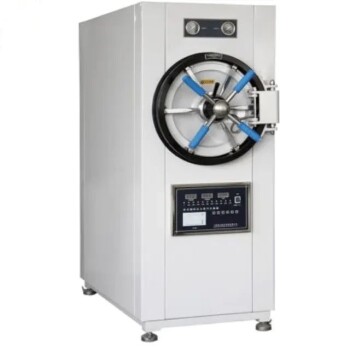
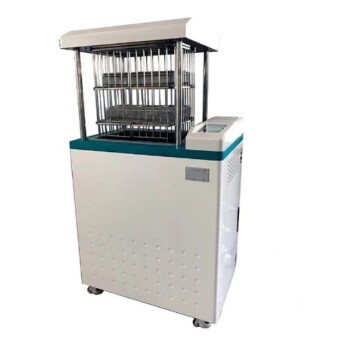
The primary function of a high-pressure stainless steel reactor (autoclave) is to serve as a precise simulation vessel. It bridges the gap between laboratory theory and industrial reality by creating a controlled hydrothermal environment. Through external electric heating and precision pressure regulation, it maintains lithiated aqueous solutions at stable, extreme conditions (typically around 300°C and 90 bar), effectively mimicking the primary circuit of a nuclear power plant.
Core Insight By replicating the thermodynamic extremes of a Pressurized Water Reactor (PWR) inside a sealed environment, an autoclave allows researchers to accelerate time. It enables the observation of long-term corrosion behaviors—such as passivation film evolution and material degradation—that would otherwise take years to manifest in an actual reactor.
Replicating the Reactor Environment
Precise Thermodynamic Control
The fundamental role of the autoclave is to maintain water in a liquid state at temperatures far above its boiling point. In a PWR, water reaches roughly 300°C; without high pressure, this water would turn to steam, altering corrosion mechanisms entirely. The autoclave applies pressure (e.g., 90 bar) to ensure the medium remains a single-phase liquid, accurately reflecting the physical state of the coolant in the reactor core.
Stabilization of Water Chemistry
Corrosion in nuclear reactors is dictated by the chemical composition of the coolant. The autoclave allows for the strict maintenance of a lithiated aqueous solution containing specific concentrations of dissolved hydrogen and boron. This stability ensures that the electrochemical reactions observed on the metal surface are due to the material properties, not fluctuations in the test solution.
Containment of Hazardous Conditions
Simulating a PWR environment involves significant safety risks due to the combination of high heat, pressure, and potentially hydrogenated water. The stainless steel construction and advanced sealing architecture of the reactor provide the necessary mechanical strength to contain these forces safely. This isolation allows researchers to manipulate variables—such as introducing lead contamination or trace impurities—without exposing personnel to danger.
Enabling Accelerated Material Analysis
Assessing Passivation Films
Materials like Alloy 690TT rely on the formation of a protective oxide layer, or passivation film, to survive. The autoclave provides the stability required to observe the formation, growth, and eventual breakdown of these films under realistic lead-contaminated or hydrogenated water chemistries.
Predicting Intergranular Corrosion
Over extended periods, alloys in PWRs are susceptible to microscopic cracking along grain boundaries. By sustaining high-temperature conditions, the autoclave accelerates the kinetics of these reactions. This enables the study of intergranular corrosion evolution and stress corrosion cracking (SCC) in a timeframe feasible for laboratory research.
Understanding the Trade-offs
Static vs. Dynamic Conditions
A standard static autoclave successfully simulates temperature and chemistry, but it may not perfectly replicate the flow dynamics of a reactor. In a real PWR, coolant flows at high velocities, stripping away corrosion products. In a static autoclave, the accumulation of ions near the metal surface can create an artificial local environment, potentially skewing corrosion rate data.
Autoclave Material Interference
While the autoclave is made of stainless steel (often 316 grade), the vessel itself can corrode or release ions into the test solution at these extreme temperatures. This "background corrosion" must be carefully accounted for, or the autoclave must be lined with inert materials (like PTFE or gold) to prevent it from contaminating the experiment.
Making the Right Choice for Your Goal
To select the correct experimental setup, you must define the specific corrosion mechanism you wish to isolate:
- If your primary focus is general corrosion rates: A static high-pressure autoclave is sufficient to determine the stability of passivation films under specific thermal and chemical conditions.
- If your primary focus is Stress Corrosion Cracking (SCC): You require a system capable of active load application (extension rate testing) within the autoclave to simulate the mechanical stresses of a reactor.
- If your primary focus is flow-accelerated corrosion: You must opt for a circulating autoclave loop rather than a static vessel to introduce the critical variable of fluid velocity.
Success in these experiments relies on treating the autoclave not just as a heated vessel, but as a precision instrument for thermodynamic control.
Summary Table:
| Feature | Function in PWR Simulation | Key Research Benefit |
|---|---|---|
| Thermodynamic Control | Maintains liquid state at 300°C and 90 bar | Accurate coolant phase replication |
| Chemical Stabilization | Regulates lithiated/boron aqueous solutions | Consistent electrochemical environment |
| Safety Containment | Robust stainless steel/sealing architecture | Safe handling of high-pressure hydrogen |
| Reaction Kinetics | Sustains extreme hydrothermal conditions | Accelerated long-term corrosion analysis |
Optimize Your Nuclear Research with KINTEK Precision
In the demanding field of corrosion science, the accuracy of your simulation determines the reliability of your results. KINTEK specializes in advanced laboratory equipment, providing high-performance high-temperature high-pressure reactors and autoclaves engineered to replicate the most extreme industrial environments.
Our solutions empower researchers to:
- Achieve precise thermodynamic control for consistent PWR primary circuit simulation.
- Ensure safety and durability with high-grade stainless steel and specialized sealing technologies.
- Expand research capabilities with our comprehensive range, including muffle furnaces, CVD systems, and specialized electrolytic cells.
Don't settle for approximate data. Enhance your lab's efficiency and accuracy with KINTEK’s industry-leading technology.
Contact our technical experts today to find the perfect reactor for your application!
References
- G.N. Karimi, Tanvir Hussain. Corrosion of cast Stellite-3 analogue in simulated PWR conditions. DOI: 10.1016/j.corsci.2018.05.023
This article is also based on technical information from Kintek Solution Knowledge Base .
Related Products
- Stainless High Pressure Autoclave Reactor Laboratory Pressure Reactor
- Mini SS High Pressure Autoclave Reactor for Laboratory Use
- High Pressure Laboratory Autoclave Reactor for Hydrothermal Synthesis
- Customizable High Pressure Reactors for Advanced Scientific and Industrial Applications
- Portable High Pressure Laboratory Autoclave Steam Sterilizer for Lab Use
People Also Ask
- Why is a laboratory high-pressure reactor used in the hydrothermal synthesis of hydroxyapatite catalysts?
- Why is a laboratory high-pressure reactor necessary for synthesizing fly ash-based zeolite? Achieve Pure Crystallization
- What role does a laboratory high-pressure reactor play in the leaching process of spent cathode materials? Optimize Recovery
- What conditions do laboratory high-pressure reactors provide for HTC? Optimize Your Biochar Production Processes
- How are high-pressure reactors used to prepare metaphosphate electrocatalysts? Master In-Situ Precursor Growth