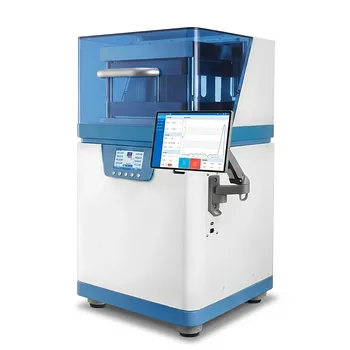
The high-temperature high-pressure reactor serves as the critical reaction vessel that enables solvothermal conditions impossible at atmospheric pressure. It creates a sealed environment where solvents like methanol can be heated far beyond their normal boiling points, facilitating the controlled nucleation and in-situ growth of ZIF-8 nanoparticles directly onto carbon nanotube (CNT) surfaces.
The reactor provides a high-energy, pressurized environment that accelerates chemical kinetics and enables the precise deposition of metal-organic frameworks (MOFs) onto conductive substrates. This ensures high crystallinity and uniform distribution of the ZIF-8 precursor within the composite material.
Overcoming Solvent Limitations
Maintaining Liquid Phase at High Temperatures
In a standard open vessel, solvents like methanol or DMF would evaporate once they reach their boiling points. The high-pressure reactor provides a sealed environment that allows these solvents to remain in a liquid or supercritical state at significantly elevated temperatures.
Enhancing Precursor Solubility
The combination of heat and autogenous pressure significantly increases the solubility of metal salts and organic ligands. This high-energy state ensures that zinc ions and 2-methylimidazole are fully dissolved and available for reaction, preventing premature precipitation.
Accelerating Coordination Kinetics
High-pressure conditions accelerate the coordination reaction between the metal center and the ligand. This energy allows the system to overcome activation barriers quickly, leading to faster formation of the ZIF-8 crystal framework compared to ambient conditions.
Facilitating In-Situ Growth and Morphology
Direct Nucleation on CNT Surfaces
One of the primary functions of this reactor is to induce the in-situ growth of ZIF-8 directly onto the carbon nanotubes. The pressurized environment forces the interaction between the growth solution and the CNT surface, ensuring the MOF particles are anchored rather than floating freely in the solvent.
Controlling Particle Size and Distribution
The stable, controlled environment of the reactor allows for the synthesis of small-sized ZIF-8 nanoparticles. By maintaining constant pressure and temperature, the reactor prevents uncontrolled crystal growth, which is essential for maintaining the high specific surface area of the composite.
Achieving High Crystallinity
The reactor ensures a stable environment for crystal nucleation and growth over extended periods, such as 24 hours. This results in ZIF-8 precursors with high crystallinity and regular pore structures, which are vital for the subsequent conversion into nitrogen-doped porous carbon.
Understanding the Trade-offs
Equipment and Safety Requirements
Operating at high temperatures and pressures requires specialized stainless steel autoclaves or reactors. These systems must be monitored closely to manage the internal pressure, as exceeding the safety limits of the vessel can lead to mechanical failure.
Risk of Crystal Agglomeration
While high temperatures accelerate synthesis, excessive heat or prolonged reaction times can lead to crystal overgrowth. If not carefully controlled, the ZIF-8 particles may agglomerate into large, irregular masses that block the pores of the carbon nanotubes and reduce the effectiveness of the final material.
Energy Consumption and Scalability
Solvothermal synthesis is generally more energy-intensive than room-temperature methods due to the prolonged heating requirements. This can make large-scale industrial production more costly and complex compared to simpler precipitation methods.
Making the Right Choice for Your Goal
When utilizing a high-pressure reactor for ZIF-8/CNT synthesis, your operational parameters should align with your specific material requirements:
- If your primary focus is high crystallinity: Maintain a steady, moderate temperature (e.g., 85°C–100°C) for a longer duration to allow for the slow, regular assembly of the crystal lattice.
- If your primary focus is uniform CNT coating: Prioritize the initial dispersion of CNTs in the solvent and use the reactor to provide the pressure needed to force in-situ nucleation on the tube walls.
- If your primary focus is small particle size: Limit the reaction time and use lower temperatures to prevent the growth phase from dominating after the initial nucleation of ZIF-8.
The high-temperature high-pressure reactor is the indispensable tool that transforms simple chemical mixtures into sophisticated, structurally intact MOF-carbon composites.
Summary Table:
| Key Reactor Function | Impact on ZIF-8/CNT Synthesis | Benefit to Final Material |
|---|---|---|
| Pressure Retention | Keeps solvents liquid far above normal boiling points | Enables high-energy solvothermal conditions |
| Enhanced Solubility | Increases dissolution of metal salts and organic ligands | Prevents premature precipitation and impurities |
| In-Situ Nucleation | Forces ZIF-8 crystals to grow directly on CNT surfaces | Ensures stable, anchored MOF-carbon bonding |
| Kinetic Control | Accelerates the coordination of crystal frameworks | Achieves high crystallinity and uniform pore structures |
| Thermal Stability | Maintains constant temperature over 24+ hour periods | Prevents crystal overgrowth and agglomeration |
Elevate Your Material Synthesis with KINTEK’s Precision Solutions
Achieving the perfect ZIF-8/CNT composite requires uncompromising control over pressure and temperature. KINTEK specializes in high-performance laboratory equipment, offering industry-leading high-temperature high-pressure reactors and autoclaves specifically designed to meet the rigorous demands of solvothermal synthesis and MOF research.
Our extensive portfolio supports your entire research workflow, featuring everything from muffle, vacuum, and CVD furnaces to high-pressure hydraulic presses, crushing systems, and essential ceramic consumables. Whether you are focused on battery research, catalysis, or advanced carbon composites, KINTEK provides the reliability and precision your lab deserves.
Ready to optimize your synthesis results? Contact our experts today to find the ideal reactor configuration for your specific application and experience the KINTEK advantage in material science.
References
- Jun Chen, Baizeng Fang. MOF-Derived Nitrogen-Doped Porous Carbon Polyhedrons/Carbon Nanotubes Nanocomposite for High-Performance Lithium–Sulfur Batteries. DOI: 10.3390/nano13172416
This article is also based on technical information from Kintek Solution Knowledge Base .
Related Products
- Customizable Laboratory High Temperature High Pressure Reactors for Diverse Scientific Applications
- High Pressure Laboratory Autoclave Reactor for Hydrothermal Synthesis
- Stainless High Pressure Autoclave Reactor Laboratory Pressure Reactor
- Mini SS High Pressure Autoclave Reactor for Laboratory Use
- Customizable High Pressure Reactors for Advanced Scientific and Industrial Applications
People Also Ask
- How do high-pressure and high-temperature reactors ensure the effective treatment of lignocellulosic wastewater in WAO?
- What equipment is required for high-pressure high-temperature reactions? Master Extreme Chemistry Safely
- How do you control high pressure in a reactor? A Guide to Safe & Stable Operation
- How does initial oxygen pressure affect the wet oxidation of pharmaceutical sludge? Master Your Oxidation Depth
- Why is argon better than nitrogen for inert atmosphere? Ensure Absolute Reactivity & Stability