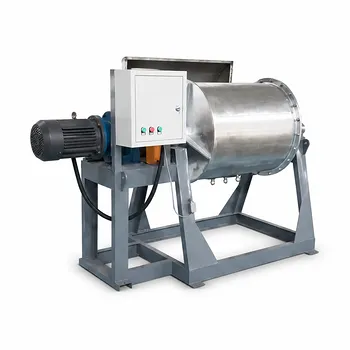
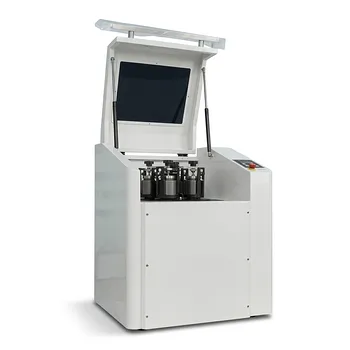
The primary function of a low-energy ball mill in the pretreatment of TiBw/TA15 composites is to achieve uniform mechanical mixing. specifically, it adheres fine TiB2 powder onto the surface of larger, spherical TA15 powder particles under argon gas protection, ensuring a homogeneous distribution without altering the core geometry of the matrix particles.
The low-energy approach prioritizes the uniform dispersion of the reinforcement precursor (TiB2) over particle size reduction. This establishes a precise compositional foundation, which is critical for controlling the in-situ synthesis reaction in subsequent processing stages.
The Mechanics of Low-Energy Adhesion
Coating the Matrix Particle
The central goal of this stage is adhesion rather than fragmentation. The low-energy ball mill uses gentle mechanical forces to attach fine TiB2 powder to the surface of larger TA15 particles. This results in a composite powder where the reinforcement precursor effectively "coats" the matrix material.
Preserving Particle Morphology
Unlike high-energy milling, which often flattens or fractures particles, low-energy milling maintains the original shape of the raw materials. The primary reference highlights that the TA15 powder retains its spherical nature. This morphological preservation is essential for flowability and packing density in later manufacturing steps.
Environmental Protection
The mixing process is conducted under argon gas protection. Titanium alloys (TA15) are highly reactive to oxygen. The inert atmosphere ensures that the mechanical mixing does not introduce impurities or oxides that would degrade the material's final mechanical properties.
Establishing the Reaction Foundation
Precursor Distribution
The quality of the final composite depends on the uniform distribution of the reinforcement phase. By ensuring the TiB2 is evenly adhered to the TA15 surfaces, the mill prevents the formation of precursor clusters.
Facilitating In-Situ Synthesis
This mixing stage is merely the preparation for a chemical reaction that happens later. By establishing intimate contact between the TiB2 and TA15 powders now, the process guarantees that the subsequent in-situ synthesis reaction proceeds uniformly throughout the material volume.
Understanding the Trade-offs
Mixing vs. Alloying
It is vital to distinguish this process from high-energy mechanical alloying. As noted in comparative processes for MoSi2 or TiC composites, high-energy mills use impact and shear to force solid-phase reactions (mechanochemistry). Low-energy mills do not induce these reactions. If your goal is to create an alloy or trigger a reaction during the milling phase, a low-energy mill is insufficient.
Agglomeration Removal
While effective at coating, low-energy mills produce lower shear forces than their planetary counterparts. They are effective at breaking up soft agglomerates (as seen in CuW30 contexts) but may struggle with hard, sintered agglomerates that require high-impact energy to disperse.
Making the Right Choice for Your Goal
To select the correct milling protocol, you must identify your specific microstructural objectives:
- If your primary focus is Uniform Coating: Use low-energy milling to adhere fine precursors to larger matrix particles without deforming the matrix.
- If your primary focus is Mechanical Alloying: Use high-energy planetary milling to fracture particles and induce solid-state reactions between powders.
The effectiveness of TiBw/TA15 composite production relies on using low-energy milling to create a perfectly mixed, unreacted precursor state that is ready for controlled synthesis.
Summary Table:
| Feature | Low-Energy Ball Milling | High-Energy Ball Milling |
|---|---|---|
| Primary Goal | Uniform mechanical mixing & coating | Particle size reduction & alloying |
| Particle Shape | Preserves original morphology (spherical) | Significant deformation & fracturing |
| Material Reaction | No solid-phase reaction induced | Triggers mechanochemical reactions |
| Energy Level | Low shear/impact forces | High impact and shear forces |
| Best For | Pretreatment of composite precursors | Mechanical alloying and grinding |
Elevate Your Composite Material Research with KINTEK
Precision in the pretreatment stage is vital for the success of in-situ synthesis. KINTEK specializes in providing high-performance crushing and milling systems designed to meet the rigorous demands of material science.
Whether you require low-energy mixing for uniform coating or high-energy planetary milling for mechanical alloying, our equipment ensures optimal results for your TiBw/TA15 and other metal matrix composites. Beyond milling, we offer a comprehensive suite of laboratory solutions, including high-temperature furnaces, hydraulic presses, and specialized ceramics to support your entire manufacturing workflow.
Ready to optimize your powder processing? Contact KINTEK today to consult with our experts and find the perfect equipment for your laboratory.
Related Products
- High Energy Planetary Ball Mill Machine for Laboratory Horizontal Tank Type
- Hybrid High Energy Vibratory Ball Mill for Lab Use
- High-Energy Omnidirectional Planetary Ball Mill Milling Machine for Laboratory
- High-Energy Omnidirectional Planetary Ball Mill Machine for Laboratory
- High Energy Planetary Ball Mill Milling Machine for Laboratory
People Also Ask
- What is the primary function of a planetary high-energy ball mill? Master Mechanical Alloying for Nickel Nanoparticles
- What role does a planetary ball mill play in the preparation of NASICON-type solid electrolytes like LATP and LAGP?
- How does a planetary ball mill provide mechanical activation for scandium recovery? Maximize Your Leaching Efficiency
- What is the primary function of a planetary ball mill? Mastering SiC/Al Composite Mixing for Homogeneity
- What is the purpose of using a planetary ball mill for cathode material regeneration? Achieve Atomic-Level Mixing