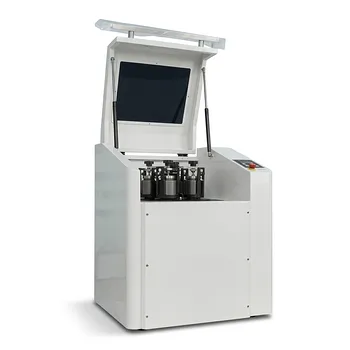
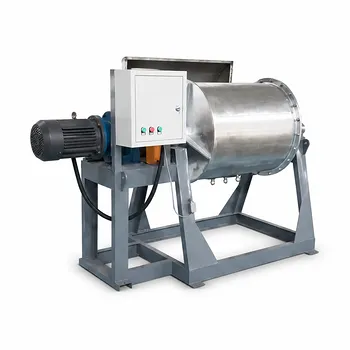
The primary function of a planetary ball mill in this context is to provide high-energy mechanical activation. By subjecting precursors such as Lithium Carbonate (Li2CO3), Titanium Dioxide (TiO2), Aluminum Oxide (Al2O3), and Ammonium Dihydrogen Phosphate (NH4H2PO4) to intense mechanical forces, the mill ensures uniform mixing and significant particle refinement. This physical processing is a prerequisite for generating the chemical reactivity needed in later stages.
By optimizing grinding parameters (such as 550 rpm), the planetary ball mill establishes a critical foundation for reaction kinetics. This mechanical activation effectively reduces the energy barrier for subsequent solid-state reactions, ensuring the final LATP electrolyte achieves a high-purity crystalline phase.
The Mechanics of Precursor Activation
High-Energy Impact and Shear
The planetary ball mill does not simply blend powders; it utilizes high-energy mechanical action.
The milling media subjects the raw materials to aggressive impact and shear forces. This physical stress breaks down the crystalline structures of the raw ingredients, specifically Li2CO3, TiO2, Al2O3, and NH4H2PO4.
Particle Refinement
A key objective of this stage is the reduction of particle size to a microscopic scale.
By grinding the precursors at optimized speeds, the mill dramatically increases the specific surface area of the powder. This refinement is far superior to manual grinding and is essential for facilitating intimate contact between solid particles.
Homogenization of Components
Achieving a uniform distribution of the four distinct chemical precursors is vital for stoichiometry.
The planetary motion ensures that no localized concentration gradients exist within the mixture. This microscopic uniformity prevents the formation of unwanted secondary phases during the heating process.
Impact on Solid-State Reactions
Enhancing Reaction Activity
The mechanical energy imparted during milling is stored in the powder as internal strain and surface energy.
This "mechanical activation" makes the precursors chemically unstable and highly reactive. Consequently, the mixture requires less thermal energy to react, promoting a more efficient solid-state reaction.
Establishing Phase Purity
The ultimate goal of the mixing stage is to prepare the material for the formation of high-purity crystalline phases.
Without the intense mixing and refinement provided by the planetary ball mill, the subsequent high-temperature reaction would likely result in incomplete reactions or impurities. The ball mill ensures that the precursors are in the optimal physical state to form the correct LATP crystal structure.
Understanding Process Criticality
The Role of Optimization
While high energy is necessary, the specific parameters must be carefully controlled.
References indicate that speeds such as 550 rpm are optimized to balance particle reduction with process efficiency. Deviating significantly from optimized speeds can lead to insufficient activation or excessive heat generation.
The Consequence of Inadequate Milling
If the milling process is shortened or performed at low energy, the precursors will remain too coarse.
This lack of refinement leads to diffusion limitations during sintering. The result is often an LATP electrolyte with poor ionic conductivity due to the presence of unreacted raw materials.
Making the Right Choice for Your Goal
To maximize the performance of your LATP solid-state electrolyte, you must view the ball milling stage as a reaction enabler, not just a mixing step.
- If your primary focus is Phase Purity: Ensure you utilize optimized high speeds (e.g., 550 rpm) to guarantee the atomic-level mixing required to prevent secondary phase formation.
- If your primary focus is Process Efficiency: Leverage the mechanical activation effects of the mill to potentially lower the required temperature or duration of the subsequent calcination step.
The planetary ball mill is the defining instrument that transforms inert raw powders into a highly reactive precursor capable of becoming a high-performance solid electrolyte.
Summary Table:
| Process Function | Mechanism of Action | Impact on LATP Quality |
|---|---|---|
| Mechanical Activation | High-energy impact and shear | Reduces energy barrier for solid-state reactions |
| Particle Refinement | Reduction to microscopic scale | Increases surface area for intimate particle contact |
| Homogenization | Uniform planetary motion | Prevents secondary phases and ensures stoichiometry |
| Reaction Kinetics | Internal strain storage | Promotes high-purity crystalline phase formation |
Elevate Your Battery Research with KINTEK Precision
High-performance LATP electrolytes demand rigorous precursor processing. KINTEK specializes in advanced laboratory equipment designed for material science excellence. Our planetary ball mills and crushing systems provide the precise mechanical activation required for superior particle refinement, while our high-temperature furnaces and pellet presses ensure seamless transition from powders to high-purity solid-state components.
Our value to you:
- Comprehensive Solutions: From milling and sieving to sintering and battery testing.
- Precision Control: Optimized equipment parameters for consistent, repeatable results.
- Expert Support: Equipment tailored for solid-state electrolyte, CVD, and battery research.
Ready to achieve atomic-level mixing and phase purity? Contact KINTEK today to find the perfect equipment for your lab!
Related Products
- High Energy Planetary Ball Mill for Laboratory Horizontal Tank Type Milling Machine
- Mini Planetary Ball Mill Machine for Laboratory Milling
- Laboratory Horizontal Planetary Ball Mill Milling Machine
- High-Energy Omnidirectional Planetary Ball Mill Milling Machine for Laboratory
- Laboratory Planetary Ball Mill Cabinet Planetary Ball Milling Machine
People Also Ask
- What is the role of a planetary ball mill in sulfide-based solid-state batteries? Engineer High-Performance Cathodes
- What are the parameters of a planetary ball mill? Master Speed, Time, and Media for Perfect Grinding
- What is the function of a planetary ball mill for nanostructured eutectic steel? Essential Prep for High-Strength Alloys
- What role does a planetary ball mill play in the preparation of NASICON-type solid electrolytes like LATP and LAGP?
- What is the function of a planetary ball mill in solid-state electrolyte prep? Milling vs. SDS Methods Explained