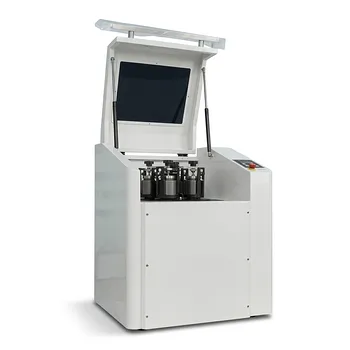
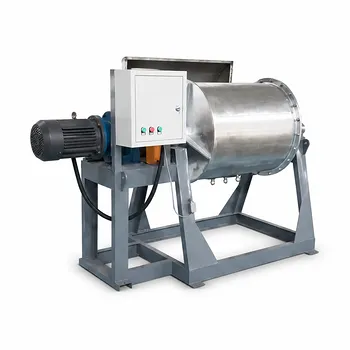
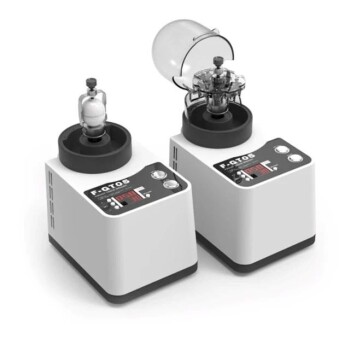
The planetary ball mill acts as the primary engine for high-energy mechanical activation during NCA synthesis. It utilizes high-speed rotation to generate intense collisions and shear forces between grinding media and precursors such as LiOH·H2O, Ni(OH)2, Co3O4, and aluminum sources. This process refines the powder to the nanometer scale and homogenizes it at a microscopic level, significantly lowering the kinetic barriers for the subsequent solid-state reaction.
Core Takeaway: The planetary ball mill transforms separate raw precursors into a highly reactive, uniform mixture. By increasing contact area and introducing lattice defects, it ensures that the chemical reaction occurs efficiently and uniformly during high-temperature sintering.
Mechanical Pre-Conditioning of Precursors
High-Energy Impact and Shear
The planetary ball mill operates by rotating the grinding jars in a direction opposite to the supporting sun wheel. This dual-rotation movement creates powerful centrifugal forces that drive the grinding balls to strike the material with extreme velocity. These intense impacts and shear forces are necessary to break down the crystalline structure of bulk precursors.
Particle Size Refinement to the Nanoscale
The mill reduces micron-sized nickel and cobalt precursors down to the nanometer scale. This drastic reduction in size increases the total surface area of the powder. A higher surface area provides more reaction sites, which is critical for achieving a complete reaction in a solid-state environment.
Mechanical Alloying and Microscopic Mixing
Unlike standard mixing, high-energy ball milling facilitates mechanical alloying, where powders are repeatedly fractured and cold-welded. This ensures that the lithium, nickel, cobalt, and aluminum sources are distributed uniformly at the atomic level. Such precision prevents the formation of secondary phases and ensures a pure NCA crystal structure.
Facilitating the Solid-State Reaction
Lowering Kinetic Barriers
The high-energy impact introduces lattice defects and internal strain into the material particles. These defects increase the stored energy within the powder, making it more chemically reactive. This higher reactivity allows the solid-state reaction to proceed at lower temperatures or shorter durations than would be possible with traditional mixing.
Enhancing Ion Diffusion
By crushing particles to nanometer dimensions, the mill significantly shortens the diffusion paths for lithium ions. During the subsequent heating phase, lithium can move more easily into the nickel-cobalt-aluminum matrix. This leads to a more homogenous final product with better electrochemical properties.
Uniform Doping and Structural Stability
The mill is essential for the effective integration of doping elements (such as magnesium or titanium) into the precursor mix. Uniformly dispersed dopants can enter the crystal lattice during heat treatment to form a "pillar effect." This structural reinforcement helps inhibit the generation of micro-cracks during the battery’s charge and discharge cycles.
Understanding the Trade-offs
Risk of Material Contamination
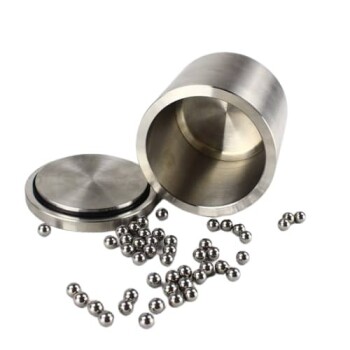
The high-energy nature of the process can lead to abrasion of the grinding jars and balls. If the media is not carefully selected (e.g., using zirconia for high-nickel materials), impurities can be introduced into the NCA powder. These contaminants can degrade the electrochemical performance and safety of the final battery cell.
Thermal Management and Over-Milling
Extense milling generates significant heat, which can cause unwanted phase transitions or the dehydration of precursors like LiOH·H2O prematurely. Excessive milling may also lead to "over-processing," where the powder becomes too amorphous. This can negatively affect the crystallinity of the cathode material after the sintering process.
How to Apply This to Your Synthesis Goal
Choosing the Right Milling Parameters
Selecting the correct speed, duration, and ball-to-powder ratio is vital for achieving the desired material characteristics.
- If your primary focus is High Rate Performance: Prioritize smaller particle sizes and longer milling times to maximize surface area and shorten ion diffusion paths.
- If your primary focus is Material Purity: Use lower rotation speeds and high-quality, wear-resistant grinding media (like YSZ) to minimize contamination from the milling equipment.
- If your primary focus is Structural Longevity: Ensure intensive mixing of doping elements to guarantee they are uniformly integrated into the lattice to prevent micro-cracking.
By mastering the mechanical activation provided by the planetary ball mill, you establish the critical foundation required for high-performance, nickel-rich cathode materials.
Summary Table:
| Mechanism | Key Function | Impact on NCA Quality |
|---|---|---|
| High-Energy Impact | Particle size refinement | Reductions to nanoscale for increased reaction sites |
| Mechanical Alloying | Microscopic homogenization | Ensures atomic-level distribution; prevents secondary phases |
| Lattice Deformation | Lowering kinetic barriers | Increases reactivity for more efficient solid-state reactions |
| Uniform Doping | Structural reinforcement | Facilitates dopant integration to prevent micro-cracking |
Elevate Your Battery Research with KINTEK Precision
Achieving the perfect NCA cathode requires more than just mixing; it demands precise mechanical activation and thermal control. KINTEK specializes in high-performance laboratory equipment designed for the rigorous demands of battery material synthesis.
From our robust planetary ball mills and crushing systems for nanoscale refinement to our advanced high-temperature furnaces (muffle, tube, and vacuum) for flawless sintering, we provide the end-to-end solutions your lab needs. We also offer essential consumables like high-purity zirconia grinding media, ceramic crucibles, and PTFE products to ensure zero contamination.
Ready to optimize your synthesis workflow? Contact our technical experts today to discover how KINTEK can enhance your material performance and research efficiency!
References
- Lifan Wang, Guicheng Liu. One-Step Solid-State Synthesis of Ni-Rich Cathode Materials for Lithium-Ion Batteries. DOI: 10.3390/ma16083079
This article is also based on technical information from Kintek Solution Knowledge Base .
Related Products
- High Energy Planetary Ball Mill for Laboratory Horizontal Tank Type Milling Machine
- High-Energy Omnidirectional Planetary Ball Mill Milling Machine for Laboratory
- Laboratory Planetary Ball Mill Rotating Ball Milling Machine
- High Energy Planetary Ball Mill Milling Machine for Laboratory
- High Energy Planetary Ball Mill Machine for Laboratory Horizontal Tank Type
People Also Ask
- What is the role of a planetary ball mill in sulfide-based solid-state batteries? Engineer High-Performance Cathodes
- What are the parameters of a planetary ball mill? Master Speed, Time, and Media for Perfect Grinding
- What is the function of a planetary ball mill for nanostructured eutectic steel? Essential Prep for High-Strength Alloys
- What role does a planetary ball mill play in the preparation of NASICON-type solid electrolytes like LATP and LAGP?
- What is the function of a planetary ball mill in solid-state electrolyte prep? Milling vs. SDS Methods Explained