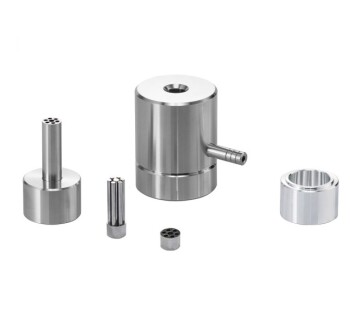
The primary function of a stainless steel high-pressure reactor in this process is to provide a sealed, thermally controlled environment for polymerization. Specifically, it enables the reaction of Methyl Methacrylate (MMA) monomers and Dicumyl peroxide (DCP) initiators at elevated temperatures (typically 130 °C) without losing the solvent to evaporation. This equipment is critical for achieving the specific weight-average molecular weight (e.g., Mw = 320,000 g/mol) required for a high-quality PMMA matrix.
By sealing the reaction environment, the high-pressure reactor decouples temperature from evaporation. This allows for higher thermal energy input without the loss of volatiles, ensuring the precise chemical kinetics needed to form a consistent polymer matrix.
Creating the Ideal Reaction Environment
Thermal Regulation Under Pressure
The synthesis of PMMA/hBN composites via solution polymerization requires temperatures that often exceed the boiling points of common solvents at atmospheric pressure.
The reactor allows you to sustain a stable temperature of 130 °C. Because the vessel is sealed, the internal pressure naturally rises, allowing the liquid phase to exist at these higher temperatures to drive the polymerization reaction efficiently.
Preventing Volatile Loss
In an open system, high temperatures would lead to rapid solvent evaporation and potentially the loss of volatile monomers.
The stainless steel high-pressure reactor creates a closed system. This containment is essential to maintain the correct stoichiometric ratio of reactants and solvent throughout the entire process, directly influencing the final molecular weight of the polymer.
Ensuring Homogeneity and Purity
Mechanical Stirring for Uniformity
A critical feature of these reactors is the integrated mechanical stirrer.
This mechanism ensures the thorough mixing of the MMA monomers, the DCP initiator, and the solvent. In the context of composite materials, this agitation is also vital for keeping any suspended particles dispersed effectively within the reacting solution.
Inert Atmosphere Control
The reactor is equipped with an argon gas inlet.
This allows you to purge oxygen from the vessel before pressurizing. Eliminating oxygen is crucial because oxygen can act as a radical scavenger, inhibiting the polymerization process or leading to unwanted side reactions that degrade the quality of the PMMA matrix.
Understanding the Trade-offs
Process Complexity vs. Control
Using a high-pressure reactor introduces significantly more complexity than standard glassware reflux methods.
You must carefully manage pressure limits and seal integrity. However, the trade-off is necessary; without this pressurized containment, you cannot achieve the specific molecular weight distributions required for high-performance composites.
Material Compatibility
While stainless steel offers excellent structural integrity for high pressure, it is chemically reactive with certain aggressive reagents.
For this specific PMMA process, stainless steel is generally sufficient. However, if your synthesis involves highly corrosive precursors (as seen in other hydrothermal methods), you would need to consider a Teflon (PTFE) lining to prevent metallic contamination and reactor corrosion.
Making the Right Choice for Your Synthesis
To ensure the successful synthesis of PMMA/hBN composites, align your equipment use with your specific chemical goals:
- If your primary focus is Molecular Weight Control: Prioritize the integrity of the reactor's seal to prevent any solvent evaporation, as concentration changes directly alter the polymer chain length (Mw ~320,000 g/mol).
- If your primary focus is Matrix Homogeneity: Ensure your mechanical stirring speed is optimized to maintain a uniform distribution of reactants and heat without inducing shear degradation.
- If your primary focus is Chemical Purity: Rigorously utilize the argon inlet to create an oxygen-free environment, preventing oxidation that could weaken the final composite.
The high-pressure reactor is the foundational tool that transforms volatile monomers into a stable, structural polymer matrix through precise containment and thermal control.
Summary Table:
| Feature | Function in PMMA/hBN Synthesis | Benefit to Final Composite |
|---|---|---|
| High-Pressure Seal | Decouples temperature from solvent evaporation | Maintains stoichiometry and targets Mw ~320,000 g/mol |
| Thermal Regulation | Sustains stable reaction temperatures (e.g., 130 °C) | Drives efficient polymerization kinetics |
| Mechanical Stirring | Uniform mixing of MMA monomers, DCP, and hBN | Ensures matrix homogeneity and particle dispersion |
| Argon Gas Inlet | Purges oxygen to create an inert atmosphere | Prevents radical scavenging and side reactions |
Elevate Your Composite Research with KINTEK Precision
Maximize your polymerization efficiency and achieve precise molecular weight distributions with KINTEK’s premium stainless steel high-pressure reactors and autoclaves. Whether you are synthesizing high-performance PMMA/hBN composites or exploring advanced material science, our equipment is designed for rigorous thermal regulation and superior chemical containment.
Why partner with KINTEK?
- Comprehensive Range: From muffle and vacuum furnaces to advanced CVD/PECVD systems.
- Specialized Lab Tools: Industry-leading hydraulic presses, crushing/milling systems, and high-purity consumables like PTFE and ceramic crucibles.
- Expert Solutions: Tailored battery research tools and cooling solutions (ULT freezers) for demanding lab environments.
Don't let volatile loss or oxygen contamination compromise your results. Contact KINTEK today to find the perfect reactor for your laboratory!
References
- T. E. Coan, Ricardo Antônio Francisco Machado. Preparation of PMMA/hBN composite coatings for metal surface protection. DOI: 10.1590/s1516-14392013005000140
This article is also based on technical information from Kintek Solution Knowledge Base .
Related Products
- Stainless High Pressure Autoclave Reactor Laboratory Pressure Reactor
- Mini SS High Pressure Autoclave Reactor for Laboratory Use
- Customizable High Pressure Reactors for Advanced Scientific and Industrial Applications
- Customizable Laboratory High Temperature High Pressure Reactors for Diverse Scientific Applications
- High Pressure Laboratory Autoclave Reactor for Hydrothermal Synthesis
People Also Ask
- Why is a laboratory high-pressure reactor used in the hydrothermal synthesis of hydroxyapatite catalysts?
- Why is a laboratory high-pressure reactor necessary for synthesizing fly ash-based zeolite? Achieve Pure Crystallization
- What role does a laboratory high-pressure reactor play in the leaching process of spent cathode materials? Optimize Recovery
- What conditions do laboratory high-pressure reactors provide for HTC? Optimize Your Biochar Production Processes
- How are high-pressure reactors used to prepare metaphosphate electrocatalysts? Master In-Situ Precursor Growth