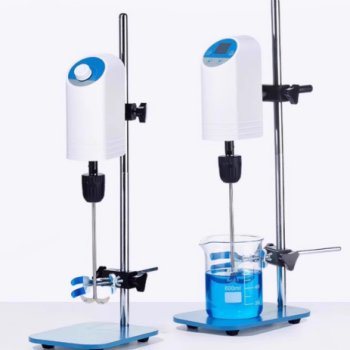
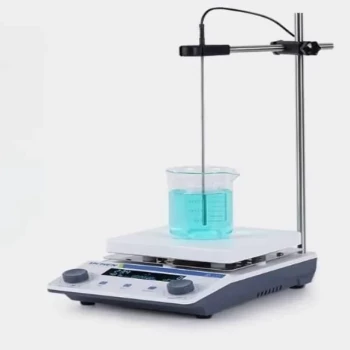
The function of a stirred tank reactor equipped with an in-situ distillation unit is to optimize the synthesis of bio-based oxazoline by combining efficient mixing with active equilibrium manipulation. This setup ensures the uniform thermal and chemical distribution required for the reaction between fatty acids and ethanolamine, while simultaneously removing water to drive the reaction toward completion.
Core Takeaway The integration of in-situ distillation is not merely for purification; it is a kinetic tool that leverages Le Chatelier’s principle. By removing the water byproduct in real-time, the system prevents the reverse reaction, significantly increasing the conversion rate and total synthesis yield.
The Role of the Stirred Tank Reactor
Ensuring Chemical Homogeneity
The primary vessel serves as the site for two specific chemical phases: amidation and the subsequent cyclization.
Because the reactants—fatty acids and ethanolamine—must interact closely, the reactor uses mechanical agitation to create a uniform mixture.
Regulating Thermal Distribution
Consistent temperature is critical for reaction kinetics.
The stirred tank design ensures that heat is distributed evenly throughout the fluid, preventing hot spots or cold zones that could impede the synthesis or degrade the bio-based materials.
The Function of In-Situ Distillation
Managing Byproducts
The chemical transformation of fatty acids and ethanolamine into oxazoline releases water as a byproduct.
If left in the reactor, this water would accumulate and eventually inhibit the reaction progress due to chemical equilibrium constraints.
Shifting the Equilibrium
The in-situ distillation unit operates concurrently with the reaction to extract this water as it forms.
By continuously removing a product of the reaction, the system shifts the chemical equilibrium to the right.
Maximizing Yield
This continuous removal creates a driving force that promotes further conversion of reactants.
The result is a significantly higher total yield of the target oxazoline molecule compared to a closed system where water is allowed to remain.
Understanding the Operational Dynamics
The Necessity of Integration
Using a standard reactor without distillation would result in a stalled reaction.
The accumulation of water would cause the reaction to reach equilibrium prematurely, leaving a significant portion of the fatty acids and ethanolamine unconverted.
Process Synergy
The effectiveness of this setup relies on the synergy between the two components.
The stirrer ensures the water can migrate to the liquid surface for evaporation, while the distillation unit immediately clears the headspace, allowing the cycle to continue efficiently.
Optimizing Synthesis Strategy
To apply this configuration effectively, consider your specific production goals:
- If your primary focus is Reaction Rate: Ensure the stirring speed is sufficient to maximize mass transfer, allowing water to reach the vapor phase quickly.
- If your primary focus is Maximum Yield: Prioritize the efficiency of the distillation column to ensure water is removed faster than it is generated, preventing any backward reaction.
This reactor configuration essentially transforms a chemically limited equilibrium process into a highly efficient, high-yield production method.
Summary Table:
| Feature | Function in Oxazoline Synthesis | Benefit |
|---|---|---|
| Mechanical Agitation | Ensures uniform chemical and thermal distribution | Prevents hotspots and ensures reactant interaction |
| In-Situ Distillation | Real-time removal of water byproduct | Shifts equilibrium to the right (Le Chatelier’s Principle) |
| Integrated Setup | Simultaneous mixing and byproduct extraction | Maximizes conversion rates and final product yield |
| Kinetic Control | Active management of reaction environment | Accelerates amidation and cyclization phases |
Elevate Your Chemical Synthesis with KINTEK Precision
Ready to optimize your bio-based molecule production? KINTEK specializes in advanced laboratory solutions designed for complex chemical workflows. From high-performance stirred tank reactors and high-pressure autoclaves to precise cooling systems and thermal processing tools, we provide the equipment necessary to master reaction kinetics and maximize your yields.
Whether you are scaling up oxazoline synthesis or exploring new battery research, our comprehensive range of high-temperature furnaces, hydraulic presses, and specialized lab consumables ensures your research is backed by reliability and innovation.
Transform your laboratory efficiency today. Contact our expert team to find your perfect solution!
References
- Chahinez Helali, Ioannis Ignatiadis. Corrosion Inhibition of Carbon Steel Immersed in Standardized Reconstituted Geothermal Water and Individually Treated with Four New Biosourced Oxazoline Molecules. DOI: 10.3390/met14121439
This article is also based on technical information from Kintek Solution Knowledge Base .
Related Products
- Visual High-Pressure Reactor for In-Situ Observation
- Custom PTFE Teflon Parts Manufacturer for Microwave Digestion Tank
- Customizable High Pressure Reactors for Advanced Scientific and Industrial Applications
- Customizable Laboratory High Temperature High Pressure Reactors for Diverse Scientific Applications
- High Pressure Laboratory Autoclave Reactor for Hydrothermal Synthesis
People Also Ask
- How do high-pressure reactors enhance biochar redox activity? Optimize Surface Functionalization and Energy Density
- What is the purpose of a high-pressure reactor in oleophilic GO modification? Optimize Grafting and Oil Dispersion.
- How does a high-pressure reactor facilitate reductive amidation? Maximize Yield & Speed in Tandem Reactions
- How does a high-pressure reactor assist in catalytic hydrogenation of 2,6-dimethylnitrobenzene? Optimize Your Process
- What is the significance of using a high-pressure reactor for the treatment of rice husk? Boost Furfural Yield & Speed