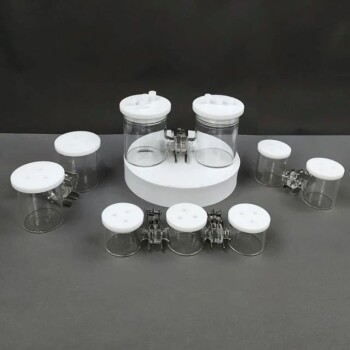
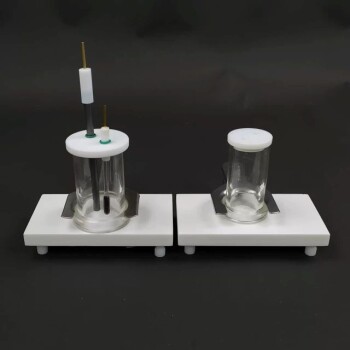
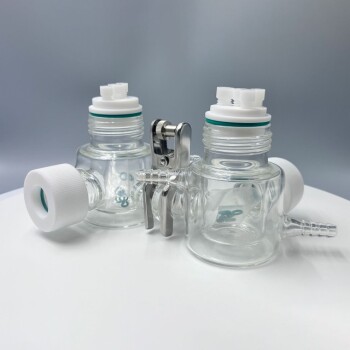
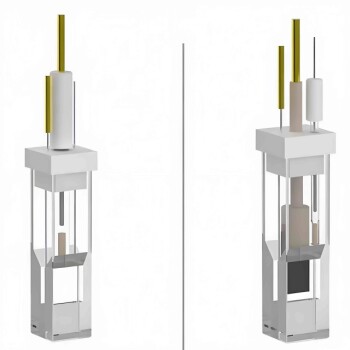
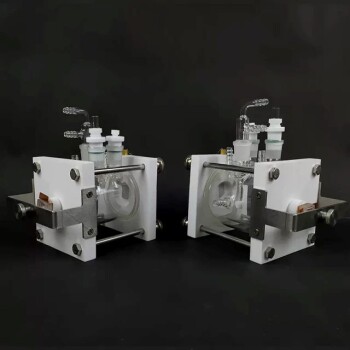
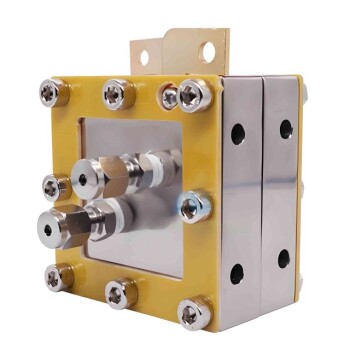
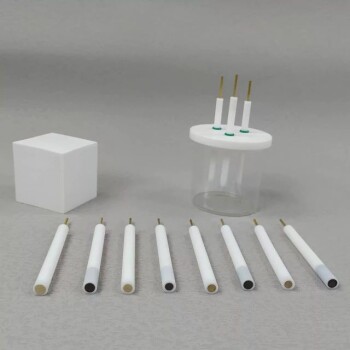
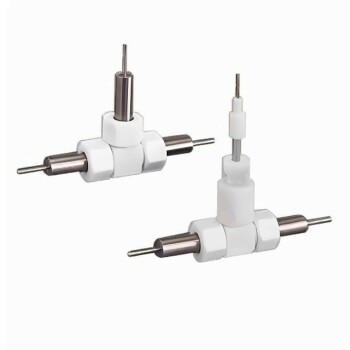
The function of a three-electrode electrochemical cell is to precisely isolate and control the polarization state of an alloy surface within a simulated concrete environment. By decoupling the current path from the potential measurement, this configuration allows researchers to accurately study electrochemical redox processes in high-pH solutions (typically 0.1 M NaOH) without the interference of solution resistance errors.
The core advantage of this system is the separation of duties: current flows through the auxiliary electrode, while voltage is measured against the reference electrode. This ensures that the data reflects the true electrochemical behavior of the alloy, rather than artifacts of the testing equipment or solution.
Simulating the Concrete Environment
To understand the behavior of reinforcement bars, you must first replicate the chemical conditions they face.
Replicating Pore Solution Chemistry
The cell typically utilizes a 0.1 M NaOH solution to mimic the liquid found in concrete pores.
This creates a highly alkaline environment with a pH of approximately 13.
Under these conditions, the system allows for the observation of how the alloy creates (or fails to create) a passive protective layer.
The Role of Component Electrodes
The three-electrode system replaces vague measurements with precise triangulation using three distinct components.
The Working Electrode (The Subject)
This is the test alloy or sample being investigated.
Its role is to serve as the site where electrochemical reactions (oxidation or reduction) occur in response to the simulated environment.
The Reference Electrode (The Standard)
This electrode provides a stable, known reference potential against which the working electrode is measured.
Common examples include Ag/AgCl electrodes. Because no significant current flows through it, its potential remains constant, ensuring measurement accuracy.
The Auxiliary/Counter Electrode (The Current Carrier)
Often made of inert materials like a graphite rod, this electrode completes the electrical circuit.
Its sole function is to allow the current required for polarization to flow through the solution without interfering with the measurement taken at the reference electrode.
Mechanics of Accuracy
The primary reason for using three electrodes instead of two is to eliminate measurement error.
Isolating Potential from Current
In this configuration, the applied current flows primarily between the working and auxiliary electrodes.
Meanwhile, the potential measurement occurs exclusively between the working and reference electrodes.
Eliminating Resistance Errors
By physically isolating these paths, the design effectively eliminates errors caused by solution resistance (IR drop).
It also prevents polarization of the reference electrode, ensuring that changes in voltage are due strictly to the chemistry of the test alloy.
Understanding Critical Factors for Accuracy
While robust, the three-electrode cell requires careful setup to ensure valid results.
Physical Geometry Matters
The electrodes are designed to be physically isolated within the specific volume of the corrosive solution.
Improper spacing between the reference and working electrodes can still introduce uncompensated resistance, skewing the data.
Solution Conductivity
While the setup minimizes resistance errors, the conductivity of the NaOH solution plays a role.
In highly resistive media, even a three-electrode setup may require additional electronic compensation (IR compensation) from the potentiostat.
Applying This Configuration to Your Research
To get the most out of your electrochemical experiments, align your focus with your specific research goals.
- If your primary focus is alloy selection: Ensure your Working Electrode represents the exact metallurgy intended for construction to observe its specific passivation capability.
- If your primary focus is environmental simulation: Rigorously verify the pH stability of your 0.1 M NaOH solution, as the Reference Electrode relies on a stable chemical baseline.
By strictly controlling the electrochemical variables, this setup transforms a theoretical simulation into a source of rigorous, actionable data on infrastructure durability.
Summary Table:
| Component | Material Example | Primary Function in Passivation Studies |
|---|---|---|
| Working Electrode | Test Alloy / Rebar | Site of electrochemical reaction and passive film formation |
| Reference Electrode | Ag/AgCl | Provides a stable potential baseline for accurate measurement |
| Auxiliary Electrode | Graphite / Platinum | Completes the circuit to allow polarization current flow |
| Electrolyte | 0.1 M NaOH | Mimics the high-pH (13) pore solution of concrete |
Elevate Your Electrochemical Research with KINTEK
Precision in simulation is the key to infrastructure durability. KINTEK specializes in advanced laboratory equipment, offering high-performance electrolytic cells and electrodes specifically designed for rigorous alloy passivation and concrete environment studies.
Whether you require specialized electrodes, high-temperature furnaces for material synthesis, or precision crushing and milling systems, our comprehensive portfolio is engineered to meet the strictest scientific standards.
Ready to achieve more accurate data? Contact our technical experts today to discover how our tailored solutions can optimize your lab's efficiency and research outcomes.
References
- Noureddine Benaioun, Jean‐Luc Bubendorff. Passive Films Formed on Fe- and Ni-Based Alloys in an Alkaline Medium: An Insight into Complementarities between Electrochemical Techniques and Near-Field Microscopies (AFM/SKPFM). DOI: 10.3390/app132111659
This article is also based on technical information from Kintek Solution Knowledge Base .
Related Products
- H Type Electrolytic Cell Triple Electrochemical Cell
- Electrolytic Electrochemical Cell Gas Diffusion Liquid Flow Reaction Cell
- Electrolytic Electrochemical Cell with Five-Port
- Electrolytic Electrochemical Cell for Coating Evaluation
- Quartz Electrolytic Electrochemical Cell for Electrochemical Experiments
People Also Ask
- What is a H type cell? A Guide to Divided Electrochemical Cells for Accurate Experiments
- How should the electrolyte be prepared and added to the H-type electrolytic cell? Best Practices for Purity and Safety
- What is the technical necessity of using an H-type electrolytic cell for NO3RR tests? Protect Your Ammonia Yields
- How does the design of an H-type electrolytic cell benefit the neutral water electrolysis process for metal recovery?
- What is the primary function of an H-type electrolytic cell in NitRR? Ensure Accurate Product Yields