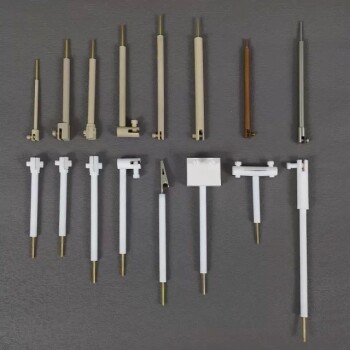
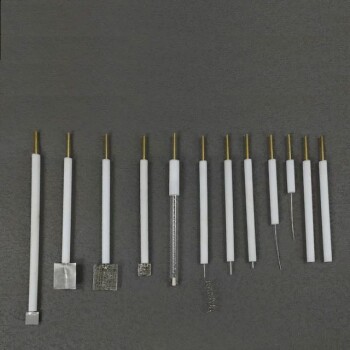
The function of a three-electrode system in electrochemical polymerization is to act as the precision control mechanism for growing conducting polymer films. Comprising a working, counter, and reference electrode, this setup enables an electrochemical workstation to strictly regulate potential or current, inducing monomers to polymerize directly onto a conductive substrate with high purity.
The core value of this system is the translation of electrical parameters into physical material properties. It allows you to tune the specific thickness, morphology, and doping levels of a film, which is essential for creating sensors with superior electrical performance.
The Mechanics of Controlled Growth
Orchestrating Polymerization
The system functions by isolating the variables of the reaction. By utilizing a working electrode (where the polymer grows), a counter electrode, and a reference electrode, the equipment creates a stable environment for electrochemical reactions.
This configuration allows the electrochemical workstation to apply precise electrical stimuli. This induces the polymerization of monomers directly onto the substrate surface.
Ensuring High Purity
A primary function of this three-electrode arrangement is to achieve high-purity film growth. Unlike chemical methods which may introduce impurities, the electrochemical approach uses controlled potential/current to drive the reaction.
This results in a "cleaner" material synthesis. The purity of the conducting polymer (CP) is directly linked to the final sensor's reliability.
Tuning Material Properties
Regulating Film Thickness
The system provides the ability to dictate exactly how much polymer is deposited. By adjusting the duration and intensity of the electrochemical parameters, you control the thickness of the sensing layer.
This is vital for sensor performance. A film that is too thick or too thin may not interact optimally with the target analyte.
Controlling Morphology and Doping
Beyond simple growth, the system functions to define the internal structure of the material. Adjusting the input parameters alters the film's morphology (surface structure) and doping levels (conductivity).
These adjustments directly impact the electrical properties of the sensing layer. A well-doped, morphologically optimized film yields a high-performance sensor.
Understanding the Trade-offs
Parameter Sensitivity
While the system offers superior control, it introduces complexity. The text notes that properties are regulated by "adjusting electrochemical parameters," implying a sensitive relationship between input and output.
Optimization Requirements
Achieving the "superior electrical properties" mentioned requires rigorous optimization. Because the system controls thickness, morphology, and doping simultaneously, finding the exact balance for a specific sensor application is a critical, often iterative, step.
Making the Right Choice for Your Goal
The three-electrode system is not just about growing a film; it is about engineering a material.
- If your primary focus is Sensitivity: Prioritize the adjustment of doping levels and morphology to maximize the electrical conductivity and surface area available for sensing.
- If your primary focus is Reproducibility: Focus on the precise regulation of polymer thickness, ensuring that every sensor manufactured has identical physical dimensions and response characteristics.
By leveraging the precision of the three-electrode system, you move from simple coating to exact material engineering.
Summary Table:
| Component | Role in Polymerization | Impact on Sensor Performance |
|---|---|---|
| Working Electrode | Substrate for monomer deposition | Determines film adhesion and surface area |
| Counter Electrode | Completes the electrical circuit | Ensures stable current flow for uniform growth |
| Reference Electrode | Provides stable potential measurement | Guarantees high purity and precise doping levels |
| Parameter Control | Regulates time, current, and voltage | Dictates film thickness and electrical conductivity |
Elevate Your Materials Research with KINTEK Precision
Unlock the full potential of your electrochemical research with KINTEK’s advanced laboratory solutions. Whether you are engineering high-performance conducting polymer sensors or developing next-generation energy storage, our comprehensive range of electrolytic cells, electrodes, and electrochemical workstations provides the stability and precision you need for high-purity material synthesis.
From high-temperature furnaces and vacuum systems to specialized battery research tools and consumables, KINTEK is the trusted partner for laboratories demanding excellence. Our experts are ready to help you optimize your setup for thickness, morphology, and doping control.
Ready to achieve superior sensor performance? Contact KINTEK today to discuss your equipment needs!
References
- Lê Văn Cường, Hyeonseok Yoon. Advances in the Use of Conducting Polymers for Healthcare Monitoring. DOI: 10.3390/ijms25031564
This article is also based on technical information from Kintek Solution Knowledge Base .
Related Products
- Three-dimensional electromagnetic sieving instrument
- H Type Electrolytic Cell Triple Electrochemical Cell
- Gold Disc Electrode
- Metal Disc Electrode Electrochemical Electrode
- Rotating Platinum Disk Electrode for Electrochemical Applications
People Also Ask
- What is sieving and how does it work? A Guide to Accurate Particle Size Analysis
- What are advantages and disadvantages of sieving method? A Guide to Reliable & Cost-Effective Particle Sizing
- What type of materials can be separated using the method of sieving? A Guide to Efficient Particle Size Separation
- What mixtures can be separated by sieving? A Guide to Efficient Solid-Solid Separation
- Why is sieving equipment necessary for processing powder prior to hot extrusion of PEO? Ensure Cathode Film Uniformity