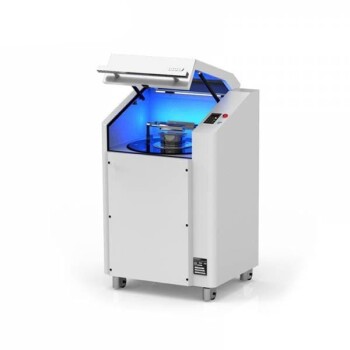
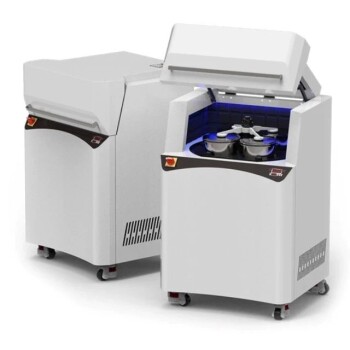
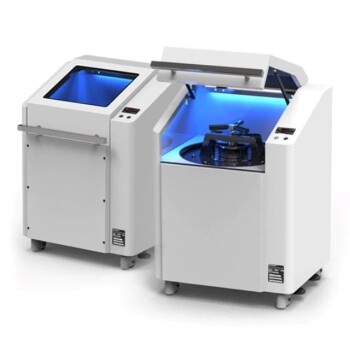
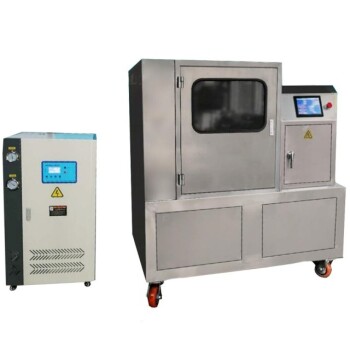
The primary function of a vibratory ball mill in carbon fiber preparation is to transform bundled, anisotropic fibers into a fine, isotropic powder. This process eliminates the influence of fiber orientation on X-ray scattering patterns, which is essential for obtaining accurate measurements of the material's internal crystal structure.
By converting oriented fibers into a randomized powder, the vibratory ball mill removes directional bias from Wide-Angle X-ray Scattering (WAXS) data. This standardization allows for the precise calculation of intrinsic structural parameters, such as grain size and lattice spacing, using the Scherrer equation.
Eliminating Directional Bias in Scattering
The Problem with Fiber Orientation
Carbon fibers are inherently anisotropic, meaning their properties and structure vary depending on the direction of measurement. In their raw bundled state, the highly aligned nature of the polymer chains creates a "preferred orientation" that distorts X-ray scattering patterns.
Achieving Isotropy through Milling
A vibratory ball mill uses high-frequency mechanical energy to break these bundles down into a fine powder. This powder is isotropic, meaning the crystals are oriented randomly in every direction, which ensures the X-ray beam hits all crystallographic planes equally.
Quantifying Intrinsic Structural Parameters
Precision in Lattice Spacing
By removing the fiber's macroscopic orientation, researchers can more accurately measure the lattice spacing ($d_{002}$). This value is critical for understanding the degree of graphitization and the density of the carbon layers.
Calculating Grain Size ($L_a$ and $L_c$)
Once the sample is in a randomized powder form, the Scherrer equation can be reliably applied to the WAXS data. This calculation determines the crystallite height ($L_c$) and crystallite width ($L_a$), which are fundamental indicators of the fiber's mechanical and thermal potential.
The Mechanics of Sample Refinement
High-Frequency Impact and Shear
The vibratory ball mill operates by subjecting the sample to intense impact and shear forces. These forces are highly effective at refining micron-sized fibers and ensuring a consistent particle size distribution throughout the sample.
Ensuring Homogeneity and Dispersion
Similar to its use in preparing composite powders or spectroscopy samples, the mill prevents agglomeration. By maintaining a uniform dispersion of particles, the mill ensures that the WAXS scan represents the entire sample volume rather than a localized cluster.
Understanding the Trade-offs
Risk of Structural Degradation
While milling is necessary for isotropy, excessive milling time or energy can introduce lattice strain or damage the very crystals being measured. Over-processing may lead to an artificial reduction in calculated grain size ($L_a, L_c$), providing a false reading of the fiber's quality.
Potential for Media Contamination
The high-energy collisions between the balls and the chamber can result in minute amounts of "wear debris" entering the sample. If the milling media (e.g., stainless steel or zirconia) is not chosen carefully, these contaminants can create spurious peaks in the WAXS pattern, complicating the analysis.
Optimizing Your Sample Preparation
To achieve the best results for carbon fiber characterization, the milling process must be carefully controlled based on the specific requirements of the testing.
- If your primary focus is crystal size accuracy ($L_a, L_c$): Use the minimum milling time required to achieve a powder state to avoid inducing mechanical strain on the crystal lattice.
- If your primary focus is identifying trace impurities: Select milling media, such as agate or high-purity alumina, that will not introduce overlapping X-ray diffraction peaks into your data.
- If your primary focus is high-throughput screening: Utilize high-frequency settings to rapidly achieve a sub-micron powder, ensuring consistent sample density for every scan.
The vibratory ball mill is the bridge between a macroscopic fiber and the microscopic data required to understand its performance at a molecular level.
Summary Table:
| Feature | Impact on WAXS Analysis | Key Measurements |
|---|---|---|
| Isotropic Conversion | Removes directional bias from aligned fibers | Lattice spacing ($d_{002}$) |
| High-Frequency Impact | Transforms bundles into uniform fine powder | Grain size ($L_a, L_c$) |
| Sample Homogeneity | Ensures representative scans across volume | Degree of Graphitization |
| Controlled Refining | Prevents agglomeration and scattering distortion | Crystal Structure Integrity |
Elevate Your Material Characterization with KINTEK
Achieving precise WAXS data starts with superior sample preparation. KINTEK specializes in high-performance vibratory ball mills, crushing and milling systems, and sieving equipment designed to ensure the isotropy and homogeneity required for advanced carbon fiber research.
Our extensive portfolio also features high-temperature furnaces (muffle, vacuum, CVD), high-pressure reactors and autoclaves, and hydraulic presses to support every stage of your material development. From battery research tools to essential PTFE and ceramic consumables, we provide the precision instruments you need for breakthrough results.
Ready to optimize your sample refinement process? Contact KINTEK today for expert guidance and tailored laboratory solutions!
References
- Tobias Hückstaedt, Johannes Ganster. Boric Acid as A Low-Temperature Graphitization Aid and Its Impact on Structure and Properties of Cellulose-Based Carbon Fibers. DOI: 10.3390/polym15214310
This article is also based on technical information from Kintek Solution Knowledge Base .
Related Products
- Hybrid High Energy Vibratory Ball Mill for Lab Use
- High Energy Vibratory Ball Mill for Lab Use
- High Energy Vibratory Laboratory Ball Mill Double Tank Type
- High Energy Vibratory Laboratory Ball Mill Grinding Mill Single Tank Type
- Lab Vibration Mill
People Also Ask
- What is the core function of a high-energy vibratory ball mill? Unlock Advanced Mechanochemical Synthesis
- What is the function of a high-energy ball mill in the synthesis of amorphous NaTaCl6? Optimize Your Ion Conductivity
- What is the role of a high-energy ball mill in battery material prep? Optimize Nanostructuring for Li-ion Performance
- What physical conditions do high-energy ball mills provide? Optimize Catalyst Synthesis via Mechanical Activation
- What is the function of a high-energy ball mill in the preparation of Ti2448 medical alloys? Key Roles Explained