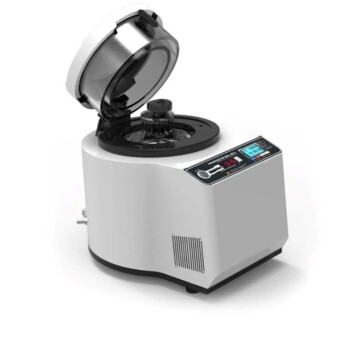
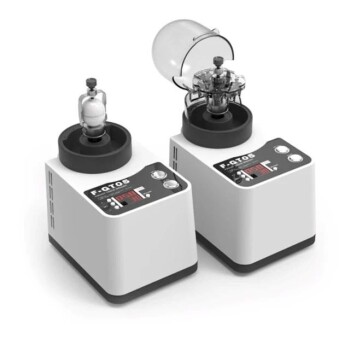
In the solid-state reaction (SSR) synthesis of LLZTO, the high-energy ball mill functions as the primary mechanical activation and homogenization tool. It is responsible for the intense grinding of raw precursor materials—specifically Lithium Carbonate, Lanthanum Oxide, Zirconium Oxide, and Tantalum Oxide—to prepare them for chemical reaction.
Core Takeaway The high-energy ball mill facilitates the solid-state reaction by physically breaking down agglomerates and maximizing the particle contact area. This mechanical refinement creates a highly uniform precursor mixture, which is a strict prerequisite for successful phase formation during the subsequent high-temperature calcination step.
Mechanisms of Action
Particle Refinement
The primary function of the mill is the reduction of particle size. Raw powders often contain large agglomerates that hinder diffusion.
High-energy milling applies impact and shear forces to shatter these clusters. This reduction occurs at the microscopic level, ensuring the raw materials are physically refined.
Increasing Contact Area
Solid-state reactions rely heavily on the diffusion of ions between solid particles.
By pulverizing the material, the mill significantly increases the specific surface area of the powder. This maximized contact area reduces the diffusion distance required between lithium, lanthanum, zirconium, and tantalum particles.
Ensuring Material Homogeneity
Uniform Dispersion
Simple mixing is insufficient for complex oxides like LLZTO.
The high-energy ball mill utilizes high-frequency vibration or rotation to force the different elemental powders into an intimate, homogeneous blend. This prevents localized "hot spots" or reactant depletion zones that would lead to impure secondary phases.
Purity Control via Media Selection
To maintain the integrity of the LLZTO electrolyte, the grinding media itself plays a functional role.
Zirconia (ZrO2) grinding balls are typically employed due to their high hardness and wear resistance. Using zirconia minimizes the introduction of metallic impurities that could degrade the electrochemical performance of the final product.
Understanding the Trade-offs
Contamination Risks
While high-energy milling is effective, it introduces a risk of media wear.
Over-milling or using low-quality grinding jars can introduce foreign debris into the powder. Even with zirconia media, extended milling cycles (e.g., 12+ hours) require monitoring to ensure the "wear" from the balls does not alter the stoichiometry of the batch.
Energy and Structure Balance
The process inputs significant mechanical energy into the powder.
While this energy is necessary to activate the powder for calcination, excessive energy input can lead to unwanted amorphization or aggregation if not carefully controlled. The goal is refinement, not necessarily a complete mechanochemical reaction within the mill itself.
How to Apply This to Your Project
When optimizing your LLZTO synthesis parameters, consider the following:
- If your primary focus is Reactivity: Prioritize milling speed and duration to maximize particle size reduction, ensuring the shortest possible diffusion paths for the calcination step.
- If your primary focus is Purity: Use high-quality zirconia grinding media and optimize for the shortest effective milling time to prevent media wear contamination.
The high-energy ball mill is not just a mixer; it is a mechanical activator that determines the efficiency of your downstream thermal processing.
Summary Table:
| Mechanism | Primary Function | Impact on LLZTO Quality |
|---|---|---|
| Particle Refinement | Breaks agglomerates & reduces size | Decreases diffusion distance for ions |
| Surface Area Increase | Maximizes contact points | Accelerates solid-state reaction kinetics |
| Homogenization | Intimate blending of oxides/carbonates | Prevents localized impurities & secondary phases |
| Mechanical Activation | Inputs energy into precursor powder | Lowers required calcination temperatures |
| Purity Control | Use of Zirconia (ZrO2) media | Minimizes metallic contamination in electrolyte |
Elevate Your Solid-State Battery Research with KINTEK
Precise LLZTO synthesis demands more than just a mixer; it requires high-performance crushing and milling systems that ensure absolute purity and optimal particle refinement. KINTEK specializes in providing the laboratory equipment essential for advanced materials science, including high-energy ball mills, zirconia grinding media, and high-temperature muffle and tube furnaces for subsequent calcination.
Whether you are a researcher optimizing ionic conductivity or a manufacturer scaling up production, our comprehensive range of hydraulic presses, PTFE products, and crucibles supports every stage of your workflow.
Ready to achieve superior phase purity in your LLZTO powders? Contact KINTEK today to find the perfect milling and thermal processing solutions tailored to your laboratory's needs.
Related Products
- High Energy Planetary Ball Mill Milling Machine for Laboratory
- High-Energy Omnidirectional Planetary Ball Mill Milling Machine for Laboratory
- High Energy Planetary Ball Mill for Laboratory Horizontal Tank Type Milling Machine
- High Energy Planetary Ball Mill Machine for Laboratory Horizontal Tank Type
- High Energy Planetary Ball Mill Milling Machine for Laboratory
People Also Ask
- What role do planetary ball mills and zirconia media play in LLZT preparation? Optimize Your Solid Electrolyte Research
- What is the primary function of a planetary ball mill? Mastering SiC/Al Composite Mixing for Homogeneity
- What is the primary purpose of using a planetary ball mill for LAGP? Achieve High-Purity Solid-State Electrolytes
- What role does a planetary ball mill play in the preparation of LGVO powders? Precision Refinement for Aerosol Deposition
- What is the function of a planetary ball mill in the preparation of high-entropy rare earth silicate multi-phase ceramics?