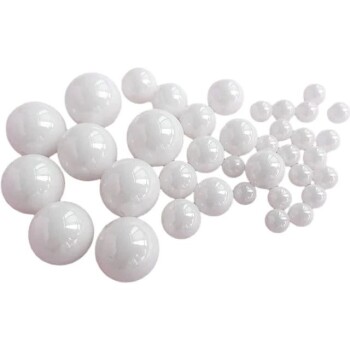
Alumina balls function as the primary mechanical drivers within a horizontal rolling reactor, serving as dense grinding and mixing media. By continuously impacting and rolling against the biomass, they generate significant shear forces that physically break down the barrier between the solid rice husk and the liquid alkaline solution.
The alumina balls act as a mechanical catalyst, transforming a passive soaking process into a high-energy environment. This significantly enhances mass transfer, allowing the chemical solvent to penetrate the dense lignocellulosic matrix and fractionate lignin and hemicellulose much faster than chemical action alone.
The Mechanism of Mechanical Assistance
Generating Physical Shear
In a static reactor, biomass simply floats in the solution. In a horizontal rolling reactor, the alumina balls create dynamic motion. As the reactor rolls, the balls tumble, collide, and slide.
Creating Impact Forces
This movement generates distinct shear forces through physical impact and rolling friction. These forces are applied directly to the rice husk particles suspended in the liquid.
Breaking Down Resistance
The primary goal of this mechanical action is to overcome the structural resistance of the biomass. The physical stress helps disrupt the tough outer layers of the rice husk.
Enhancing Mass Transfer Efficiency
Improving Solid-Liquid Contact
The efficiency of fractionation relies heavily on the interaction between the solid phase (rice husk) and the liquid phase (alkaline solution). The alumina balls ensure these two phases are constantly and vigorously mixed.
Accelerating Matrix Penetration
By constantly agitating the mixture, the balls facilitate the deep penetration of the alkaline solution into the husk's structure. This forces the solvent into the complex lignocellulosic matrix more effectively than simple stirring would.
Speeding Up Dissolution
The combination of physical breakdown and improved solvent contact directly leads to accelerated dissolution. This rapid breakdown is essential for efficiently separating the lignin and hemicellulose from the raw biomass.
Understanding the Operational Dynamics
The Necessity of Motion
It is important to recognize that the alumina balls are effectively useless without the rotation of the reactor. Their ability to generate shear force is entirely dependent on the kinetic energy provided by the rolling mechanism.
Balancing Impact and Chemistry
The process relies on a synergy between mechanical force and chemical solvency. The balls provide the physical access, but the alkaline solution performs the actual molecular fractionation. Both must be present for the system to function as described.
Making the Right Choice for Your Goal
To maximize the efficiency of your fractionation process, consider how mechanical aids align with your objectives:
- If your primary focus is process speed: Utilize alumina balls to drastically reduce reaction time by accelerating the physical breakdown of the biomass structure.
- If your primary focus is extraction yield: Rely on the enhanced mass transfer generated by the balls to ensure the solvent reaches deep into the lignocellulosic matrix, accessing hard-to-reach lignin and hemicellulose.
By integrating alumina balls, you convert a standard chemical extraction into a mechanically enhanced, high-efficiency fractionation process.
Summary Table:
| Function | Description | Impact on Process |
|---|---|---|
| Mechanical Driver | Generates shear forces through tumbling and impact | Breaks down the tough lignocellulosic matrix |
| Mixing Media | Ensures vigorous contact between rice husk and alkaline solution | Eliminates passive soaking; prevents biomass floating |
| Mass Transfer Catalyst | Facilitates deep solvent penetration into biomass pores | Dramatically increases extraction speed and yield |
| Kinetic Energy Source | Converts reactor rotation into physical impact stress | Accelerates dissolution of lignin and hemicellulose |
Optimize Your Biomass Research with KINTEK
Ready to transform your fractionation processes? KINTEK specializes in advanced laboratory solutions designed for high-performance research. From high-density alumina balls and ceramic grinding media to state-of-the-art rolling reactors, crushing systems, and milling equipment, we provide the tools necessary to achieve superior mass transfer and extraction yields.
Whether you are working on biomass fractionation, battery research, or material synthesis, our comprehensive portfolio—including high-temperature reactors, autoclaves, and hydraulic presses—is engineered for precision and durability.
Maximize your lab's potential today. Contact a KINTEK expert to find the perfect equipment and consumables for your specific application.
References
- Hyun Jin Jung, Kyeong Keun Oh. NaOH-Catalyzed Fractionation of Rice Husk Followed by Concomitant Production of Bioethanol and Furfural for Improving Profitability in Biorefinery. DOI: 10.3390/app11167508
This article is also based on technical information from Kintek Solution Knowledge Base .
Related Products
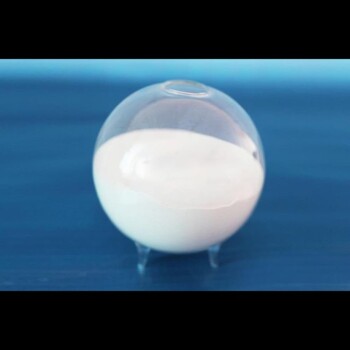
- High Purity Alumina Granulated Powder for Engineering Advanced Fine Ceramics
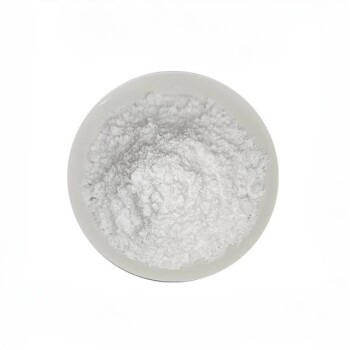
- Advanced Engineering Fine Ceramics Low Temperature Alumina Granulation Powder
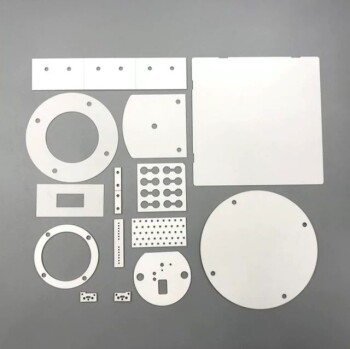
- Custom-Made Alumina Zirconia Special-Shaped Ceramic Plates for Engineering Advanced Fine Ceramics Processing
- High Temperature Wear-Resistant Alumina Al2O3 Plate for Engineering Advanced Fine Ceramics
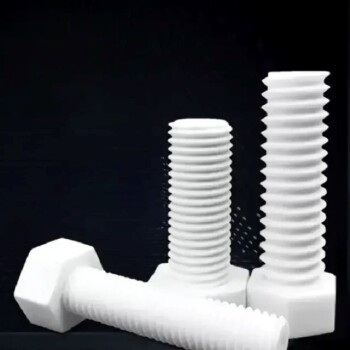
- High Quality Alumina Ceramic Screw for Engineering Advanced Fine Ceramics with High Temperature Resistance and Insulation
People Also Ask
- What is the function of high-purity alumina powder in pack cementation? Ensure Uniform Aerospace Blade Coatings
- How should alumina powder be selected for polishing a disc electrode, and what is the procedure for removing scratches? Achieve a Perfect Mirror Finish
- What are the properties and handling precautions for alumina powder as a polishing material? Achieve a Flawless Finish with Precision
- Why is it necessary to apply alumina powder to graphite molds for TiC10/Cu-Al2O3? Ensure Smooth Release.
- What measures should be taken to prevent cross-contamination when using different sizes of alumina powder?