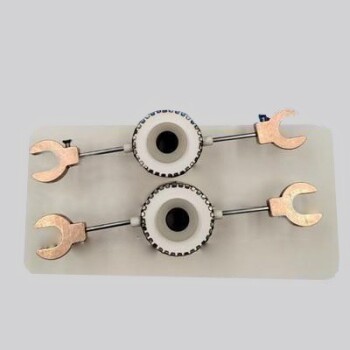
Alumina milling jars serve as the contamination-controlled containment vessels for the critical raw material mixing stage of SiC/B4C composite powder preparation. They house the mixture of boron carbide (B4C) powder, silicon (Si) powder, and ethanol media, creating a chemically stable environment that allows for rigorous mechanical mixing without introducing detrimental metallic impurities.
The use of alumina jars is a strategic choice to prioritize material purity. While the mechanical action ensures the uniform dispersion necessary for high-quality composites, the alumina material specifically prevents the introduction of metal contaminants that would otherwise degrade the ceramic's final properties.
The Mechanics of the Milling Environment
Facilitating Uniform Dispersion
The primary operational function of the alumina jar is to facilitate the homogenization of the powder mixture.
Inside the jar, the mechanical energy—generated by the movement of the jar and grinding media—forces the Silicon and Boron Carbide powders to mix intimately.
This process breaks down agglomerates and ensures that the constituent powders are evenly distributed within the ethanol medium.
Providing Chemical Stability
Alumina (aluminum oxide) provides a chemically inert surface during the milling process.
Unlike metallic containers, alumina does not react with the ethanol solvent or the ceramic powders.
This stability is essential for maintaining the stoichiometry of the SiC/B4C mixture, ensuring that the chemical composition remains consistent from the start of the process to the end.
The Critical Role of Purity Control
Minimizing Metallic Contamination
The most significant advantage of using alumina jars over steel or other metallic alternatives is the elimination of metal wear debris.
In high-performance ceramics, even trace amounts of iron or other metals can act as defects, lowering the melting point or weakening the structural integrity of the final sintered product.
Alumina jars are sufficiently wear-resistant to withstand the abrasion of mixing, ensuring that the "foreign" material introduced into the batch is minimized.
A Moderately Hard Grinding Interface
The primary reference describes the alumina environment as "moderately hard."
This hardness strikes a balance: it is durable enough to contain the abrasive B4C and Si powders effectively, yet it avoids the extreme costs associated with harder liner materials like diamond or cubic boron nitride.
Understanding the Trade-offs
Wear vs. Contamination
While alumina jars prevent metallic contamination, they are not impervious to wear.
Because Boron Carbide (B4C) is harder than alumina, some wear of the jar's inner surface is inevitable over long milling durations.
However, in many ceramic processing contexts, a small amount of aluminum oxide contamination is considered a "compatible" impurity—far less detrimental to the sintering process than metallic iron or nickel would be.
Efficiency Limitations
Alumina is lighter and less dense than materials like tungsten carbide or steel.
If the milling media (balls) are also alumina, the kinetic energy delivered during impacts may be lower than with heavier media.
This may require longer milling times to achieve the same level of particle refinement and dispersion compared to higher-density systems.
Making the Right Choice for Your Project
To determine if alumina milling jars are the correct tool for your specific composite preparation, consider your performance requirements.
- If your primary focus is electrical and structural purity: Choose alumina jars to strictly eliminate conductive metallic impurities that could compromise the dielectric strength or high-temperature performance of the ceramic.
- If your primary focus is budget and general homogenization: Utilize alumina as a cost-effective, high-wear-resistance solution that provides adequate durability for standard mixing durations without the expense of exotic liners.
Select alumina when the integrity of the ceramic chemistry is as critical as the physical blending of the powders.
Summary Table:
| Feature | Function in SiC/B4C Preparation |
|---|---|
| Material | High-purity Aluminum Oxide (Alumina) |
| Primary Role | Contamination-controlled containment & homogenization |
| Contamination Control | Eliminates metallic iron/nickel impurities |
| Chemical Stability | Inert to ethanol solvents and ceramic powders |
| Mechanical Benefit | Breaks down agglomerates for uniform dispersion |
| Hardness Balance | Durable enough for abrasive Si/B4C mixing |
Elevate Your Advanced Ceramic Processing with KINTEK
Precision in material preparation is the foundation of high-performance ceramics. KINTEK specializes in providing the high-quality laboratory equipment and consumables necessary for rigorous research and production. Whether you are developing SiC/B4C composites or advanced semiconductors, our comprehensive range of alumina milling jars, crushing and milling systems, and high-purity crucibles ensures your materials remain free from detrimental contaminants.
From high-temperature furnaces (muffle, vacuum, CVD) for sintering to hydraulic presses and planetary ball mills, KINTEK provides the tools needed to maintain stoichiometry and structural integrity.
Ready to optimize your powder preparation workflow? Contact our experts today to find the perfect milling solutions for your lab’s specific requirements.
Related Products
- Laboratory Jar Ball Mill with Alumina Zirconia Grinding Jar and Balls
- Laboratory Jar Mill with Agate Grinding Jar and Balls
- Laboratory Ball Mill Jar Mill with Metal Alloy Grinding Jar and Balls
- Laboratory Single Horizontal Jar Mill
- Laboratory Micro Horizontal Jar Mill for Precision Sample Preparation in Research and Analysis
People Also Ask
- What are the primary functions of using a ball mill for BZCY72 powder? Achieve High Purity and Enhanced Sintering
- In what way does a laboratory ball mill affect material properties when modifying PHBV/pulp fiber composites?
- Why is a laboratory ball mill required for ultra-fine fly ash? Unlock Nano-Scale Adsorption Power
- What is the function of a laboratory ball mill in the preparation of AMMCs? Optimize Dispersion & Grain Refinement
- What is the function of a laboratory ball mill in the pretreatment of waste tire char (WTC)? Optimize Material Reactivity