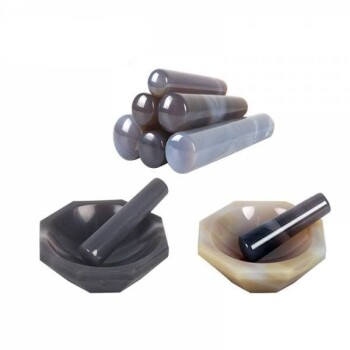
The function of an agate mortar and pestle in this specific context is to physically blend the raw powders—Li2CO3, Al2O3, TiO2, and (NH4)2HPO4—into a homogeneous mixture while strictly preventing contamination. Unlike softer grinding tools, agate provides a mechanism to mix these precursors without shedding material into the sample.
The core value of using agate lies in its material properties: its extreme hardness and wear resistance prevent the introduction of metallic impurities during the mixing process, preserving the high chemical purity required for LATP glass-ceramic synthesis.
Preserving Chemical Purity
The mixing stage is critical because the quality of the final glass-ceramic is dictated by the purity of the precursor mixture.
The Risk of Metallic Contamination
Standard laboratory mixing tools, particularly those made of metal or softer ceramics, are prone to abrasion.
As powders are ground and mixed, microscopic particles from the tool can shear off and contaminate the batch.
For LATP (Lithium Aluminum Titanium Phosphate) synthesis, even trace metallic impurities can alter the material's final electrochemical properties.
The Agate Advantage
Agate is a naturally hard silica mineral with exceptional wear resistance.
When used to mix abrasive powders like Al2O3 and TiO2, the agate surface does not degrade.
This ensures that the stoichiometry of your mixture remains exactly as calculated, containing only the intended reactants: Li2CO3, Al2O3, TiO2, and (NH4)2HPO4.
Mechanical Mixing Efficiency
Beyond purity, the mortar and pestle provide the physical force necessary to create a uniform blend.
Homogenization of Precursors
The manual grinding action ensures that the four distinct powders are intimately mixed.
This proximity is vital for the subsequent solid-state reaction or melting steps, ensuring the elements react evenly throughout the batch.
Particle Size Reduction
While the primary goal is mixing, the pestle also helps break down agglomerates in the raw powders.
This results in a finer, more uniform powder bed, which facilitates more consistent reaction kinetics during heat treatment.
Operational Considerations
While agate is the superior choice for purity, there are practical considerations to keep in mind regarding this equipment.
Scalability Limits
Using a mortar and pestle is a manual, labor-intensive process.
It is highly effective for small-batch laboratory synthesis but is not suitable for large-scale industrial production without mechanization (e.g., agate ball milling).
Maintenance of the Surface
Although agate is hard, it is brittle and must be handled with care to avoid chipping.
Furthermore, the surface must be meticulously cleaned between different experiments to prevent cross-contamination from previous batches, which would negate the purity benefits.
Application for Your Project
To ensure the best results for your LATP glass-ceramic synthesis, prioritize your equipment based on your purity requirements.
- If your primary focus is high electrochemical performance: Use the agate mortar and pestle exclusively to eliminate the variable of metallic contamination.
- If your primary focus is experimental consistency: Ensure the grinding duration and force are standardized, as manual mixing can vary between operators.
The choice of agate is not merely about mixing; it is a quality control measure to guarantee the chemical integrity of your final material.
Summary Table:
| Feature | Benefit for LATP Synthesis |
|---|---|
| High Hardness | Prevents abrasion and material shedding during mixing |
| Chemical Inertness | Ensures no metallic impurities alter electrochemical properties |
| Manual Control | Allows for effective de-agglomeration of precursor powders |
| Wear Resistance | Maintains long-term tool integrity against abrasive Al2O3 and TiO2 |
Elevate Your Material Research with KINTEK Precision
Achieve the highest chemical purity in your LATP glass-ceramic synthesis with KINTEK’s premium agate mortars and pestles. Beyond our specialized grinding tools, we offer a comprehensive suite of laboratory equipment, including high-temperature furnaces, planetary ball mills, and hydraulic pellet presses designed specifically for battery research and advanced ceramic processing.
Don't let metallic contamination compromise your electrochemical performance. From high-purity ceramics and crucibles to professional crushing and milling systems, KINTEK provides the tools you need for consistent, reliable results.
Ready to optimize your lab's performance? Contact KINTEK today for a customized solution!
Related Products
- Nature Agate Mortar and Pestle for Grinding and Mixing
- Laboratory Jar Mill with Agate Grinding Jar and Balls
People Also Ask
- Why are agate mortars and pestles used for grinding iron oxide? Ensure Sample Purity for XRD Analysis
- What is the function of an agate mortar and pestle? Ensure Purity in Halide Solid-State Electrolyte Synthesis
- What is the primary function of an agate mortar and pestle? Optimize VO2+ CaZn2(PO4)2 Nanopowder Pre-Treatment
- Why is an agate mortar and pestle required for grinding Zr3(Al1-xSix)C2? Ensure Maximum Sample Purity
- Why is an agate mortar and pestle preferred for grinding MAX phase? Ensure Sample Purity & Zero Contamination