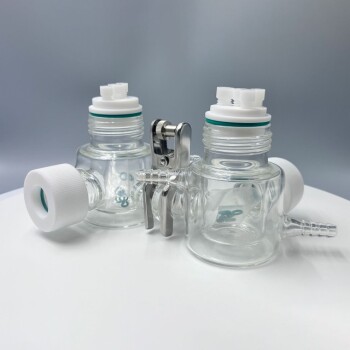
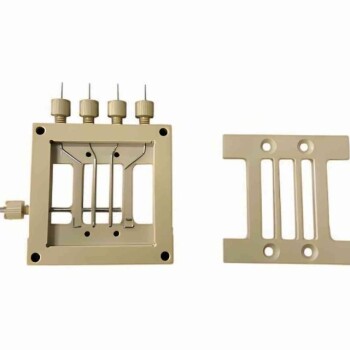
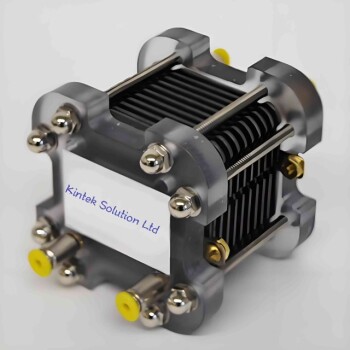
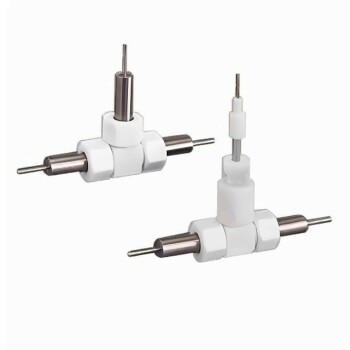
The primary function of an electrolytic cell in a tritium measurement system is to serve as an isotopic concentrator. By adding electrolytes and applying direct current to a water sample, the cell selectively breaks down and removes ordinary water molecules while retaining heavier tritium molecules. This process significantly increases the specific radioactivity of the remaining sample, making low-level tritium detectable by standard instruments.
By exploiting the difference in electrolysis rates between light and heavy isotopes, the cell achieves a tritium concentration factor of 10 to 15 times. This enrichment is the critical step that lowers the detection limit enough for liquid scintillation counters to measure low-level radioactivity.
The Mechanics of Isotopic Enrichment
Utilizing Differential Electrolysis Rates
The core principle behind the electrolytic cell is the difference in electrolysis rates between isotopes. When direct current is applied to the water sample, light hydrogen (ordinary water) electrolyzes and turns into gas more readily than heavy hydrogen (tritium).
Because the lighter isotopes evolve faster, they are removed from the system as gas. The heavier tritium isotopes are left behind in the liquid phase.
Separation Coefficients
This process relies on the "separation coefficient" between hydrogen and oxygen isotopes. The cell creates an environment where this coefficient favors the retention of tritium.
As the process continues, the tritium becomes increasingly concentrated within the residual liquid.
Significant Volume Reduction
To achieve enrichment, the cell physically reduces the volume of the water sample. The process converts the majority of the water into hydrogen and oxygen gas, which is vented away.
The result is a much smaller final sample volume containing nearly all the original tritium. This volume reduction is directly proportional to the enrichment factor.
The Role in Radioactivity Measurement
Lowering Detection Limits
The ultimate goal of the electrolytic cell is to lower the detection limit of the analysis. Environmental tritium levels are often too low for direct measurement.
By increasing the concentration of tritium by a factor of 10 to 15, the cell boosts the signal of the sample.
Enabling Liquid Scintillation Counting
Liquid scintillation counters are precise, but they have a minimum sensitivity threshold. The electrolytic cell bridges the gap between trace environmental levels and this threshold.
Once the sample is enriched, it can be transferred to the counter for precise radioactivity measurement.
Understanding the Process Constraints
Requirement for Electrolytes
Electrolysis cannot occur effectively in pure water. To facilitate the flow of current and the separation process, electrolytes must be added to the sample inside the cell.
This makes the chemical composition of the sample a critical variable in the enrichment process.
Sample Consumption
This is a destructive concentration method regarding volume. You must start with a large volume of water to end up with a small, highly concentrated sample.
This volume loss is a necessary trade-off to achieve the required sensitivity for low-level detection.
Optimizing Your Measurement Strategy
Depending on the specific requirements of your analysis, understanding the role of the electrolytic cell helps in planning your workflow.
- If your primary focus is environmental monitoring: The cell is essential for detecting background levels of tritium that fall below standard instrument sensitivity.
- If your primary focus is rapid screening: You may wish to bypass this step, as electrolytic enrichment is a time-consuming process reserved for high-precision, low-level quantification.
The electrolytic cell effectively amplifies the "signal" of tritium within a water sample, transforming an undetectable trace into a measurable data point.
Summary Table:
| Feature | Function in Tritium Enrichment |
|---|---|
| Core Mechanism | Differential electrolysis rates (light vs. heavy hydrogen) |
| Enrichment Factor | Typically 10 to 15 times the original concentration |
| Process Goal | Lower detection limits for liquid scintillation counters |
| Key Outcome | Drastic volume reduction with high tritium retention |
| Requirement | Addition of electrolytes to facilitate current flow |
Elevate Your Low-Level Tritium Analysis with KINTEK
Precise radioactivity measurement starts with superior enrichment tools. At KINTEK, we specialize in high-performance laboratory solutions tailored for specialized research environments. Whether you are conducting environmental monitoring or nuclear research, our comprehensive range of electrolytic cells and electrodes, high-purity consumables, and precision lab equipment ensures your samples meet the most rigorous sensitivity thresholds.
Why choose KINTEK?
- Expertise in Isotopics: Specialized electrodes designed for efficient electrolytic separation.
- Comprehensive Lab Support: From high-temperature furnaces and hydraulic presses to PTFE consumables and cooling solutions, we provide the full ecosystem for your research.
- Precision Guaranteed: Our tools are engineered to lower detection limits and improve data accuracy.
Ready to optimize your enrichment workflow? Contact us today to discuss your project requirements!
References
- Damian Komar, V. A. Antonov. Spectrometric gamma radiation detection units based on high-resolution crystals SrI 2(Eu) and LaBr3(Ce). DOI: 10.21175/rad.abstr.book.2023.32.15
This article is also based on technical information from Kintek Solution Knowledge Base .
Related Products
- H Type Electrolytic Cell Triple Electrochemical Cell
- PTFE Electrolytic Cell Electrochemical Cell Corrosion-Resistant Sealed and Non-Sealed
- Electrolytic Electrochemical Cell for Coating Evaluation
- Quartz Electrolytic Electrochemical Cell for Electrochemical Experiments
- Customizable PEM Electrolysis Cells for Diverse Research Applications
People Also Ask
- What is a H type cell? A Guide to Divided Electrochemical Cells for Accurate Experiments
- How should the electrolyte be prepared and added to the H-type electrolytic cell? Best Practices for Purity and Safety
- What is the technical necessity of using an H-type electrolytic cell for NO3RR tests? Protect Your Ammonia Yields
- How does the design of an H-type electrolytic cell benefit the neutral water electrolysis process for metal recovery?
- What is the primary function of an H-type electrolytic cell in NitRR? Ensure Accurate Product Yields