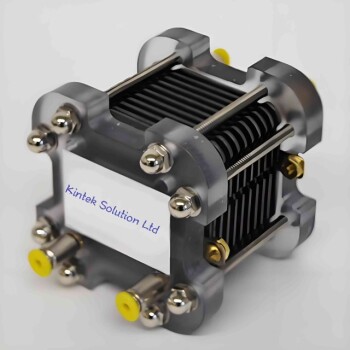
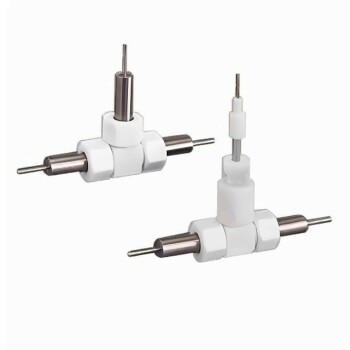
An in-situ spectro-electrochemical cell serves as a real-time observation window into the active chemistry of a battery. It functions as a specialized reaction container designed to allow analytical probes—such as those from X-ray diffractometers (XRD) or Raman spectrometers—to directly interact with the electrode surface while the battery undergoes charge and discharge cycles.
By enabling the continuous monitoring of the formation and decomposition of products like lithium carbonate (Li2CO3), this technology allows researchers to move beyond static snapshots and observe the dynamic electrochemical reaction mechanisms as they happen.
The Mechanics of Real-Time Observation
Breaking the "Black Box"
Standard battery testing often treats the cell as a "black box," measuring only external output. An in-situ cell changes this by physically accommodating external instruments.
It provides a line of sight or a pathway for signals to reach the electrode surface without disrupting the sealed internal environment necessary for the battery to operate.
Integration with Analytical Tools
This cell design is specifically engineered to pair with high-precision instruments.
The primary reference highlights X-ray diffractometers (XRD) and Raman spectrometers as the key tools used. These instruments direct energy (X-rays or laser light) onto the electrode to gather data on the material's structure and composition.
Analyzing Li-CO2 Chemistry
Tracking Reaction Products
The primary function of this setup in Li-CO2 research is to verify the existence and behavior of specific chemical compounds.
The most critical product monitored is lithium carbonate (Li2CO3). The cell allows researchers to confirm when this compound forms and exactly how it behaves during the battery's operation.
Monitoring Formation and Decomposition
Crucially, the cell allows for the observation of reversibility.
Researchers use the cell to watch Li2CO3 form during discharge and, more importantly, track its decomposition during the charge cycle. This confirms whether the battery chemistry is functioning as intended.
The Scientific Value: Revealing Mechanisms
Moving Beyond Post-Mortem Analysis
Without in-situ technology, researchers typically must disassemble a battery after it has died to study the electrodes.
This "post-mortem" approach only provides a snapshot of the end state. It fails to capture intermediate steps or unstable species that exist only while current is flowing.
Uncovering the "How"
The in-situ spectro-electrochemical cell solves the temporal problem.
By correlating the spectroscopic data (the chemical "fingerprints") with the electrochemical data (voltage and current), scientists can map out the exact reaction mechanisms driving the battery's performance.
Operational Considerations
The Necessity of Specialized Hardware
It is important to recognize that this is not a standard off-the-shelf battery case.
The cell is a specialized reaction container. It must be robust enough to hold the battery components securely while simultaneously remaining "open" to analytical probes.
Data Fidelity
The quality of insights depends entirely on the cell's ability to maintain a stable environment.
If the probe interface interferes with the electrochemical reaction, the data may be compromised. Therefore, the cell's design is as critical as the analytical instruments themselves.
Making the Right Choice for Your Research
If you are designing a study on Li-CO2 battery performance, consider your specific analytical needs:
- If your primary focus is confirming reaction reversibility: Use this cell to prove that Li2CO3 physically decomposes during the charging phase, rather than just assuming it based on voltage curves.
- If your primary focus is defining the reaction pathway: Use the cell to capture intermediate states of product formation that would be lost in a post-mortem analysis.
Ultimately, the in-situ spectro-electrochemical cell is the definitive tool for proving the chemical reality behind electrical performance.
Summary Table:
| Feature | In-Situ Spectro-Electrochemical Cell Function |
|---|---|
| Core Purpose | Real-time observation of dynamic electrochemical reactions |
| Key Probes | Compatible with XRD (X-ray diffraction) and Raman spectroscopy |
| Target Compound | Monitoring Lithium Carbonate (Li2CO3) formation/decomposition |
| Data Advantage | Captures intermediate states lost in post-mortem analysis |
| Scientific Value | Maps reaction mechanisms by correlating chemical & electrical data |
Elevate Your Battery Research with KINTEK Precision
Unlock the full potential of your Li-CO2 and advanced battery studies with KINTEK’s specialized laboratory solutions. From high-performance in-situ electrolytic cells and electrodes to essential battery research tools, our equipment is designed to bridge the gap between electrical output and chemical reality.
Whether you require high-temperature furnaces, vacuum systems, or precision hydraulic presses for pellet preparation, KINTEK provides the robust hardware necessary for cutting-edge material science. Don't settle for 'black box' data—gain the clarity your research deserves.
Ready to optimize your lab setup? Contact our technical experts today to find the perfect tools for your specific application!
Related Products
- Thin-Layer Spectral Electrolysis Electrochemical Cell
- Side Window Optical Electrolytic Electrochemical Cell
- Electrolytic Electrochemical Cell for Coating Evaluation
- Electrolytic Electrochemical Cell with Five-Port
- PTFE Electrolytic Cell Electrochemical Cell Corrosion-Resistant Sealed and Non-Sealed
People Also Ask
- What are the recommended post-experiment procedures for cleaning and storing the thin-layer spectroelectrochemical cell?
- What preparation steps are required before initiating an experiment with the thin-layer spectroelectrochemical cell?
- What operational environments and sealing options are available for the thin-layer spectroelectrochemical cell?
- For what types of systems, temperature ranges, and sealing configurations is the thin-layer spectroelectrochemical cell designed? Ideal for Aqueous and Non-Aqueous Analysis
- What are the necessary preparation steps before using a thin-layer spectroelectrochemical cell? A Guide to Reliable Results