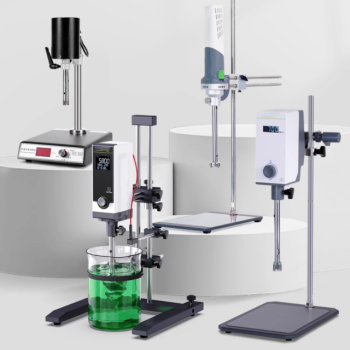
The primary function of an ultrasonic homogenizer is to forcefully disperse aluminum oxide nanoparticles (Al2O3NPs) within deionized water to create a uniform suspension. By leveraging high-frequency vibrations, the device generates a physical phenomenon known as cavitation, which breaks apart the particle clusters that naturally form during the preparation process.
Core Takeaway: Nanoparticles naturally clump together due to van der Waals forces, which invalidates experimental data. An ultrasonic homogenizer provides the necessary energy to disrupt these forces, ensuring the stable, high-concentration dispersion required for accurate toxicity studies.
The Mechanism of Action
The Cavitation Effect
The ultrasonic homogenizer operates by generating high-frequency vibrations within the liquid. These vibrations create microscopic bubbles that rapidly expand and collapse.
This process is called cavitation. When these bubbles collapse, they release intense energy that acts as a physical hammer against the suspended particles.
Breaking van der Waals Forces
Aluminum oxide nanoparticles do not naturally float as separate entities; they are drawn together by van der Waals forces. These attractive forces cause the particles to form large aggregates or clumps.
The energy released by the cavitation effect is strong enough to overcome these attractive forces. This effectively shatters the aggregates, returning the nanoparticles to individual units dispersed throughout the water.
Why Homogenization is Critical for Experiments
Achieving Uniform Dispersion
For any scientific application, particularly biological exposure, the solution must be consistent. If the particles remain aggregated, the solution is not a true suspension but a mixture of water and heavy clumps.
The homogenizer ensures uniform dispersion, meaning the concentration of nanoparticles is consistent throughout the entire volume of the liquid.
Ensuring Experimental Accuracy
The primary reference highlights the necessity of this process for toxicity exposure experiments.
If a stock solution contains aggregates, the dosage measurement will be incorrect. Homogenization creates the stable, high-concentration stock solutions required to ensure that toxicity data is accurate and reproducible.
Understanding the Trade-offs
The Necessity of Optimization
Using an ultrasonic homogenizer is not a "set it and forget it" process. The reference notes the importance of applying specific power levels and durations.
Balancing Power and Stability
If the power is too low or the duration too short, the van der Waals forces will remain dominant, and the solution will remain clumped.
Conversely, parameters must be carefully tuned to achieve stability without unnecessary processing. Success relies on finding the precise settings that yield a stable suspension for your specific concentration.
Making the Right Choice for Your Goal
To ensure your aluminum oxide nanoparticle suspensions yield valid data, consider the following based on your specific objectives:
- If your primary focus is Solution Stability: Prioritize finding the specific power duration that fully disrupts van der Waals forces to prevent immediate re-aggregation.
- If your primary focus is Toxicity Research: Verify that your homogenization process yields a uniform dispersion, as stock solution consistency directly correlates to the accuracy of your exposure results.
Mastering the ultrasonic homogenization process is the single most critical step in converting raw nanoparticle powder into a scientifically usable variable.
Summary Table:
| Feature | Function in Al2O3 Suspension Preparation |
|---|---|
| Core Mechanism | Cavitation via high-frequency ultrasonic vibrations |
| Physical Impact | Overcomes van der Waals forces to break particle aggregates |
| Primary Result | Achieves uniform, high-concentration nanoparticle dispersion |
| Critical Benefit | Ensures dose accuracy and reproducibility in toxicity studies |
| Optimization | Requires precise tuning of power levels and processing duration |
Elevate Your Nanotechnology Research with KINTEK Precision
Achieving consistent nanoparticle dispersion is the foundation of reliable scientific data. KINTEK specializes in advanced laboratory solutions, offering high-performance ultrasonic homogenizers, shakers, and cooling solutions designed to handle the most demanding suspension protocols.
Whether you are conducting toxicity studies or developing advanced materials, our equipment ensures your Al2O3NPs remain stable and uniform. From high-temperature furnaces and reactors to essential consumables like PTFE and ceramics, KINTEK provides the comprehensive tools your lab needs for excellence.
Ready to optimize your dispersion process? Contact KINTEK today for expert guidance and high-quality lab equipment!
References
- Nina Doskocz, Monika Załęska‐Radziwiłł. Molecular Response of Bacteria Exposed to Wastewater-Borne Nanoparticles. DOI: 10.3390/app15147746
This article is also based on technical information from Kintek Solution Knowledge Base .
Related Products
- High Shear Homogenizer for Pharmaceutical and Cosmetic Applications
- High Performance Lab Homogenizer for Pharma Cosmetics and Food R&D
- Lab Sterile Slapping Type Homogenizer for Tissue Mashing and Dispersing
- Laboratory High Throughput Tissue Grinding Mill Grinder
- Laboratory Disc Rotary Mixer for Efficient Sample Mixing and Homogenization
People Also Ask
- Why Use a High Shear Homogenizer for Cathode Slurries? Optimize Double-Layer Solid-State Battery Production
- What is the function of high-shear dispersion equipment in corona-resistant nanocomposites? Elevate Your Insulation
- What is the necessity of using an industrial-grade high-shear homogenizer for biomass washing? Ensure Process Efficiency
- What are the advantages of using a high-shear homogenizer for BED/GMA coatings? Achieve Superior Nano-Dispersion
- What role does a high-shear homogenizer play in ODC catalyst suspensions? Unlock Superior Electrochemical Efficiency