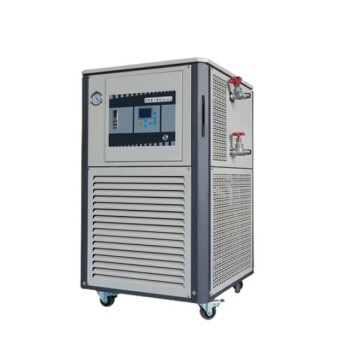
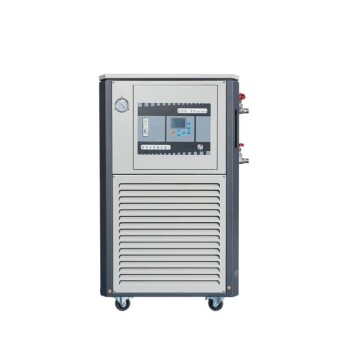
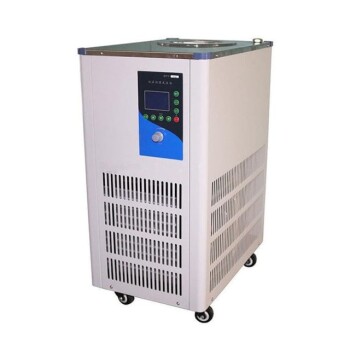
Precise thermal control is the determining factor for the chemical efficacy of alkaline activation. A Thermostatic Reaction Vessel is necessary to maintain specific temperatures, such as 120°C, which drive essential mineral transformations and surface cleaning mechanisms required for successful leaching.
The vessel's primary function is to enable the conversion of aragonite to calcite and the release of chloride ions. Without this controlled thermal environment, physical barriers remain on niobium components, inhibiting the downstream alkaline leaching process.
The Role of Thermal Precision in Activation
The necessity of the Thermostatic Reaction Vessel lies in its ability to hold the chemical environment at a steady state.
This stability is not merely about heating; it is about reaching and maintaining the exact energy threshold required for specific phase changes.
Driving Mineral Transformation
The activation process relies on converting calcium carbonate from one form to another.
Specifically, the system facilitates the transformation of aragonite into calcite.
This structural change is temperature-dependent and occurs optimally within a controlled environment, such as at 120°C.
Facilitating Ion Migration
Beyond structural changes, the thermal environment dictates chemical solubility.
The maintained temperature allows chloride ions to effectively exit the solid matrix and enter the solution.
This migration is essential for altering the chemical composition of the waste material.
Surface Preparation and Cleaning
The ultimate goal of using a thermostatic system is to modify the surface properties of the material.
If the surface is not properly prepared, subsequent processing steps will fail.
Cleansing Niobium Components
The reaction vessel provides the conditions necessary to cleanse the surface of niobium components found within the waste.
This cleaning process removes contaminants and physical obstructions that naturally adhere to the material.
Removing Physical Barriers
The primary justification for this equipment is the removal of physical barriers.
By converting minerals and solubilizing ions, the vessel ensures that the material is exposed and reactive.
This preparation is a prerequisite for the next stage: alkaline leaching.
Risks of Inadequate Temperature Control
Understanding the necessity of this vessel requires looking at the risks of using uncontrolled heating methods.
Incomplete Phase Conversion
Without a thermostatic system, temperature fluctuations can interrupt the aragonite-to-calcite transformation.
Incomplete conversion leaves the material chemically stable and resistant to activation, rendering the process inefficient.
Persistent Surface Blockages
If the specific temperature (e.g., 120°C) is not maintained, chloride ions may not fully enter the solution.
This results in uncleansed surfaces on niobium components.
These remaining physical barriers will block the chemical agents used in subsequent leaching, leading to poor extraction rates.
Optimizing Your Activation Process
To ensure the success of your titanium-magnesium waste treatment, focus on the specific parameters your vessel must maintain.
- If your primary focus is Phase Transformation: Ensure your vessel can maintain a strict 120°C setpoint to drive the full conversion of aragonite to calcite.
- If your primary focus is Leaching Efficiency: Prioritize thermal stability to guarantee the removal of physical barriers from niobium surfaces before the leaching stage begins.
The Thermostatic Reaction Vessel is the critical enabler that turns a simple heating step into a precise chemical activation capable of unlocking valuable materials.
Summary Table:
| Feature | Function in Alkaline Activation | Benefit for Titanium-Magnesium Waste |
|---|---|---|
| Precise Thermal Control | Maintains constant 120°C setpoint | Ensures 100% conversion of aragonite to calcite |
| Phase Stability | Facilitates mineral transformation | Removes physical barriers from niobium components |
| Ion Migration | Enables chloride ions to enter solution | Cleanses surfaces for downstream leaching efficiency |
| Reaction Vessel Design | Provides a controlled chemical environment | Prevents incomplete activation and extraction loss |
Optimize Your Chemical Activation with KINTEK Precision
Don't let inadequate temperature control compromise your recovery rates. KINTEK specializes in high-performance laboratory equipment, providing the precision needed for complex mineral transformations. Whether you are processing titanium-magnesium waste or conducting advanced material research, our comprehensive range of high-temperature high-pressure reactors, autoclaves, and thermostatic vessels ensures consistent, reliable results.
From crushing and milling systems for initial preparation to sophisticated electrolytic cells and furnace solutions, KINTEK delivers the durability and thermal stability your lab requires. Empower your research and industrial processing today.
Contact KINTEK for a Professional Consultation
References
- Almagul Ultarakova, P.C. Burns. Studies for hydrometallurgical processing of titanium-magnesium production sludge with niobium extraction in solution. DOI: 10.31643/2023/6445.18
This article is also based on technical information from Kintek Solution Knowledge Base .
Related Products
- Customizable High Pressure Reactors for Advanced Scientific and Industrial Applications
- Stainless High Pressure Autoclave Reactor Laboratory Pressure Reactor
- Custom PTFE Teflon Parts Manufacturer for Three-Necked Round Bottom Flask
- High Purity Pure Graphite Crucible for Evaporation
- Carbon Graphite Boat -Laboratory Tube Furnace with Cover
People Also Ask
- What is the function of high-pressure reactors in the synthesis of MFI-type zeolites? Master Dry Gel Conversion.
- Graphene Fiber Synthesis: Key High-Pressure Reactor Processing Conditions Explained
- What is the primary function of a high-pressure reactor in NiMoO4 preparation? Optimize Hydrothermal Catalyst Synthesis
- What reactor is used for high pressure reactions? Select the Right Autoclave for Your Lab
- What are the hazards of high pressure reactors? A Guide to Managing Explosive Risks