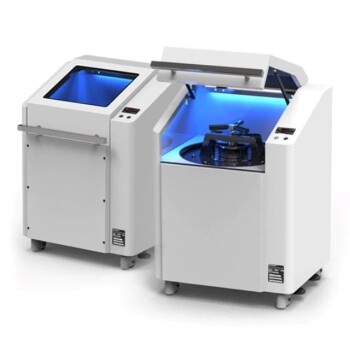
The use of an ultrasonic cleaner with acetone and ethanol is a mandatory surface preparation step to ensure coating survival. It is necessary to aggressively strip the M42 high-speed steel substrate of grease, dust, and microscopic contaminants. This specific cleaning regimen is the only reliable way to expose the raw substrate material, which is the absolute baseline requirement for successful sputtering.
Core Takeaway Reliable thin-film deposition depends entirely on the interface between the coating and the substrate. Skipping ultrasonic cleaning leaves microscopic barriers of oil or dust that prevent physical adhesion, inevitably causing the coating to peel during the high-energy sputtering process or while the tool is in service.
The Mechanics of Decontamination
The Power of the Cavitation Effect
Ultrasonic cleaners do not merely rinse the material; they utilize high-energy impact force.
Sound waves create microscopic bubbles in the liquid that collapse violently against the surface of the M42 steel. This phenomenon, known as cavitation, physically blasts away stubborn contaminants that simple soaking cannot remove.
The Role of Organic Solvents
The mechanical action of the ultrasonic machine is paired with the chemical action of acetone and ethanol.
These specific organic solvents are chosen for their ability to dissolve grease and oils common in metal manufacturing. While the solvents break down the chemical bonds of the contaminants, the ultrasonic energy dislodges them from the surface.
Why Adhesion Depends on Cleanliness
Removing the "Invisible" Barrier
For a sputtered film to stick, the atoms must bond directly to the M42 steel lattice.
Grease, dust, and oxides act as an intermediate layer. If these are present, the sputtered atoms bond to the contaminant rather than the steel.
Ensuring Physical Adhesion
The primary reference emphasizes that thorough cleaning is a prerequisite for strong physical adhesion.
Without this direct contact, the bond strength is significantly compromised. This structural weakness makes the coating susceptible to mechanical failure.
The Risks of Inadequate Preparation
Immediate Process Failure
Sputtering is a high-energy process.
If the surface is not pristine, the stress of the deposition itself can cause the coating to detach. This leads to coating peeling inside the vacuum chamber before the product is even finished.
Service Life Reduction
Even if a poorly cleaned part looks acceptable initially, it will likely fail under stress.
M42 high-speed steel is typically used in demanding applications. Under service conditions, the weak adhesion caused by residual contaminants will lead to rapid delamination and tool failure.
Making the Right Choice for Your Goal
To ensure your sputtering process yields high-quality, durable coatings on M42 steel, strictly adhere to this cleaning protocol.
- If your primary focus is Adhesion Strength: You must treat ultrasonic cleaning with solvents as a critical manufacturing step, not just a rinsing phase, to remove all barriers between the film and substrate.
- If your primary focus is Process Reliability: You must standardize the cleaning duration and solvent quality to prevent batch failures caused by peeling during the sputtering cycle.
A pristine surface is the single most important variable in achieving a coating that remains intact under high-stress conditions.
Summary Table:
| Step | Agent/Process | Primary Function |
|---|---|---|
| Chemical Dissolution | Acetone & Ethanol | Dissolves oils, grease, and organic manufacturing residues. |
| Mechanical Action | Cavitation Effect | Blasts away microscopic dust and stubborn particles via collapsing bubbles. |
| Surface Preparation | Raw Substrate Exposure | Removes the invisible barrier between M42 steel and sputtered atoms. |
| Quality Assurance | Adhesion Strengthening | Prevents coating delamination and premature tool failure during service. |
Elevate Your Coating Precision with KINTEK
Don't let microscopic contaminants compromise your sputtering results. At KINTEK, we understand that high-performance thin films on M42 high-speed steel require the highest standards of surface preparation.
Our comprehensive range of ultrasonic cleaners and laboratory consumables—including precision cleaning tools and high-purity ceramics—is designed to ensure your substrates are pristine and ready for deposition. Whether you are performing battery research, utilizing our PVD/CVD solutions, or requiring robust crushing and milling systems to prepare your samples, KINTEK provides the reliability your lab demands.
Ready to ensure maximum adhesion and process reliability? Contact our experts today to find the perfect equipment for your high-energy deposition needs!
References
- А. E. Litvinov, Etibar Balaev. Parameters of protective carbon films applied on high-speed steels M42 via magnetronic sputtering. DOI: 10.17580/cisisr.2023.01.17
This article is also based on technical information from Kintek Solution Knowledge Base .
Related Products
- Laboratory Sterilizer Lab Autoclave Pulsating Vacuum Desktop Steam Sterilizer
- Laboratory Oscillating Orbital Shaker
- Custom PTFE Teflon Parts Manufacturer Corrosion Resistant Cleaning Rack Flower Basket
- Laboratory Scientific Electric Heating Blast Drying Oven
- Portable High Pressure Laboratory Autoclave Steam Sterilizer for Lab Use
People Also Ask
- What is the primary function of a laboratory sterilization autoclave? Master the Physics of Wet Heat Sterilization
- In what industries and applications are steam sterilizers or autoclaves used? Discover Key Uses Across 4 Major Sectors
- What precautions should be taken during autoclave in laboratory? A Complete Safety Guide to Prevent Burns and Explosions
- What extreme conditions does a laboratory autoclave simulate? Testing Wear Resistance of Nuclear Fuel Cladding
- What role does a laboratory autoclave play in HEA corrosion research? Key to Validating Advanced Reactor Materials