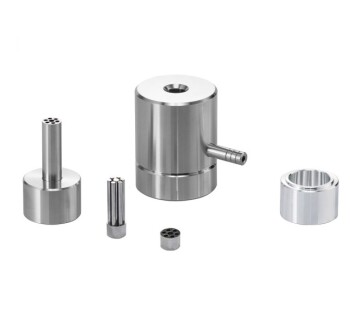
The primary function of a high-pressure reactor in this context is to establish and maintain a strictly controlled environment that forces carbon dioxide into a supercritical state. By achieving specific temperature and pressure thresholds, the reactor allows the CO2 to act as both a solvent and a physical foaming agent, penetrating the Polycaprolactone (PCL) matrix to prepare it for expansion.
The reactor is the critical vessel that enables the phase transition of CO2 by holding conditions above $T_c=31^\circ\text{C}$ and $P_c=7.38\text{ MPa}$. This facilitates the saturation of the polymer and allows for rapid depressurization, which is the mechanism that generates the microcellular foam structure.
Enabling the Supercritical State
To understand the reactor's role, one must understand the state of the foaming agent. The reactor allows the process to bypass standard gaseous or liquid states.
Reaching the Critical Threshold
The reactor creates an environment where temperature exceeds 31°C and pressure exceeds 7.38 MPa. These are the critical points required to transform standard carbon dioxide into Supercritical Carbon Dioxide (ScCO2).
The Dual Role of ScCO2
Once in this supercritical state inside the reactor, the CO2 exhibits unique properties. It acts as a solvent that can effectively penetrate and saturate the solid PCL matrix, a feat that gaseous CO2 cannot accomplish efficiently.
The Mechanics of Foam Generation
The reactor does not just hold pressure; it facilitates the physical transformation of the material through saturation and release.
Saturation of the Matrix
The reactor creates a closed system where the ScCO2 dissolves into the PCL polymer. This "soaking" period ensures that the foaming agent is distributed evenly throughout the material.
Nucleation via Depressurization
After saturation, the reactor facilitates rapid depressurization. This sudden drop in pressure causes the dissolved gas to become unstable, generating a massive number of bubble nuclei that expand to form the microcellular structure.
Equipment and Control Features
Beyond simple containment, the reactor provides the mechanical stability and adaptability required for precise material synthesis.
Structural Integrity
As the primary pressure vessel, the reactor is typically constructed from high-strength materials like stainless steel or specialized alloys. This ensures it can safely withstand the internal stresses of the supercritical process without corrosion or failure.
Dimensional Regulation
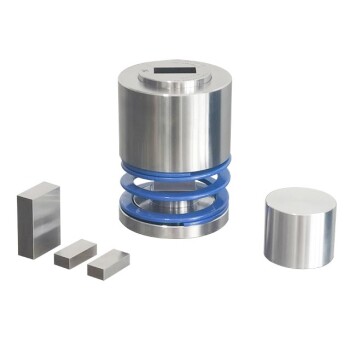
In advanced setups, the reactor can house a customized limiting mold. By physically restricting the PCL's expansion during the foaming phase, the reactor setup can control the growth direction and final thickness of the composite material.
Critical Operational Considerations
While the reactor is essential for ScCO2 foaming, operators must navigate specific constraints to ensure success and safety.
Precision vs. Variability
The process relies entirely on maintaining the environment above the critical points ($T_c$ and $P_c$). Any fluctuation below these levels inside the reactor will cause the CO2 to revert to gas or liquid, resulting in a failure to saturate the PCL and a lack of foam formation.
Geometric Constraints
While the reactor allows for expansion, the resulting foam shape is undefined unless a limiting mold is used. Without internal constraints, the rapid expansion can lead to irregular densities or inconsistent sample dimensions.
Optimizing the Foaming Process
To achieve specific material properties for your Polycaprolactone foam, focus on how you manipulate the reactor's parameters.
- If your primary focus is consistent microcellular structure: Prioritize the rapid depressurization rate; a faster pressure drop within the reactor generates a higher number of bubble nuclei.
- If your primary focus is specific sample dimensions (e.g., for EMI testing): Utilize a limiting mold within the reactor to mechanically restrict expansion and ensure uniform thickness.
- If your primary focus is full saturation: Ensure the reactor maintains conditions well above 31°C and 7.38 MPa for a sufficient duration before triggering depressurization.
The high-pressure reactor is not merely a container, but the active driver that forces the phase changes necessary to engineer advanced porous materials.
Summary Table:
| Feature | Function in ScCO2 Foaming |
|---|---|
| Critical Threshold | Maintains Temp > 31°C and Pressure > 7.38 MPa to reach supercritical state |
| CO2 State Control | Enables CO2 to act as a solvent to penetrate and saturate the PCL matrix |
| Nucleation Mechanism | Facilitates rapid depressurization to trigger microcellular bubble growth |
| Structural Support | Uses high-strength alloys and limiting molds to control foam density and shape |
Elevate Your Material Research with KINTEK
Precision is paramount in supercritical foaming. KINTEK specializes in advanced laboratory equipment, providing the high-temperature high-pressure reactors and autoclaves essential for mastering ScCO2 processes and Polycaprolactone (PCL) synthesis.
Our specialized reactor systems ensure strictly controlled environments for saturation and rapid depressurization, helping you achieve consistent microcellular structures and precise material dimensions. Beyond reactors, we offer a comprehensive range of crushing systems, hydraulic presses, and cooling solutions to support every stage of your polymer and battery research.
Ready to optimize your foaming process? Contact KINTEK today to discover how our high-pressure solutions can enhance your lab's efficiency.
References
- Yujin Zhou, Mengdong Zhang. Technical development and application of supercritical CO2 foaming technology in PCL foam production. DOI: 10.1038/s41598-024-57545-6
This article is also based on technical information from Kintek Solution Knowledge Base .
Related Products
- Customizable High Pressure Reactors for Advanced Scientific and Industrial Applications
- Customizable Laboratory High Temperature High Pressure Reactors for Diverse Scientific Applications
- Stainless High Pressure Autoclave Reactor Laboratory Pressure Reactor
- Mini SS High Pressure Autoclave Reactor for Laboratory Use
- Visual High-Pressure Reactor for In-Situ Observation
People Also Ask
- What is the function of high-pressure reactors in the synthesis of MFI-type zeolites? Master Dry Gel Conversion.
- Graphene Fiber Synthesis: Key High-Pressure Reactor Processing Conditions Explained
- What is the primary function of a high-pressure reactor in NiMoO4 preparation? Optimize Hydrothermal Catalyst Synthesis
- What reactor is used for high pressure reactions? Select the Right Autoclave for Your Lab
- What are the hazards of high pressure reactors? A Guide to Managing Explosive Risks