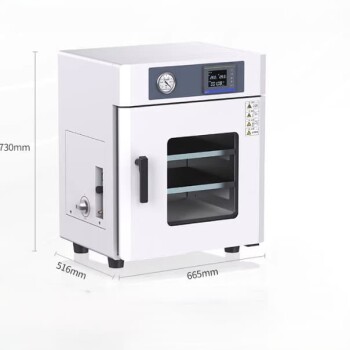
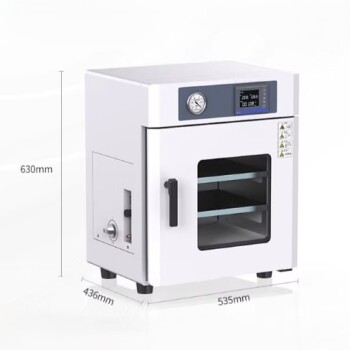
The primary function of a vacuum drying oven in this context is the rigorous elimination of trace moisture and residual solvents from PEO polymers and lithium salts (such as LiTFSI). By processing these materials under a vacuum at temperatures ranging from 50°C to 150°C, the oven prevents water-induced side reactions, ensuring the electrochemical stability necessary for high-performance batteries.
Core Takeaway Because PEO and LiTFSI are highly hygroscopic (prone to absorbing moisture), standard drying is insufficient to prevent battery failure. The vacuum drying oven is the definitive tool for achieving a truly anhydrous state, which is required to prevent corrosion of the lithium metal anode and to minimize interfacial impedance.
The Criticality of Moisture Removal
Combatting Hygroscopic Properties
Both Polyethylene Oxide (PEO) and lithium salts like LiTFSI possess strong hygroscopic characteristics. Without deep drying, these materials naturally retain or absorb atmospheric moisture, which cannot be removed by simple heating alone.
Protecting the Lithium Anode
The presence of even trace amounts of water is detrimental to lithium metal batteries. Moisture reacts aggressively with the metallic lithium anode, leading to corrosion and dangerous side reactions.
Ensuring Electrochemical Stability
By removing moisture, the vacuum oven stabilizes the electrolyte system. This prevents the degradation of battery performance and ensures the material maintains high ionic conductivity without suffering from moisture-induced instability.
The Mechanism of Action
The Role of High Temperature
The process typically operates between 50°C and 150°C, depending on the specific thermal stability of the polymer and the solvent involved. This thermal energy provides the kinetic force required to drive water molecules and volatile solvents out of the solid or slurry matrix.
The Advantage of Vacuum Conditions
The vacuum environment serves two distinct purposes. First, it lowers the boiling point of liquids, allowing for efficient evaporation of organic solvents (like acetonitrile or DMAc) and moisture without overheating the polymer. Second, it creates a sealed environment that prevents humid air from re-entering the mixture during the drying process.
Solvent-Free Membrane Production
For electrolytes prepared via solution casting, the oven is essential for removing the casting solvents. This results in uniformly thick, solvent-free membranes that are critical for consistent cycling performance.
Understanding the Trade-offs
Temperature Sensitivity
While heat is necessary for drying, excessive temperatures can degrade the polymer backbone or decompose the lithium salt. You must balance the need for rapid drying against the thermal limits of your specific PEO composite to avoid irreversible material damage.
Process Duration
Deep vacuum drying is rarely a quick process. Achieving a high anhydrous standard often requires extended drying periods (constant temperature over time). Rushing this step leads to "surface dry" materials that still contain deep-seated moisture, resulting in high internal resistance later.
Vacuum Pump Maintenance
The efficiency of the oven relies entirely on the quality of the vacuum. Volatile solvents and acidic moisture removed from the samples can degrade vacuum pump oil or seals. Regular maintenance is required to ensure the pressure levels remain low enough to be effective.
Making the Right Choice for Your Goal
Depending on your specific research or production targets, the application of the vacuum oven shifts slightly.
- If your primary focus is Long-Term Cycling Stability: Prioritize extended drying times to ensure the absolute removal of moisture, as this directly prevents the side reactions that corrode the anode over time.
- If your primary focus is Membrane Fabrication: Focus on the controlled removal of organic solvents to achieve a uniform, defect-free electrolyte film with low interfacial impedance.
Thorough pretreatment in a vacuum drying oven is not merely a cleaning step; it is the fundamental baseline for the safety and viability of any solid-state lithium battery.
Summary Table:
| Feature | Function in PEO Pretreatment | Impact on Battery Performance |
|---|---|---|
| Vacuum Environment | Lowers boiling points of solvents & prevents re-hydration | Ensures solvent-free membranes and low impurity levels |
| Temperature (50-150°C) | Drives out trace moisture and residual organic solvents | Prevents water-induced side reactions and anode corrosion |
| Anhydrous Processing | Rigorous elimination of hygroscopic water | Maximizes ionic conductivity and reduces interfacial impedance |
Elevate Your Battery Research with KINTEK Precision
Don't let trace moisture compromise your solid-state electrolyte performance. KINTEK specializes in advanced laboratory solutions designed for rigorous material pretreatment. Our high-performance vacuum drying ovens provide the precise temperature control and vacuum stability required for PEO and lithium salt processing.
From high-temperature furnaces and vacuum systems to battery research tools, hydraulic presses for pellet preparation, and essential consumables like PTFE products and crucibles, KINTEK is your partner in achieving anhydrous perfection.
Ready to optimize your lab’s efficiency? Contact our experts today to find the perfect equipment for your research goals!
Related Products
- 56L Vertical Laboratory Vacuum Drying Oven
- 23L Laboratory Vacuum Drying Oven
- Laboratory Scientific Electric Heating Blast Drying Oven
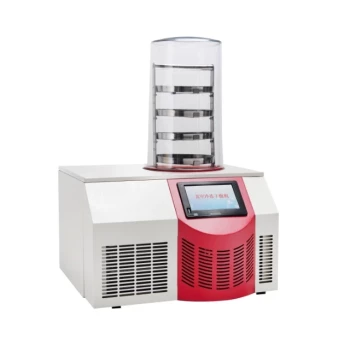
- Benchtop Laboratory Vacuum Freeze Dryer
- Dental Porcelain Zirconia Sintering Ceramic Vacuum Press Furnace
People Also Ask
- Why is a laboratory vacuum drying oven recommended for rice straw residues? Protect Your Biomass Integrity
- What role does a laboratory vacuum drying oven play in the preparation of modified multi-walled carbon nanotubes?
- What is the importance of using a laboratory vacuum drying oven? Preserving Slow-Release Microcapsule Integrity
- Why is a Laboratory Vacuum Drying Oven recommended for PBAT microspheres? Protect Sensitive Polymer Integrity
- What role does a laboratory vacuum drying oven play in processing nanoparticle powder samples? Protect Sample Integrity