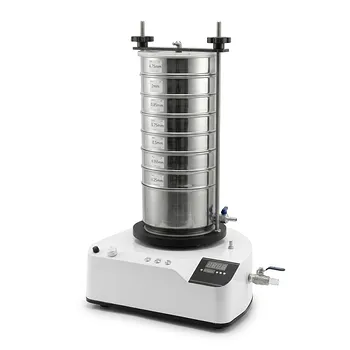
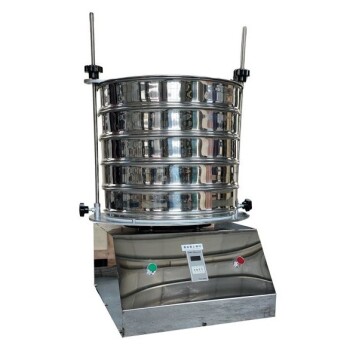
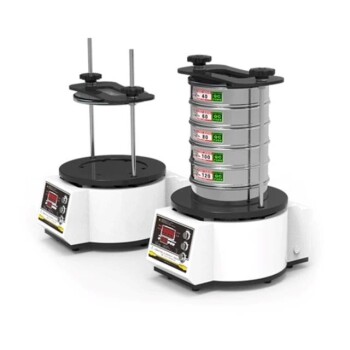
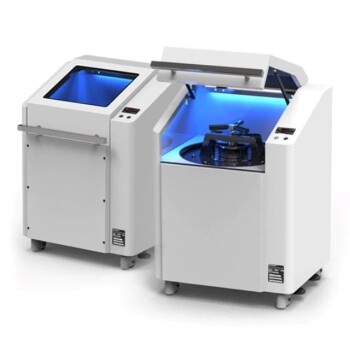
In the processing of NMC (Nickel Manganese Cobalt) battery black mass, industrial-grade sieving serves as the essential physical gateway for material purification and process optimization. By utilizing high-precision meshes, typically around the 0.5 mm specification, this equipment achieves the preliminary separation of active substances from residual current collector fragments and large-scale impurities. This step is foundational because it ensures particle size uniformity, which is the primary driver for efficiency in subsequent heat treatment and chemical recovery stages.
The primary purpose of industrial-grade sieving is to isolate high-value black mass from metallic contaminants while standardizing particle size to maximize the yield and speed of downstream chemical reactions.
Achieving Effective Physical Separation
Removing Current Collector Fragments
Industrial sieving physically screens crushed battery materials to separate the active black mass powder from coarse copper and aluminum foil fragments. These metallic fragments, if not removed, act as significant contaminants that complicate the chemistry of the recycling process.
Reducing Bulk Impurities
Beyond foils, the sieving process filters out large-scale impurities and non-active materials before they enter the high-value recovery stream. This early-stage purification is critical for reducing the volume of inert material that must be processed in later, more expensive stages.
Enhancing Thermodynamic and Chemical Efficiency
Ensuring Uniformity for Heat Treatment
Sieving ensures that the material entering the heat treatment process has a consistent particle size distribution. Uniformity prevents localized overheating or under-processing, allowing for a more predictable and controlled thermal reaction across the entire batch.
Improving Reaction Conversion Rates
Consistent particle sizes lead to higher conversion efficiency during chemical reactions. When the surface area-to-volume ratio is standardized, the kinetics of the reaction become more uniform, directly increasing the total recovery rate of valuable metals.
Impact on Downstream Recovery Quality
Refining Leaching Solution Purity
By effectively removing coarse metallic fragments early, sieving significantly reduces the impurity content in the subsequent leaching solution. This reduction is vital for improving the selectivity of lithium extraction and lowering the cost of final purification.
Optimizing Final Material Properties
When processing materials for reuse, such as porous carbon composites, finer sieving (e.g., 200-mesh) is used to ensure coating consistency. This level of precision helps reduce internal contact resistance in the finished electrode and improves the accuracy of electrochemical testing.
Understanding the Trade-offs and Pitfalls
The Risk of Mesh Clogging and Wear
High-precision meshes are susceptible to "blinding" or clogging, especially when dealing with the slightly adhesive nature of certain battery binders. Constant monitoring and the use of self-cleaning technologies are necessary to maintain throughput and prevent particle size drift.
Balancing Throughput with Precision
Choosing a mesh that is too fine can significantly slow down production rates, while a mesh that is too coarse allows metallic contaminants to bypass the screen. The 0.5 mm specification is often chosen as a technical sweet spot for industrial-scale black mass processing to balance volume with purity.
How to Apply This to Your Process
Recommendations for Material Processing Goals
- If your primary focus is maximizing metal recovery purity: Use a multi-stage sieving approach that starts with a 0.5 mm screen and graduates to finer grading to ensure the leaching solution is free of copper and aluminum.
- If your primary focus is optimizing heat treatment throughput: Prioritize the uniformity of the feed material to prevent "cold spots" in the reactor, ensuring all active substances reach the required reaction temperature simultaneously.
- If your primary focus is laboratory-scale analysis or quality control: Employ standardized sieves at the 125 µm level to accurately grade pyrolyzed materials and verify the efficiency of your industrial-scale equipment.
By correctly integrating high-precision sieving, you transform a raw, contaminated crushed mixture into a refined feedstock, directly dictating the ultimate profitability and purity of your recovered NMC materials.
Summary Table:
| Key Function | Process Impact | Technical Benefit |
|---|---|---|
| Physical Separation | Removes copper/aluminum foils & coarse impurities | Prevents chemical contamination in leaching stages |
| Thermal Optimization | Ensures consistent particle size distribution | Prevents localized overheating during heat treatment |
| Recovery Enhancement | Standardizes surface area-to-volume ratio | Maximizes reaction kinetics and metal extraction rates |
| Quality Control | Refines material for reuse (e.g., 200-mesh) | Reduces internal resistance in finished electrodes |
Optimize Your Battery Recycling Workflow with KINTEK
Achieving high-purity metal recovery from NMC black mass requires precision at every stage. KINTEK specializes in high-performance laboratory equipment designed to streamline your processing—from initial crushing and milling systems and high-precision sieving equipment to critical high-temperature furnaces (muffle, tube, and vacuum) for thermal treatment.
Whether you are refining leaching solutions or developing next-gen electrodes, our comprehensive portfolio includes high-pressure reactors, hydraulic presses, and specialized battery research tools to ensure your results meet the highest industrial standards.
Ready to enhance your recovery yields and process efficiency? Contact our experts today to discover how KINTEK’s advanced solutions can empower your laboratory or pilot plant.
References
- Christin Stallmeister, Bernd Friedrich. Influence of Flow-Gas Composition on Reaction Products of Thermally Treated NMC Battery Black Mass. DOI: 10.3390/met13050923
This article is also based on technical information from Kintek Solution Knowledge Base .
Related Products
- Three-dimensional electromagnetic sieving instrument
- Laboratory Vibratory Sieve Shaker Machine for Dry and Wet Three-Dimensional Sieving
- Laboratory Test Sieves and Sieving Machines
- Laboratory Test Sieves and Vibratory Sieve Shaker Machine
- Laboratory Wet Three-Dimensional Vibratory Sieve Shaker Machine
People Also Ask
- Why is sieving equipment essential for the classification of processed bio-activated carbon? Optimize Performance
- What are the limitations of sieving? Understanding the Constraints of Particle Size Analysis
- What are advantages and disadvantages of sieving method? A Guide to Reliable & Cost-Effective Particle Sizing
- How is sieving important? The Critical Role of Particle Size Analysis in Quality Control
- What is sieving and how does it work? A Guide to Accurate Particle Size Analysis