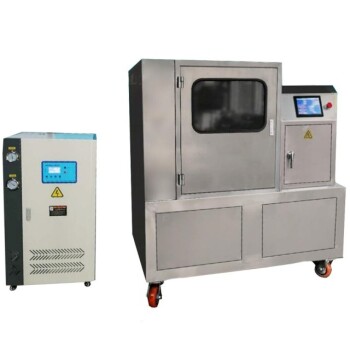
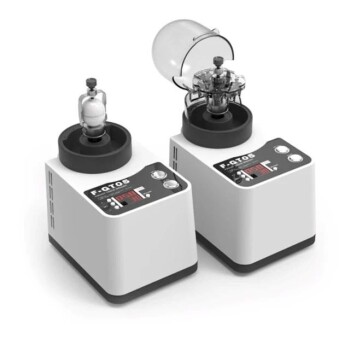
At its core, cryogenic ball milling is a powder processing technique that combines two distinct principles: the intense mechanical grinding of a high-energy ball mill with the material-altering effects of cryogenic temperatures. A material is first submerged in or sprayed with a cryogenic liquid, like liquid nitrogen or argon, to make it extremely cold and brittle. It is then placed into a sealed jar with hardened balls and subjected to high-speed rotation and collisions, which efficiently pulverize it into an ultra-fine powder.
The fundamental advantage of cryogenic ball milling is its dual action: the extreme cold makes materials brittle for easier fracturing while simultaneously suppressing the heat generated during milling. This prevents unwanted changes to the material's microstructure, enabling the creation of novel nanostructures that are impossible to achieve with standard room-temperature milling.
The Mechanics of the Process: A Two-Part System
To understand cryogenic ball milling, it's best to view it as the integration of two powerful systems: the cryogenic environment and the high-energy mill.
The Cryogenic Environment
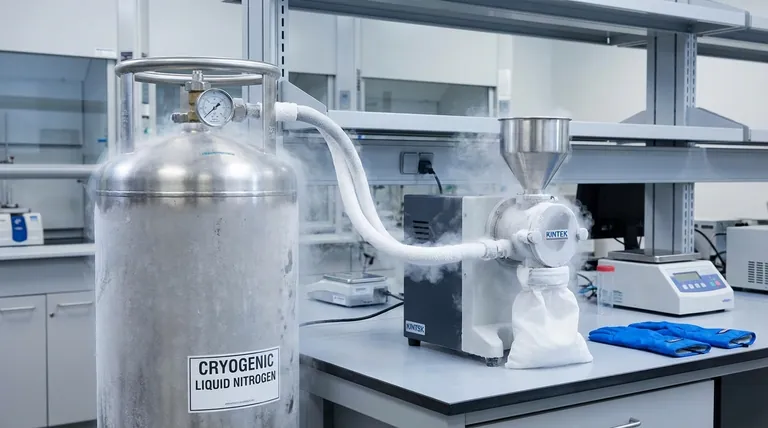
The process begins by introducing the material to a cryogenic liquid. This is typically done by spraying the liquid onto the material as it's fed into the mill or by directly submerging the powder in the liquid.
This step achieves two critical goals. First, it dramatically lowers the material's temperature, which often makes ductile or soft materials hard and brittle, allowing them to be fractured easily rather than deforming. Second, it acts as a constant heat sink during the violent milling process.
The High-Energy Ball Mill
Once cooled, the material is processed in a ball mill. This consists of a grinding jar filled with the material and several hard grinding balls.
The jar is placed in a machine that imparts immense energy. A common laboratory setup is a planetary ball mill, where the grinding jar (the "planet") rotates on its own axis while also revolving around a central point (the "sun wheel"), often in the opposite direction.
This complex motion results in high-energy impacts where the balls collide with the material and the jar wall, rapidly grinding the particles down to the micro or nano-scale.
Why Use Cryogenic Temperatures? The Core Benefits
The addition of a cryogenic step is deliberate and unlocks unique material processing capabilities that are not possible at room temperature.
Enhanced Microstructural Refinement
The primary benefit is the suppression of recovery and recrystallization. Intense milling generates significant localized heat, which can cause the material's internal crystal structure to "heal" or reform into larger grains.
The cryogenic liquid constantly removes this heat, preventing these thermal processes. This "locks in" the fine-grained, highly-strained nanostructure created by the milling action.
Efficient Grinding of Difficult Materials
Many materials, especially polymers, are tough and elastic at room temperature. Attempting to mill them results in the material deforming or melting rather than fracturing.
Cooling these materials below their glass transition temperature makes them brittle, allowing them to be shattered into a fine powder with ease.
Synthesis of Novel Nanomaterials
This technique is widely used for synthesizing metallic nanoparticles and amorphous alloys in large quantities. By preventing thermal effects, cryo-milling allows researchers to create materials with unique properties determined by their nanoscale structure.
Understanding the Trade-offs and Considerations
While powerful, the technique requires careful control and an awareness of potential challenges to achieve desired results.
Material Purity and Contamination
The choice of cryogenic liquid is critical. While liquid nitrogen is common, it can react with certain materials, leading to nitrogen contamination or the formation of unwanted nitrides.
For reactive materials or when high purity is essential, liquid argon is used instead, as it is completely inert and will not contaminate the sample.
Process Control for Particle Size
The final particle size is not arbitrary. It is a direct result of several controllable factors.
Key variables include the size and material of the grinding balls, the ratio of ball-to-powder mass, the rotational speed of the mill, and the total milling time. Adjusting these allows for the controlled synthesis of powders with a specific size distribution.
Applying Cryo-Milling to Your Goal
The right approach depends entirely on your end goal.
- If your primary focus is synthesizing novel nanostructures or amorphous alloys: The key benefit is the cryogenic temperature's ability to suppress thermal recovery and recrystallization, locking in a highly refined microstructure.
- If your primary focus is efficiently grinding tough, ductile, or heat-sensitive polymers: The embrittlement caused by the cryogenic liquid is your main advantage, allowing for clean fractures where room-temperature milling would fail.
- If your primary focus is maintaining high material purity with reactive metals: Choose liquid argon as your cryogenic medium to prevent unwanted side reactions and nitrogen contamination.
Ultimately, cryogenic ball milling provides a powerful method for engineering materials at the nanoscale by precisely controlling both mechanical force and thermal behavior.
Summary Table:
| Key Aspect | Description |
|---|---|
| Core Principle | Combines high-energy ball milling with cryogenic cooling (e.g., liquid nitrogen). |
| Primary Benefit | Makes materials brittle for efficient grinding and suppresses heat to prevent microstructural changes. |
| Ideal For | Synthesizing nanomaterials, grinding tough polymers, and processing heat-sensitive materials. |
| Key Variables | Ball size/material, ball-to-powder ratio, rotational speed, milling time, and cryogenic liquid choice. |
Ready to engineer advanced materials with precision?
KINTEK specializes in high-performance laboratory equipment, including cryogenic ball mills designed for reliable, controlled nanomaterial synthesis. Whether your goal is creating novel nanostructures or efficiently grinding difficult materials, our solutions deliver the accuracy and purity your research demands.
Contact us today to discuss how our expertise can advance your laboratory's capabilities. Get in touch via our contact form and let's achieve your material science goals together.
Visual Guide

Related Products
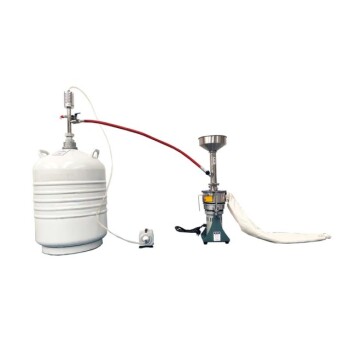
- Liquid Nitrogen Cryogenic Grinder Mill Cryomill Airflow Ultrafine Pulverizer
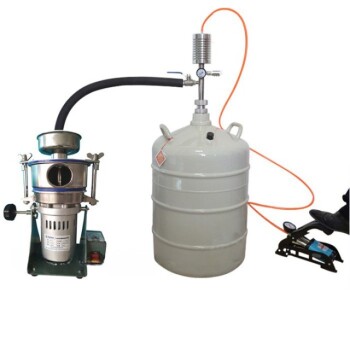
- Small Cryogenic Grinder Cryomill Cryogrinder with Liquid Nitrogen for Laboratory Use
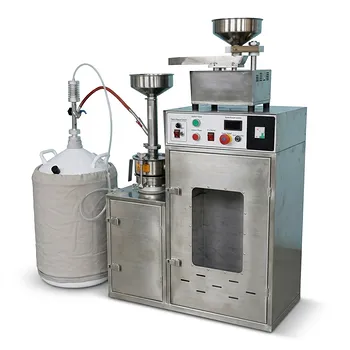
- Liquid Nitrogen Cryogenic Grinder Mill Cryomill with Screw Feeder
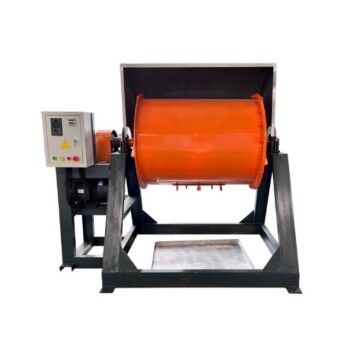
- Stainless Steel Laboratory Ball Mill for Dry Powder and Liquid with Ceramic Polyurethane Lining
- Mini Planetary Ball Mill Machine for Laboratory Milling
People Also Ask
- Why is a cryogenic grinder required for cured alkyd resin HRMAS NMR? Ensure Structural Integrity & Sample Precision
- What are cryogenic ground spices? Unlock Maximum Flavor with Advanced Grinding Technology
- What food is cryogenic grinding? The Ultimate Guide to Preserving Flavor & Aroma
- What is cryogenic grinding of crumb rubber? Achieve Fine, High-Quality Rubber Powder
- What is cryogenic grinding of herbs? Preserve Flavor and Potency with Sub-Zero Milling