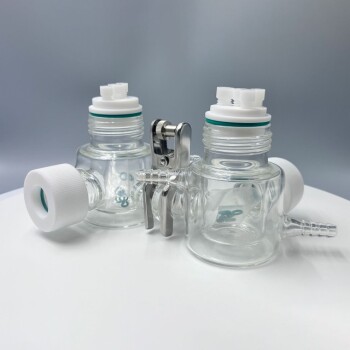
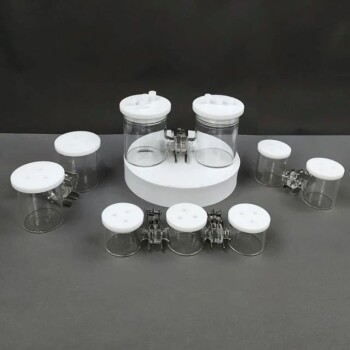
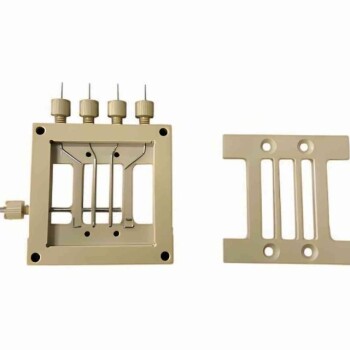
In Contact Glow Discharge Electrolysis (CGDE), the design of the reaction vessel is critical for managing both safety and data integrity. A borosilicate glass cell equipped with side tubes serves two specific functions: it acts as a pressure release valve for gases and vapors generated by high heat, and it creates an access point for maintaining precise electrolyte levels without disrupting the sealed experimental environment.
Core Takeaway: The side tubes in a CGDE cell are essential for stabilizing the reaction environment. They prevent dangerous pressure buildup caused by Joule heating and gas generation while enabling researchers to replenish electrolytes, ensuring the electrode remains consistently immersed for accurate data collection.
Managing the Physical Byproducts of CGDE
Contact Glow Discharge Electrolysis is a high-energy process that generates significant physical byproducts. The side tubes are the primary mechanism for managing these outputs safely.
Releasing Electrolytic Gases
During the electrolysis process, gases such as hydrogen and oxygen are produced at the electrodes. The side tubes provide a dedicated pathway for these gases to escape the cell.
Venting Vapor from Joule Heating
CGDE involves the formation of plasma, which introduces intense Joule heating to the system. This heat causes the rapid generation of water vapor.
Maintaining Pressure Equilibrium
Without a venting mechanism, the combination of electrolytic gases and water vapor would cause a dangerous spike in internal pressure. The side tubes allow these byproducts to exit freely, maintaining a safe pressure equilibrium within the glass vessel.
Ensuring Experimental Precision
Beyond safety, the side tubes play a vital role in maintaining the rigorous conditions required for scientific validity.
Enabling Non-Destructive Additions
The side tubes allow researchers to add electrolytes using pipettes. This design enables necessary adjustments without requiring the removal of the sealed top cover.
Preserving the Setup Integrity
By keeping the top cover sealed, the experimental setup remains undisturbed. This minimizes external variables and maintains the stability of the atmosphere inside the cell.
Consistency of Electrode Immersion
As water vapor escapes, the liquid level in the cell drops. The side tubes allow for the precise addition of fluid to counteract this loss, ensuring the electrode immersion area remains constant throughout the experiment.
Understanding Design Constraints and Trade-offs
While the side tube design solves specific problems, it introduces specific operational requirements that researchers must monitor.
The Requirement for Thermal Resistance
The cell is constructed from borosilicate glass specifically to withstand the thermal stress mentioned earlier. Standard glass could shatter under the rapid temperature changes induced by Joule heating and vapor generation.
Volume Management vs. Stability
The "open" nature of the side tubes—necessary for venting—creates a continuous loss of solvent via steam. This necessitates active monitoring and replenishment by the researcher to prevent the electrolyte concentration and electrode surface area from fluctuating.
Optimizing Your Experimental Setup
To maximize the utility of a borosilicate CGDE cell, consider your specific experimental objectives:
- If your primary focus is Safety: Ensure the side tubes are completely unobstructed to allow for the immediate release of hydrogen, oxygen, and high-temperature steam.
- If your primary focus is Data Accuracy: utilize the side tubes to replenish electrolytes frequently, maintaining a static liquid level to guarantee consistent current density and voltage readings.
Leveraging the side tubes effectively allows for a controlled transition from standard electrolysis to the high-energy stability required for plasma generation.
Summary Table:
| Feature | Function in CGDE Research | Impact on Experiment |
|---|---|---|
| Side Tubes | Pressure relief & electrolyte replenishment | Prevents pressure buildup; maintains liquid levels |
| Borosilicate Glass | High thermal shock resistance | Prevents vessel cracking from intense Joule heating |
| Sealed Environment | Isolation of reaction atmosphere | Minimizes external variables and ensures data integrity |
| Venting Mechanism | Release of Hydrogen, Oxygen, and Steam | Ensures safety by maintaining pressure equilibrium |
Elevate Your Plasma Research with KINTEK Precision
Maximize the safety and precision of your Contact Glow Discharge Electrolysis (CGDE) experiments with KINTEK’s specialized glassware. As experts in laboratory equipment, KINTEK provides high-quality borosilicate glass electrolytic cells and high-performance electrodes designed to withstand extreme thermal stress.
Whether you are focusing on battery research, chemical synthesis, or material science, our comprehensive portfolio—including high-temperature reactors, electrolytic cells, and precision crushing systems—is engineered to meet the rigorous demands of your lab.
Ready to optimize your experimental setup? Contact KINTEK today to discover how our high-durability consumables and advanced laboratory solutions can enhance your research efficiency and safety.
References
- Giovanni Battista Alteri, Danilo Dini. Contact Glow Discharge Electrolysis: Effect of Electrolyte Conductivity on Discharge Voltage. DOI: 10.3390/catal10101104
This article is also based on technical information from Kintek Solution Knowledge Base .
Related Products
- Side Window Optical Electrolytic Electrochemical Cell
- Electrolytic Electrochemical Cell with Five-Port
- PTFE Electrolytic Cell Electrochemical Cell Corrosion-Resistant Sealed and Non-Sealed
- Electrolytic Electrochemical Cell for Coating Evaluation
- Customizable PEM Electrolysis Cells for Diverse Research Applications
People Also Ask
- What are the critical safety and operational precautions when using a side-window optical electrolytic cell? Ensure Safe and Accurate Experiments
- What is the correct procedure for post-experiment shutdown and cleaning of a side-window optical electrolytic cell? Ensure Safety and Data Accuracy
- What maintenance procedures are recommended for a side-window optical electrolytic cell? Ensure Data Accuracy & Extend Cell Lifespan
- What are the ideal storage conditions for a side-window optical electrolytic cell? Ensure Long-Term Accuracy and Performance
- What is a side-window optical electrolytic cell? See Your Electrochemical Reactions in Action