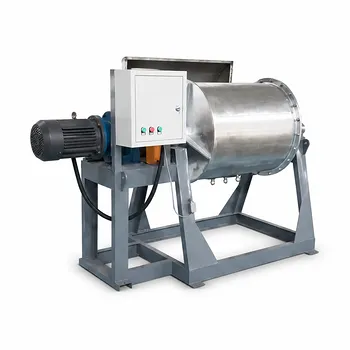
A high-energy ball mill serves as the primary mechanism for the low-energy blending of dual-scale titanium powders. This process utilizes physical grinding and mixing actions to drive ultra-fine, nano-scale particles into the porous cavities of coarse sponge titanium powder. By coating the surface of the larger particles, the mill facilitates the creation of a unique three-dimensional (3D) shell structure.
The high-energy ball mill transforms a mixture of disparate powder sizes into a structured composite by using mechanical force to fill the pores of coarse titanium with nano-scale particles. This specialized architecture is the critical foundation for achieving an ideal balance between high strength and toughness in the final material.
The Mechanics of Microstructural Architecture
Achieving Surface Coating and Cavity Filling
Coarse sponge titanium naturally possesses inherent surface porosity and irregular cavities. The high-energy ball mill uses physical impact to force nano-scale particles into these microscopic spaces. This ensures that the two distinct scales of powder are physically integrated rather than just loosely mixed.
Formation of the 3D Shell Structure
As the milling continues, the ultra-fine particles eventually form a continuous coating around the coarse titanium cores. This encapsulation creates a 3D shell structure that persists through subsequent processing stages. This specific geometry is what allows the finished metal to resist crack propagation while maintaining high structural integrity.
Shortening Atomic Diffusion Paths
Thorough mixing at the microscopic level ensures that different components are in immediate proximity. This reduces the distance atoms must travel during subsequent high-temperature sintering. Shorter diffusion paths lead to higher solid-state reaction efficiency and greater purity in the final product.
Enhancing Material Homogeneity
Breaking Up Nanoparticle Agglomerates
Ultra-fine and nano-scale powders have a high surface energy, which frequently causes them to clump or "agglomerate." The intense shear forces generated by the ball mill break these clusters apart. This ensures that the reinforcement phase is distributed evenly across the matrix rather than concentrated in weak spots.
Promoting Uniform Dispersion
In composites, the mill ensures that reinforcement phases, such as graphene or ceramic particles, are uniformly dispersed. This uniform distribution is a prerequisite for achieving isotropic properties, meaning the material performs consistently in all directions. It effectively prevents the localized phase inconsistencies that can lead to structural failure.
Inducing Mechanical Alloying
Beyond simple mixing, the mill can facilitate cold welding and diffusion between different particle clusters. This mechanical alloying process refines the size of the reinforcement phases and improves the interfacial bonding. Stronger bonding between the titanium matrix and the additives directly translates to enhanced mechanical strength.
Understanding the Trade-offs
Low-Energy vs. High-Energy Settings
While the device is a "high-energy" mill, the mixing phase for dual-scale powders often requires carefully controlled, lower-energy parameters. Excessive energy can lead to unwanted plastic deformation or work hardening of the coarse particles too early in the process. Finding the balance is essential to preserve the "sponge" core while still achieving a secure coating.
Risk of Contamination and Overheating
Extended milling times increase the risk of introducing impurities from the grinding jars or the hardened steel balls. Additionally, the friction generated during high-speed rotation can lead to significant heat buildup. If not managed, this heat can cause the titanium to oxidize, which severely compromises the ductility of the final component.
Making the Right Choice for Your Goal
Selecting the appropriate milling strategy is essential for tailoring the properties of your titanium composite.
- If your primary focus is balancing strength and toughness: Use low-energy blending settings to preserve the coarse sponge core while ensuring the nano-scale powder fully coats the surface cavities.
- If your primary focus is achieving solid-state amorphization: Utilize high-frequency, high-energy impacts over extended durations to induce the intense plastic deformation required for a non-crystalline structure.
- If your primary focus is preventing reinforcement agglomeration: Focus on optimizing rotational speeds to maximize shear forces, ensuring that nano-additives are embedded into the matrix rather than clumping together.
When used with precision, the high-energy ball mill is the foundational tool for engineering advanced titanium microstructures with highly predictable mechanical properties.
Summary Table:
| Function | Key Mechanism | Impact on Material |
|---|---|---|
| Cavity Filling | Mechanical impact forcing nano-particles into pores | Creates a stable 3D shell structure |
| De-agglomeration | Intense shear forces breaking clusters | Ensures uniform dispersion of reinforcements |
| Diffusion Efficiency | Shortening atomic travel distances | Leads to faster sintering and higher purity |
| Mechanical Alloying | Cold welding and grain refinement | Improves interfacial bonding and strength |
Optimize Your Material Synthesis with KINTEK Precision
Achieving the perfect balance of strength and toughness in dual-scale titanium powders requires more than just basic mixing—it requires precise mechanical force and reliable equipment. KINTEK specializes in high-performance crushing and milling systems, including advanced ball mills tailored for sophisticated microstructural engineering.
Beyond milling, our portfolio supports every stage of your material research. We offer a comprehensive range of high-temperature furnaces (vacuum, CVD, and atmosphere), hydraulic presses for pelletizing, and high-quality consumables like ceramics and crucibles. Whether you are working on advanced metallurgy, battery research, or ceramic composites, KINTEK provides the tools necessary for consistent, isotropic results.
Ready to elevate your lab’s efficiency and material homogeneity?
Contact our specialists today to find the right equipment for your research.
References
- Tamás Mikó, Zoltán Gácsi. A Novel Process to Produce Ti Parts from Powder Metallurgy with Advanced Properties for Aeronautical Applications. DOI: 10.3390/aerospace10040332
This article is also based on technical information from Kintek Solution Knowledge Base .
Related Products
- High Energy Planetary Ball Mill Milling Machine for Laboratory
- High-Energy Omnidirectional Planetary Ball Mill Milling Machine for Laboratory
- High Energy Planetary Ball Mill Machine for Laboratory Horizontal Tank Type
- High Energy Planetary Ball Mill for Laboratory Horizontal Tank Type Milling Machine
- High Energy Planetary Ball Mill Milling Machine for Laboratory
People Also Ask
- How does a planetary ball mill provide mechanical activation for scandium recovery? Maximize Your Leaching Efficiency
- What role do planetary ball mills and zirconia media play in LLZT preparation? Optimize Your Solid Electrolyte Research
- What is the function of a planetary ball mill in the preparation of high-entropy rare earth silicate multi-phase ceramics?
- What is the purpose of using a planetary ball mill for cathode material regeneration? Achieve Atomic-Level Mixing
- What is the primary function of a planetary ball mill? Mastering SiC/Al Composite Mixing for Homogeneity