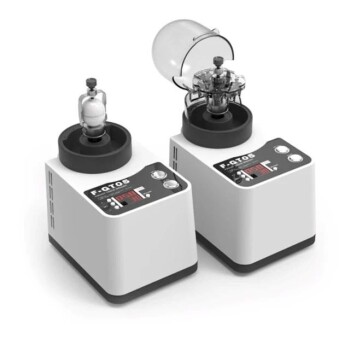
Mechanical activation via a planetary ball mill functions by subjecting red mud to high-energy impacts that fundamentally alter the material's physical and chemical state. This process breaks down particle sizes to vastly increase the available surface area while simultaneously inducing structural lattice distortion. These changes "prime" the red mud, making it significantly more receptive to the subsequent carbonate leaching process.
By lowering the chemical energy barrier required for reaction, mechanical activation acts as a catalyst for extraction. This physical pre-treatment enhances reagent penetration and reactivity, directly increasing the scandium leaching rate from 22.9% to over 30.9%.
The Mechanism of Physical Change
High-Energy Impact Generation
A planetary ball mill does not simply mix materials; it generates intense kinetic energy.
Inside the mill, the collision of grinding media creates high-energy impacts against the red mud particles. This is the foundational step that drives all subsequent activation.
Increasing Reactive Surface Area
The immediate result of these impacts is the physical comminution (reduction) of the red mud particles.
By pulverizing the material, the mill exposes a much larger total surface area. This maximizes the contact interface available for chemical reagents during the leaching phase.
Structural and Thermodynamic Effects
Inducing Lattice Distortion
Beyond simple size reduction, the mechanical force disrupts the internal crystal structure of the red mud minerals.
This phenomenon, known as lattice distortion, introduces stress and defects into the mineral structure. These structural imperfections make the mineral less stable and more eager to react chemically.
Lowering the Activation Energy
The combination of increased surface area and lattice distortion alters the thermodynamics of the leaching process.
This mechanical activation significantly lowers the chemical energy barrier. Consequently, the reaction requires less chemical energy to proceed, facilitating easier extraction of the target metal.
Impact on Leaching Performance
Enhanced Reagent Penetration
Because the physical structure is fractured and the surface area is maximized, leaching agents can enter the material more deeply.
The mechanical pre-treatment ensures that the carbonate solution penetrates the red mud particles more effectively than it would in a non-activated state.
Quantifiable Efficiency Gains
The practical result of this activation is a measurable boost in yield.
Without this pre-treatment, the scandium leaching rate sits at approximately 22.9%. With the mechanical activation provided by the planetary ball mill, the reactivity increases enough to push the recovery rate to over 30.9%.
Understanding the Process Limits
The Extent of Recovery
While mechanical activation provides a clear benefit, it is an enhancement rather than a total solution.
The process increases recovery by roughly 8 percentage points (from 22.9% to 30.9%). This indicates that while mechanical activation effectively unlocks a specific portion of the scandium, a majority of the target material remains bound within the red mud residue even after this high-energy treatment.
Assessing the Value for Your Process
To determine if integrating a planetary ball mill is the right step for your recovery circuit, consider your specific constraints:
- If your primary focus is maximizing reaction kinetics: Mechanical activation is essential because it lowers the chemical energy barrier, allowing the leaching reaction to occur more readily.
- If your primary focus is yield optimization: The ball mill is a critical addition, as it physically modifies the red mud to unlock an additional ~8% of total recoverable scandium.
Mechanical activation transforms red mud from a passive material into a reactive feedstock, directly converting physical energy into improved chemical extraction.
Summary Table:
| Mechanism Feature | Physical/Chemical Impact | Impact on Scandium Recovery |
|---|---|---|
| High-Energy Impact | Particle size reduction (comminution) | Vastly increases reactive surface area |
| Lattice Distortion | Structural defects and internal stress | Lowers the chemical energy barrier for leaching |
| Reagent Penetration | Fractured mineral structure | Facilitates deeper carbonate solution access |
| Efficiency Gain | Improved reaction kinetics | Increases leaching rate by approximately 8% |
Revolutionize Your Material Activation with KINTEK
Unlock the full potential of your recovery processes with KINTEK’s high-performance crushing and milling systems. Whether you are working on scandium extraction from red mud or complex mineral processing, our planetary ball mills and sieving equipment provide the precise mechanical activation needed to lower energy barriers and maximize yields.
From high-temperature furnaces and vacuum reactors to advanced battery research tools and hydraulic presses, KINTEK specializes in laboratory equipment that bridges the gap between passive materials and reactive feedstocks.
Ready to enhance your lab's efficiency and recovery rates? Contact our experts today to find the perfect solution for your workflow!
References
- Xiaofei Li, Song Wang. Summary of Research Progress on Metallurgical Utilization Technology of Red Mud. DOI: 10.3390/min13060737
This article is also based on technical information from Kintek Solution Knowledge Base .
Related Products
- High Energy Planetary Ball Mill for Laboratory Horizontal Tank Type Milling Machine
- High-Energy Omnidirectional Planetary Ball Mill Milling Machine for Laboratory
- Laboratory Planetary Ball Mill Rotating Ball Milling Machine
- High Energy Planetary Ball Mill Milling Machine for Laboratory
- High Energy Planetary Ball Mill Machine for Laboratory Horizontal Tank Type
People Also Ask
- What is the role of a planetary ball mill in sulfide-based solid-state batteries? Engineer High-Performance Cathodes
- What are the parameters of a planetary ball mill? Master Speed, Time, and Media for Perfect Grinding
- What is the function of a planetary ball mill for nanostructured eutectic steel? Essential Prep for High-Strength Alloys
- What role does a planetary ball mill play in the preparation of NASICON-type solid electrolytes like LATP and LAGP?
- What is the function of a planetary ball mill in solid-state electrolyte prep? Milling vs. SDS Methods Explained