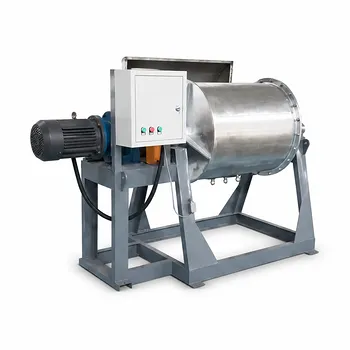
The horizontal ball mill is the primary tool for achieving atomic-level uniformity and surface activation in aluminum-based porous composites. By subjecting metal powders to prolonged mechanical impact and inter-particle grinding, the mill breaks down the resilient aluminum oxide layer and ensures alloying elements are perfectly distributed, creating a necessary foundation for successful liquid phase sintering.
The horizontal ball mill serves as both a high-precision mixer and a mechanical activator. It transforms raw powder mixtures into a homogeneous, reactive precursor by disrupting surface oxides and preventing the agglomeration of reinforcement phases.
Establishing the Foundation for Sintering
Achieving Atomic-Level Uniformity
In the preparation of porous aluminum composites, the mill processes mixtures of aluminum, magnesium, tin, copper, and boron for up to 24 hours. The continuous mechanical impacts ensure that these alloying elements are distributed at an atomic level throughout the matrix. This level of precision is critical for the consistency of the final porous structure.
Disruption of the Passive Oxide Film
Aluminum particles are naturally covered by a stable, protective oxide film that prevents effective bonding during thermal processing. The horizontal ball mill uses inter-particle grinding to mechanically fracture this layer. This surface activation allows for direct contact between metal particles, which is a prerequisite for the subsequent liquid phase sintering process.
Creating a Reactive Precursor
The prolonged milling process does more than just mix; it stores mechanical energy within the powder particles. This energy increases the chemical reactivity of the material. By the end of the milling cycle, the powder is no longer a simple mixture but a highly engineered precursor ready for consolidation.
Enhancing Microstructural Integrity
Dispersion and De-agglomeration
When incorporating reinforcement phases like carbon nanotubes (CNTs) or alumina nanoparticles, the mill’s shear and impact forces are vital. These forces effectively break up clusters of particles that naturally tend to stick together. Ensuring a uniform dispersion prevents weak spots in the composite and guarantees consistent mechanical properties across the material.
Coating and Surface Engineering
The ball mill allows for "mechanical coating," where smaller reinforcement particles are driven onto the surface of larger matrix particles. This creates a homogeneous microstructure before the material is ever heated. Such a uniform starting point is essential for controlling the pore distribution in the final aluminum composite.
Mechanical Alloying and Phase Control
High-energy milling can trigger solid-state reactions, synthesizing specific compounds like nanocrystalline intermetallics. By controlling parameters like the ball-to-powder ratio and rotation speed, engineers can synthesize reinforcement phases in situ. This results in a stronger bond between the matrix and the reinforcement at the nanoscale.
Understanding the Trade-offs
Impact Energy vs. Particle Morphology
High-speed milling provides the energy needed for alloying but can deform the original morphology of specialized particles, such as high-entropy alloys. Conversely, low-speed milling (e.g., 200 rpm) preserves particle shapes but may lack the energy to break down tough oxide films. Selecting the correct rotation speed is a delicate balance between activation and preservation.
Milling Time and Contamination
While long milling times (up to 24 hours) ensure uniformity, they also increase the risk of impurity pickup from the milling media or the atmosphere. Excessive milling can also lead to over-hardening of the aluminum powder, making it difficult to press into shapes before sintering. Monitoring the milling duration is critical to avoid compromising the material's purity.
How to Apply This to Your Project
Selecting the Right Milling Strategy
- If your primary focus is breaking down oxide films for sintering: Use a high-energy horizontal mill for an extended duration (12–24 hours) to ensure maximum inter-particle grinding and surface activation.
- If your primary focus is dispersing delicate nano-reinforcements: Use a planetary or horizontal mill at moderate speeds to provide enough shear for de-agglomeration without destroying the reinforcement’s structure.
- If your primary focus is preserving particle shape: Opt for a low-speed stirring action (approx. 200 rpm) to achieve a uniform blend while avoiding high-intensity impacts that flatten or fragment the powder.
The horizontal ball mill remains the indispensable bridge between raw elemental powders and high-performance, microstructurally sound aluminum composites.
Summary Table:
| Function | Mechanism | Impact on Material |
|---|---|---|
| Uniformity | Prolonged mechanical impact | Atomic-level distribution of alloying elements |
| Surface Activation | Inter-particle grinding | Fractures oxide films to enable liquid phase sintering |
| Dispersion | Shear and impact forces | Breaks up agglomerated reinforcement nanoparticles |
| Energy Storage | Mechanical alloying | Creates high-reactivity precursors for consolidation |
| Phase Control | Solid-state reactions | Synthesizes nanocrystalline intermetallics in situ |
Elevate Your Material Prep with KINTEK Precision
Achieving the perfect porous composite requires more than just mixing—it requires the right mechanical activation. KINTEK specializes in high-performance laboratory equipment designed for the most demanding materials science applications. From our advanced crushing and milling systems to our comprehensive range of high-temperature furnaces (muffle, vacuum, and atmosphere), we provide the tools necessary to ensure atomic-level uniformity and superior microstructural integrity.
Whether you are refining aluminum-based composites or developing advanced ceramics, our portfolio—including hydraulic presses, planetary ball mills, and specialized crucibles—is engineered to deliver consistent, repeatable results.
Ready to optimize your milling and sintering workflow? Contact our experts today to find the ideal solution for your laboratory's unique requirements.
References
- Bisma Parveez, Muneer Baig. Microstructure and Strengthening Effect of Coated Diamond Particles on the Porous Aluminum Composites. DOI: 10.3390/ma16083240
This article is also based on technical information from Kintek Solution Knowledge Base .
Related Products
- Laboratory Horizontal Planetary Ball Mill Milling Machine
- High Energy Planetary Ball Mill for Laboratory Horizontal Tank Type Milling Machine
- High Energy Planetary Ball Mill Machine for Laboratory Horizontal Tank Type
- Stainless Steel Laboratory Ball Mill for Dry Powder and Liquid with Ceramic Polyurethane Lining
- Laboratory Four-Body Horizontal Jar Mill
People Also Ask
- What is the primary purpose of using a planetary ball mill for iridium powder? Achieve Microscopic Mixing Uniformity
- What is the primary function of a planetary ball mill for Al2O3-TiC/CaF2 powders? Achieving Microstructural Homogeneity
- What is the role of a planetary ball mill in sulfide-based solid-state batteries? Engineer High-Performance Cathodes
- What is the function of a planetary ball mill in MAX phase powder preparation? Unlock High-Purity Atomic Homogeneity
- Why are planetary ball mills used for intermetallic precursors? Achieve Precise Atomic-Level Mechanical Alloying