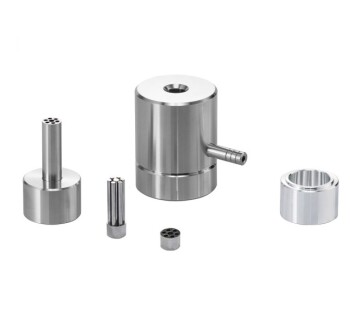
The primary role of a stainless steel high-pressure reactor in MIL-88B synthesis is to create a sealed, extreme environment that drives the coordination reaction between the iron source and the organic ligand.
By maintaining high temperatures and pressures within a closed system, the reactor forces the reactants (Iron and NH2-BDC) to dissolve and interact within a mixed solvent. This specific environment is essential for facilitating rapid crystallization, directly resulting in a Metal-Organic Framework (MOF) characterized by high porosity and superior chemical stability.
Core Takeaway The reactor is not merely a container; it is a thermodynamic tool that elevates the boiling point of solvents to increase reactant solubility. This controlled high-pressure state allows for the rapid, uniform crystallization necessary to achieve the distinct structural integrity and porosity of MIL-88B.
Creating the Critical Reaction Environment
The Mechanism of Autogenous Pressure
The reactor creates a "hydrothermal" condition by sealing the reaction mixture inside a fixed volume.
As the temperature rises, often exceeding the atmospheric boiling point of the solvent, the internal pressure increases significantly.
This allows the solvent to remain in a liquid or fluid state at temperatures where it would normally evaporate, enabling reactions that require higher thermal energy.
Enhanced Solubility of Precursors
Standard atmospheric conditions are often insufficient to fully dissolve the iron source and the organic ligand (NH2-BDC).
The high-pressure environment generated inside the stainless steel reactor drastically increases the solvation capacity of the mixed solvent.
This ensures that the reactants are thoroughly mixed at a molecular level, which is a prerequisite for a uniform coordination reaction.
Driving Crystallization and Structure
Promoting Rapid Crystallization
The synthesis of MIL-88B relies on the kinetics of the reaction.
The reactor's environment accelerates the nucleation and growth of crystals.
This rapid crystallization is critical for establishing the framework's structure without allowing time for impurities or amorphous phases to form.
Defining Porosity and Stability
The ultimate goal of using this specific reactor type is to dictate the physical properties of the final material.
The controlled pressure and temperature facilitate the formation of a highly ordered lattice structure.
This results in an MOF with high porosity (essential for applications like gas storage or catalysis) and excellent chemical stability.
Understanding the Trade-offs and Risks
Material Purity and Contamination
While stainless steel provides the necessary strength, direct contact with the steel shell can sometimes introduce contaminants.
In many high-pressure hydrothermal applications, a chemically inert liner (such as PTFE) is used inside the steel shell.
Without a liner, corrosive reactants could damage the reactor or leach foreign metal ions into the MIL-88B, compromising its phase purity.
Safety and Operational Limits
High-pressure reactors operate under significant thermodynamic stress.
They require precise temperature control to prevent over-pressurization, which can be catastrophic.
Furthermore, these reactors are typically batch-process vessels, which can limit scalability compared to continuous flow systems.
Making the Right Choice for Your Goal
To optimize your synthesis of MIL-88B, consider how the reactor configuration aligns with your specific requirements:
- If your primary focus is Phase Purity: Ensure your stainless steel reactor is equipped with an inert PTFE liner to prevent metal ion leaching during the reaction.
- If your primary focus is Crystallinity: Prioritize precise temperature control to maintain the specific high-pressure conditions required for uniform crystal growth.
- If your primary focus is Chemical Stability: Verify that the reactor seal can sustain the pressure for the full duration of the rapid crystallization phase to ensure a robust framework.
The stainless steel high-pressure reactor is the foundational tool that transforms simple precursors into complex, stable MIL-88B frameworks by manipulating the physics of solubility and crystallization.
Summary Table:
| Feature | Role in MIL-88B Synthesis | Key Benefit |
|---|---|---|
| Autogenous Pressure | Elevates solvent boiling point | Enables high-energy reactions |
| Enhanced Solubility | Dissolves Iron & NH2-BDC precursors | Molecular-level reactant mixing |
| Rapid Crystallization | Accelerates nucleation and growth | Prevents impurity formation |
| Structural Control | Defines ordered lattice framework | High porosity and chemical stability |
| Inert Lining (PTFE) | Prevents metal ion leaching | Ensures maximum phase purity |
Elevate Your MOF Synthesis with KINTEK Precision
Achieving the perfect crystalline structure for MIL-88B requires uncompromising thermodynamic control. KINTEK specializes in advanced laboratory equipment, providing the high-performance high-temperature high-pressure reactors and autoclaves essential for hydrothermal synthesis.
Our reactors are designed for safety and precision, ensuring uniform heating and pressure for your most sensitive chemical reactions. Whether you need stainless steel vessels, specialized PTFE products, or ceramics and crucibles, KINTEK delivers the tools to optimize your laboratory's efficiency and research outcomes.
Ready to scale your synthesis? Contact KINTEK today to explore our comprehensive range of reactors and laboratory consumables tailored for your specific research needs.
References
- Yuqing Du, Gang Cheng. Self-assembled organic monolayer functionalized MIL-88B for selective acetone detection at room temperature. DOI: 10.1007/s44275-024-00014-z
This article is also based on technical information from Kintek Solution Knowledge Base .
Related Products
- Stainless High Pressure Autoclave Reactor Laboratory Pressure Reactor
- Mini SS High Pressure Autoclave Reactor for Laboratory Use
- Customizable High Pressure Reactors for Advanced Scientific and Industrial Applications
- Customizable Laboratory High Temperature High Pressure Reactors for Diverse Scientific Applications
- High Pressure Laboratory Autoclave Reactor for Hydrothermal Synthesis
People Also Ask
- Why is a laboratory high-pressure reactor used in the hydrothermal synthesis of hydroxyapatite catalysts?
- Why is a laboratory high-pressure reactor necessary for synthesizing fly ash-based zeolite? Achieve Pure Crystallization
- What role does a laboratory high-pressure reactor play in the leaching process of spent cathode materials? Optimize Recovery
- What conditions do laboratory high-pressure reactors provide for HTC? Optimize Your Biochar Production Processes
- How are high-pressure reactors used to prepare metaphosphate electrocatalysts? Master In-Situ Precursor Growth