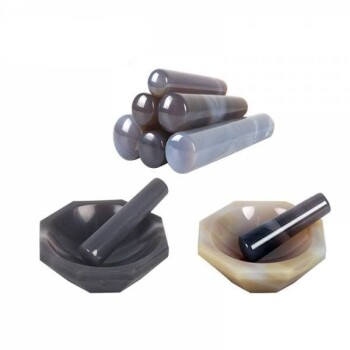
The agate mortar and pestle serves as a precision tool for contamination-free homogenization. In the context of refractory research and carbon deposition studies, it is used to mechanically grind and refine solid sulfur with iron oxide ($Fe_2O_3$) powders. Its primary role is to create a uniform preliminary distribution of sulfur across the catalyst precursor while strictly preventing the introduction of impurities.
By leveraging the extreme hardness and chemical inertness of agate, researchers can mechanically grind precursors to a high degree of uniformity while ensuring absolute sample purity—a prerequisite for valid data in high-temperature thermal treatment experiments.
The Critical Role of Material Inertness
Preventing Sample Contamination
The validity of refractory research depends on the purity of the raw materials. Agate is chemically inert, meaning it does not react with the sulfur or iron oxide during the grinding process.
Unlike softer or reactive materials, agate ensures that no foreign impurities are introduced into the mixture. This guarantees that any observed effects in later stages are due to the sample chemistry, not equipment contamination.
Utilizing Extreme Hardness
Refractory oxides like iron oxide can be abrasive. The extreme hardness of agate prevents the mortar and pestle from degrading under the physical stress of grinding.
This durability ensures the tool maintains a smooth surface. It prevents micro-particles of the grinding tool from chipping off and polluting the catalyst precursor.
Achieving Structural Homogeneity
Uniform Surface Distribution
The goal of using the mortar and pestle is not simply to combine two powders. The mechanical action refines the sulfur, distributing it evenly over the surface of the iron oxide ($Fe_2O_3$) particles.
This creates a uniform preliminary distribution. It ensures that the sulfur is in intimate contact with the iron oxide catalyst precursor before any heat is applied.
Pre-requisite for Thermal Treatment
A homogeneous starting sample is non-negotiable for consistent results. This preparation step sets the baseline for subsequent high-temperature thermal treatment experiments.
Without this thorough mechanical mixing, carbon deposition studies would suffer from localized inconsistencies. The agate mortar ensures the entire sample reacts predictably during heating.
Understanding the Trade-offs
The Human Variable
While an agate mortar and pestle offers purity, it is a manual mechanical process. Consistency relies heavily on the operator's technique. Variations in grinding time or pressure can lead to slight differences between batches.
Scalability Limits
This method is optimized for precision research and small sample sizes. It is generally not suitable for processing large quantities of material, where automated ball milling might be required despite higher contamination risks.
Ensuring Experimental Success
To maximize the reliability of your refractory research, consider your specific experimental goals:
- If your primary focus is sample purity: Exclusively use agate tools to eliminate the risk of metallic or ceramic cross-contamination during the grinding phase.
- If your primary focus is reaction consistency: Dedicate sufficient time to the grinding process to ensure the sulfur is uniformly distributed across the iron oxide surface before thermal treatment.
The integrity of your final data begins with the mechanical precision of your raw material preparation.
Summary Table:
| Feature | Benefit in Refractory Research |
|---|---|
| Material Inertness | Prevents chemical reactions and ensures absolute sample purity. |
| Extreme Hardness | Resists abrasion from iron oxide, preventing tool-wear contamination. |
| Manual Precision | Enables uniform mechanical distribution of sulfur on catalyst precursors. |
| Surface Integrity | Maintains a smooth grinding surface for consistent particle refinement. |
| Thermal Baseline | Creates a homogeneous mixture essential for high-temperature treatment. |
Elevate Your Research Precision with KINTEK
Consistency in refractory and catalyst studies begins with the purity of your sample preparation. KINTEK specializes in high-performance laboratory equipment, providing the crushing and milling systems and high-purity agate consumables necessary to eliminate contamination and ensure structural homogeneity.
From preparing precursors to conducting advanced thermal analysis in our high-temperature furnaces (vacuum, tube, or atmosphere) and high-pressure reactors, we offer the comprehensive tools your lab needs for valid, repeatable data.
Ready to optimize your material preparation? Contact our laboratory specialists today to find the perfect milling and furnace solutions tailored to your specific research requirements.
References
- Joris Kadok, Jacques Poirier. Inhibiting the sp2 carbon deposition by adjunction of sulphurous species in refractory ceramics subjected to CO and H2 reducing atmosphere. DOI: 10.1016/j.jeurceramsoc.2019.03.008
This article is also based on technical information from Kintek Solution Knowledge Base .
Related Products
- Nature Agate Mortar and Pestle for Grinding and Mixing
- Laboratory Jar Mill with Agate Grinding Jar and Balls
People Also Ask
- Why are agate mortars and pestles used for grinding iron oxide? Ensure Sample Purity for XRD Analysis
- What is the function of an agate mortar and pestle? Ensure Purity in Halide Solid-State Electrolyte Synthesis
- What is the primary function of an agate mortar and pestle? Optimize VO2+ CaZn2(PO4)2 Nanopowder Pre-Treatment
- Why is an agate mortar and pestle required for grinding Zr3(Al1-xSix)C2? Ensure Maximum Sample Purity
- Why is an agate mortar and pestle preferred for grinding MAX phase? Ensure Sample Purity & Zero Contamination