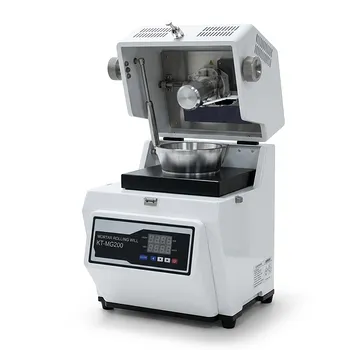
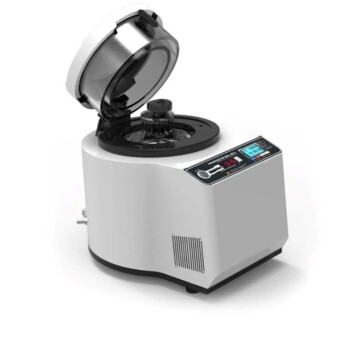
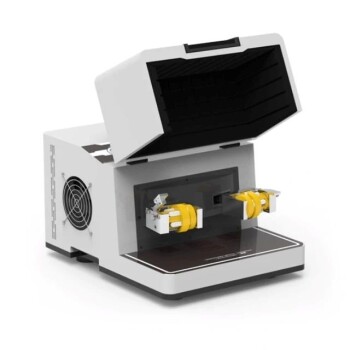
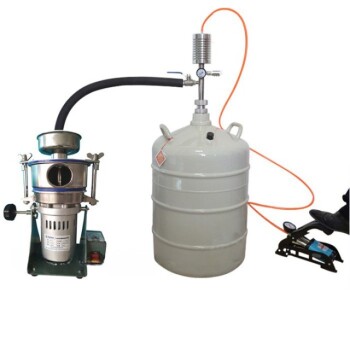
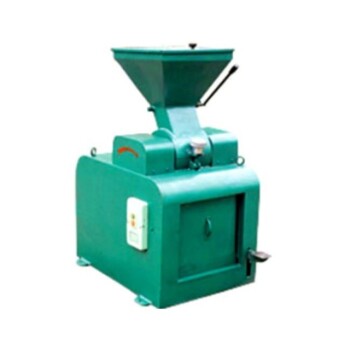
Precision in feedstock preparation is the critical first step for successful torrefaction. Laboratory grinders and standard sieving systems work in tandem to convert raw materials, such as dried sludge or digestate, into a powder with a strictly controlled particle size. This mechanical standardization is essential for creating the physical conditions necessary for consistent thermal degradation.
By standardizing particle size, often through a 1 mm mesh, you maximize the material's specific surface area. This ensures heat penetrates the biomass rapidly and evenly, eliminating variables that could skew kinetic modeling or lead to incomplete carbonization.
The Physics of Particle Standardization
Achieving Uniformity Through Sieving
Laboratory grinders break down coarse biomass, but the grinder alone is not enough. The addition of a standard sieving system acts as a quality control gate.
By passing the ground material through a specific mesh size (commonly 1 mm), you ensure that every particle entering the reactor falls within a specific size tolerance.
Increasing Specific Surface Area
The primary physical outcome of this process is a significant increase in the specific surface area of the material.
When you reduce large chunks of sludge or digestate into a fine powder, you expose more of the material's mass to the thermal environment. This exposure is the fundamental driver for the chemical reactions that follow.
Impact on Thermal Dynamics
Facilitating Rapid Heat Transfer
Torrefaction relies on the efficient movement of heat. A high specific surface area allows thermal energy to transfer rapidly from the reactor environment to the particle.
This minimizes the thermal lag time, ensuring the material reaches the target temperature almost simultaneously with the reactor environment.
Preventing Incomplete Carbonization
If particles are too large or irregular, heat may not reach the core of the particle effectively.
Uniform grinding and sieving ensure heat is transferred uniformly to the interior of the particles. This prevents the issue of incomplete carbonization, where the outer shell is torrefied but the core remains raw.
The Role in Research Validity
Ensuring Reliability of Experimental Results
In a laboratory setting, variables must be isolated. If particle size varies, thermal behavior varies, leading to erratic data.
Standardized preparation guarantees that observed changes in the material are due to the torrefaction parameters, not inconsistencies in the feedstock preparation.
Supporting Kinetic Model Analyses
Researchers rely on kinetic models to predict how materials will behave at scale.
These models require precise inputs to function correctly. By ensuring uniform heating and reaction rates, grounded and sieved feedstocks provide the high-quality data necessary for accurate kinetic model analyses.
Understanding the Risks of Improper Preparation
The Consequence of Uneven Heating
It is important to recognize the trade-off of skipping precise preparation: reliability drops immediately.
Without the specific surface area provided by grinding and sieving, heating becomes uneven. This results in a heterogeneous product that cannot be accurately characterized or compared against other samples.
Compromised Data Integrity
If the feedstock is not uniform, the "noise" in the data increases significantly.
Kinetic models derived from such data will be flawed. The models will attempt to account for physical heat transfer limitations (due to large particle size) rather than the true chemical reaction kinetics of the biomass.
Making the Right Choice for Your Goal
To ensure your torrefaction process yields valid data and high-quality product, align your preparation method with your specific objectives:
- If your primary focus is Kinetic Modeling: Prioritize the use of a standard 1 mm sieve to eliminate particle size variables that could distort reaction rate calculations.
- If your primary focus is Product Quality: Focus on the grinding process to maximize specific surface area, ensuring the material is carbonized completely through to the particle core.
Uniform feedstock preparation is the invisible foundation upon which all reliable torrefaction data is built.
Summary Table:
| Feature | Role in Feedstock Preparation | Impact on Torrefaction |
|---|---|---|
| Laboratory Grinder | Mechanical breakdown of raw biomass (sludge/digestate) | Increases specific surface area for faster heating |
| Sieving System | Particle size standardization (typically <1 mm) | Eliminates size variables and ensures uniform carbonization |
| Uniformity | Creates a homogeneous powder profile | Prevents incomplete carbonization and thermal lag |
| Data Accuracy | Isolates thermal variables from physical noise | Essential for reliable kinetic modeling and research validity |
Elevate Your Biomass Research with KINTEK Precision
Don't let inconsistent feedstock compromise your torrefaction results. KINTEK specializes in high-performance laboratory equipment designed to deliver the mechanical standardization your research demands.
Our comprehensive range of crushing and milling systems, sieving equipment, and high-temperature furnaces ensures your materials are perfectly prepared and processed every time. Whether you are focused on kinetic modeling or high-quality product output, KINTEK provides the tools—from dental and vacuum furnaces to PTFE consumables and crucibles—to guarantee data integrity and thermal uniformity.
Ready to optimize your laboratory workflow? Contact our technical experts today to find the perfect grinding and heating solutions for your specific application.
References
- Kacper Świechowski, Andrzej Białowiec. Waste to Energy: Solid Fuel Production from Biogas Plant Digestate and Sewage Sludge by Torrefaction-Process Kinetics, Fuel Properties, and Energy Balance. DOI: 10.3390/en13123161
This article is also based on technical information from Kintek Solution Knowledge Base .
Related Products
- Laboratory Grinding Mill Mortar Grinder for Sample Preparation
- Laboratory High Throughput Tissue Grinding Mill Grinder
- Laboratory Hybrid Tissue Grinding Mill
- Small Cryogenic Grinder Cryomill Cryogrinder with Liquid Nitrogen for Laboratory Use
- Lab Vibration Mill
People Also Ask
- What laboratory apparatus is used for grinding? Match the Right Mill to Your Sample Material
- What is the function of a laboratory grinding mill? Achieve Precise Sample Preparation for Accurate Results
- What is the purpose of using a laboratory grinder and standard sieves? Unlock Precise Rice Husk Pretreatment
- What is the role of laboratory-grade grinders and sieves in sample prep? Ensure High-Precision Corrosion Analysis
- What is the purpose of using a laboratory grinder with specific mesh sieves for oat straw? Optimize Pellet Quality