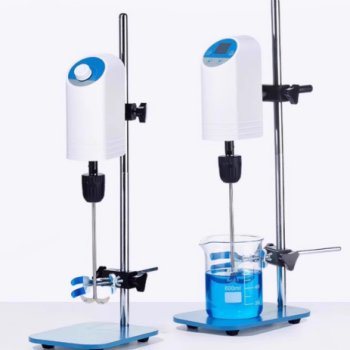
Laboratory heating and stirring systems are the foundational tools for creating effective alumina sol-gel precursors. They function by driving the complete dissolution of aluminum tri-sec-butoxide in sec-butanol at elevated temperatures, specifically around 87 °C, while applying powerful mechanical stirring. This dual action ensures the precursor solution achieves the necessary chemical uniformity required for high-performance coatings.
The primary role of these systems is to provide the continuous shear force and precise thermal regulation necessary to stabilize solid content and pH, which ultimately dictates the film-forming quality of the final alumina coating.
The Mechanics of Precursor Dissolution
Achieving Complete Solubility
To prepare an alumina sol-gel, standard ambient mixing is insufficient. The system must maintain a high temperature, typically 87 °C, to facilitate the reaction.
This thermal energy allows the aluminum tri-sec-butoxide to fully dissolve within the sec-butanol solvent. Without precise heating, the components may fail to integrate, leading to an unstable solution.
The Necessity of Continuous Shear Force
Heat alone is not enough; the physical dynamics of the fluid are equally critical. The system utilizes powerful mechanical stirring to apply continuous shear force throughout the mixture.
This constant agitation prevents sedimentation and ensures that the chemical components of the sol remain intimately mixed. It guarantees that the solution is not just a suspension, but a chemically uniform precursor.
Controlling Critical Chemical Parameters
Maintaining Solid Content Accuracy
The operational precision of heating and stirring directly impacts the final concentration of the solution. These systems enable the specific targeting of solid content, such as 10 wt.% Al2O3.
By ensuring full dissolution and homogeneity, the equipment prevents variances in concentration that could weaken the final product.
Stabilizing pH Levels
In addition to solid content, the chemical environment must be strictly controlled. The mixing process helps meet and maintain the required pH values for the sol.
If the stirring is inconsistent or the temperature fluctuates, the pH can drift, compromising the chemical stability of the precursor.
Common Pitfalls to Avoid
Inadequate Shear Force
A common error is assuming that gentle mixing is sufficient for sol-gel preparation. The process requires continuous, powerful shear to maintain uniformity.
If the mechanical stirring is too weak, the chemical components may separate, resulting in an inhomogeneous solution that cannot form a proper film.
Temperature Instability
Precision is paramount regarding thermal regulation. Fluctuating temperatures during the dissolution phase can lead to incomplete reactions.
Failing to maintain the target of 87 °C can result in undissolved solids, directly degrading the quality of the alumina coating.
Making the Right Choice for Your Goal
To ensure the success of your alumina coating, your equipment must be matched to the specific demands of the chemical process.
- If your primary focus is Film-Forming Quality: Prioritize systems that offer high-torque mechanical stirring to ensure absolute homogeneity of the precursor.
- If your primary focus is Chemical Stability (pH and Solids): Ensure your heating apparatus offers precise, stable temperature control at 87 °C to prevent drift during the dissolution phase.
Precision in the laboratory stage is the only path to a durable, high-quality industrial coating.
Summary Table:
| Feature | Role in Alumina Sol-Gel Preparation | Key Requirement |
|---|---|---|
| Thermal Regulation | Facilitates complete dissolution of aluminum tri-sec-butoxide | Precise maintenance of 87 °C |
| Mechanical Stirring | Provides continuous shear force to prevent sedimentation | Powerful, high-torque agitation |
| pH Stabilization | Ensures chemical stability and consistent film-forming | Constant mixing during reaction |
| Solid Content Control | Targets specific concentrations (e.g., 10 wt.% Al2O3) | Uniform distribution of solutes |
Elevate Your Sol-Gel Synthesis with KINTEK Precision
Consistency in alumina sol-gel preparation demands absolute control over thermal and mechanical variables. At KINTEK, we specialize in providing high-performance laboratory equipment designed to meet the rigorous standards of material science. Our portfolio features advanced heating and stirring systems, alongside homogenizers and shakers, specifically engineered to provide the powerful shear force and thermal stability required for 10 wt.% Al2O3 precursor solutions.
Whether you are focusing on battery research, ceramic coatings, or chemical synthesis, KINTEK offers a comprehensive range of laboratory equipment and consumables, including high-temperature furnaces, hydraulic presses, and specialized PTFE products to support your most demanding workflows.
Ready to ensure the film-forming quality of your next coating? Contact our technical experts today to find the perfect heating and stirring solution for your lab.
References
- Anja Pfennig, Marcus Wolf. The Insignificant Improvement of Corrosion and Corrosion Fatigue Behavior in Geothermal Environment Applying Boehmit Coatings on High Alloyed Steels. DOI: 10.3390/app14041575
This article is also based on technical information from Kintek Solution Knowledge Base .
Related Products
- Laboratory Small Constant Temperature Heated Magnetic Stirrer Heater and Stirrer
- High Performance Laboratory Stirrers for Diverse Applications
- Automatic Heated Hydraulic Press Machine with Heated Plates for Laboratory Hot Press
- Laboratory Scientific Electric Heating Blast Drying Oven
- 30T 40T Split Automatic Heated Hydraulic Press Machine with Heated Plates for Laboratory Hot Press
People Also Ask
- What role does a magnetic stirrer with heating play in ZnO nanoparticle synthesis? Precision Control for Quality Results
- What role does a constant temperature heating magnetic stirrer play in MFC-HAp synthesis? Achieve Material Homogeneity
- What is the function of a laboratory magnetic stirrer in Ni–Cr–P electrodeposition? Optimize Ion Transport & Coating
- Why is a laboratory magnetic stirrer required for benzoic acid esters? Boost Reaction Speed & Yield with High RPM
- What role does a laboratory magnetic stirrer play in TiO2 and TiO2-Ag sol preparation? Master Chemical Kinetics