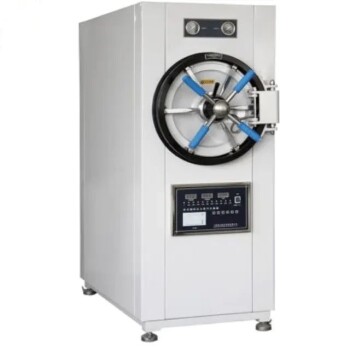
The high-pressure autoclave is the primary vessel for providing the hydrothermal environment required to transform amorphous silica precursors into an ordered mesoporous framework. By maintaining a constant temperature—typically 110 degrees Celsius for a duration of 96 hours—the autoclave facilitates the crystallization and ordered assembly of the silicon source around a surfactant template, ensuring the formation of a regular hexagonal channel structure.
Core Takeaway: The high-pressure autoclave acts as a controlled reactor that uses heat and autogenous pressure to drive the chemical condensation and structural ordering of silica, which is impossible under standard atmospheric conditions.
Creating the Hydrothermal Environment
Elevating the Reaction Energy
In the synthesis of MCM-41, the autoclave serves as a sealed system that allows the internal pressure to rise as the temperature increases. This hydrothermal environment raises the boiling point of the solvent, providing the thermal energy necessary for the silica source (such as TEOS) to undergo thorough hydrolysis and polycondensation.
Maintaining Temperature Stability
Consistency is critical for the formation of uniform pores. The autoclave maintains a precise thermal setpoint, which ensures that the nucleation and growth of the silica framework occur at a steady rate, preventing defects in the resulting material.
Driving Structural Formation
Template-Directed Assembly
The specific role of the autoclave is to provide the kinetic environment where the template agent (surfactant) and the silicon source can interact. Under constant pressure and heat, the silica species migrate and organize around the surfactant micelles to form a highly ordered 2D hexagonal lattice.
Facilitating Silica Condensation
The high-pressure environment promotes the condensation of silanol groups, which strengthens the silica-oxygen-silica (Si-O-Si) bonds. This process is essential for building a robust framework that can withstand the subsequent removal of the template during calcination.
Improving Material Solubility
The elevated pressure within the autoclave increases the solubility of raw materials in the precursor gel. This ensures that the reactants are effectively distributed in the liquid phase, allowing for more uniform in-situ growth of the mesoporous channels.
Technical Safeguards and Material Integrity
Chemical Resistance via PTFE Liners
Because the synthesis gels for MCM-41 are often highly alkaline, autoclaves utilize a PTFE (polytetrafluoroethylene) liner. This chemically inert insert protects the stainless steel outer shell from corrosion while ensuring the purity of the hydrothermal reaction.
Mechanical Pressure Management
The stainless steel exterior of the autoclave is designed to handle the mechanical pressure loads generated during the 96-hour reaction. This allows researchers to safely reach the temperatures required for crystallization without the risk of vessel failure or solvent loss.
Common Pitfalls to Avoid
Temperature and Time Imbalance
Deviating from the recommended 110°C or 96-hour duration can result in a loss of structural order. If the temperature is too low, the silica may not fully condense; if it is too high or the duration is too long, the mesoporous structure may collapse into a more thermodynamically stable dense phase.
Improper Filling Ratios
The volume of the precursor gel within the PTFE liner must be carefully managed. Overfilling the autoclave can lead to excessive pressure spikes, while underfilling may result in insufficient autogenous pressure to drive the hydrothermal crystallization process.
How to Apply This to Your Project
Making the Right Choice for Your Goal
- If your primary focus is Maximum Pore Ordering: Ensure the autoclave is maintained at exactly 110°C for the full 96-hour duration to allow the template-directed assembly to complete fully.
- If your primary focus is Material Purity: Always use a clean, unscratched PTFE liner to prevent metallic contamination from the autoclave walls during the alkaline synthesis process.
- If your primary focus is Structural Stability: Prioritize a steady cooling phase after the hydrothermal treatment to avoid thermal shock to the newly formed silica framework.
Utilizing a high-pressure autoclave correctly ensures that your MCM-41 reaches its full potential as a high-surface-area material with a perfectly organized hexagonal architecture.
Summary Table:
| Feature/Function | Description | Technical Requirement |
|---|---|---|
| Reaction Environment | Provides hydrothermal energy for silica polycondensation | 110°C for 96 hours |
| Structural Ordering | Facilitates assembly around surfactant templates | 2D Hexagonal Lattice formation |
| Chemical Resistance | Protects vessel from highly alkaline synthesis gels | PTFE (Teflon) Liners |
| Pressure Management | Sustains autogenous pressure for material solubility | Stainless steel shell integrity |
Elevate Your Material Research with KINTEK Precision
Achieve uncompromising structural integrity in your MCM-41 synthesis with KINTEK’s industry-leading laboratory equipment. We specialize in high-performance high-pressure reactors and autoclaves equipped with chemical-resistant PTFE liners, specifically designed to withstand the rigorous 96-hour hydrothermal cycles your research demands.
Whether you require precise temperature control for mesoporous silica or robust crushing, milling, and furnace systems for advanced material processing, KINTEK provides the reliability and expertise you need to drive innovation.
Ready to optimize your lab's performance? Contact us today to discuss your custom equipment needs!
References
- Hind F. Hasan, Abdelfattah Amari. Synthesizing and Characterizing a Mesoporous Silica Adsorbent for Post-Combustion CO2 Capture in a Fixed-Bed System. DOI: 10.3390/catal13091267
This article is also based on technical information from Kintek Solution Knowledge Base .
Related Products
- Mini SS High Pressure Autoclave Reactor for Laboratory Use
- High Pressure Laboratory Autoclave Reactor for Hydrothermal Synthesis
- Stainless High Pressure Autoclave Reactor Laboratory Pressure Reactor
- Desktop Fast High Pressure Laboratory Autoclave Sterilizer 16L 24L for Lab Use
- Portable High Pressure Laboratory Autoclave Steam Sterilizer for Lab Use
People Also Ask
- Why use high-pressure reactors for molecular sieve synthesis? Unlock Superior Crystallinity and Framework Control
- What is the function of a high-pressure reactor autoclave? Enhancing Cu/N Co-Doped Carbon Catalyst Synthesis
- Why are high-pressure reactors or autoclaves necessary for the synthesis of new functional materials? Unlock Precision.
- What are the advantages of using a high-pressure reactor like an autoclave? Maximize Liquefaction Speed & Yield
- How are high-pressure reactors used to prepare metaphosphate electrocatalysts? Master In-Situ Precursor Growth