Knowledge What is the temperature coefficient of graphene? Mastering Its Unique Thermal Contraction
Author avatar

Tech Team · Kintek Solution

Updated 1 week ago

What is the temperature coefficient of graphene? Mastering Its Unique Thermal Contraction


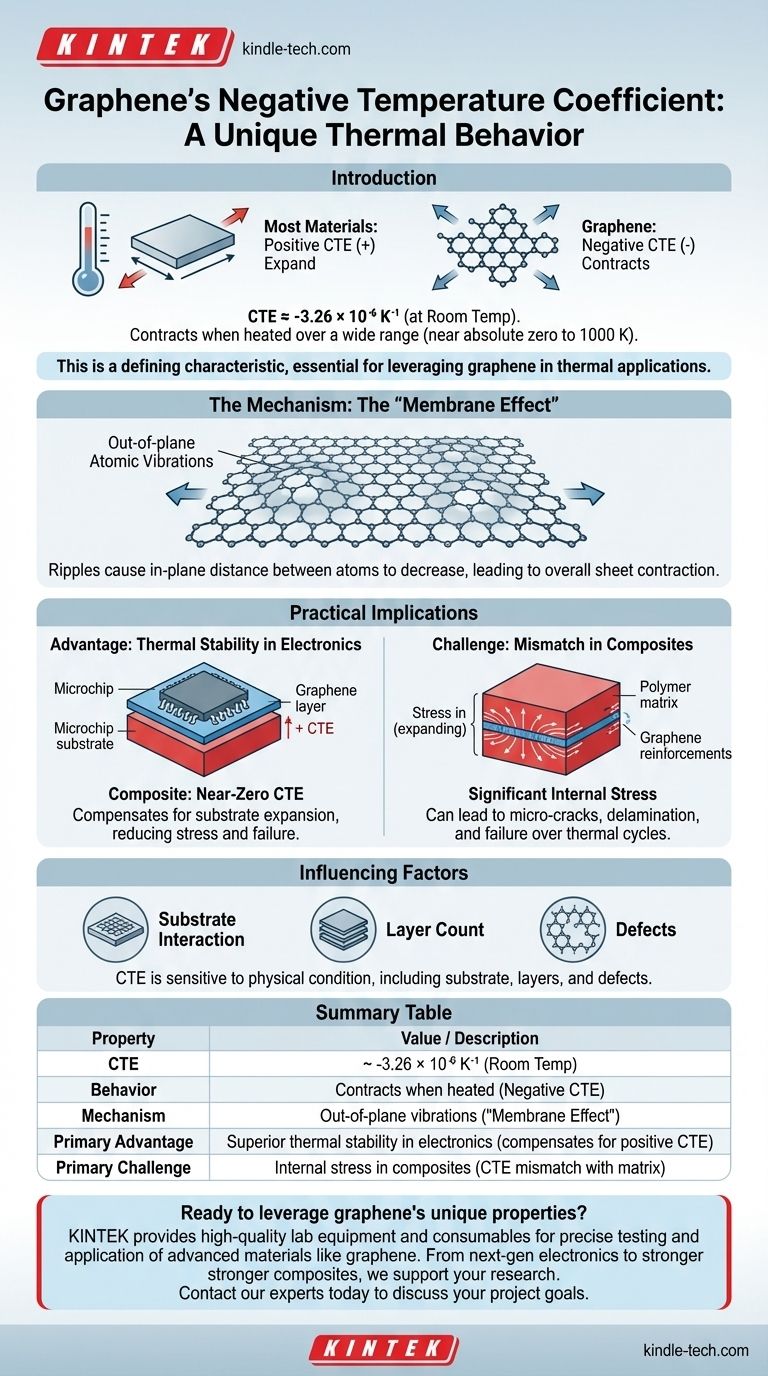
At room temperature, graphene has a negative temperature coefficient of thermal expansion (CTE) of approximately -3.26 × 10⁻⁶ K⁻¹. This means that, unlike most materials which expand when heated, graphene actually contracts. This unusual property holds true over a wide temperature range, from near absolute zero up to 1000 K (about 727 °C).

The most critical takeaway is that graphene’s negative thermal expansion is not a minor anomaly; it is a defining characteristic. Understanding this counter-intuitive behavior—shrinking upon heating—is essential for leveraging graphene in any thermal application.

What is the temperature coefficient of graphene? Mastering Its Unique Thermal Contraction

What a Negative Temperature Coefficient Means

Defining Thermal Expansion

The coefficient of thermal expansion (CTE) measures how much a material's size changes with a change in temperature. Most materials have a positive CTE, meaning they expand when heated and contract when cooled.

This behavior is predictable and is a fundamental consideration in engineering, from building bridges to designing microchips.

Graphene's Unique Contraction

Graphene defies this common principle. Its negative CTE indicates that the material shrinks as its temperature increases.

This phenomenon is not exclusive to graphene but is characteristic of many 2D materials. It stems directly from its unique, one-atom-thick structure.

The Mechanism: The "Membrane Effect"

The reason for this contraction lies in atomic vibrations. When graphene is heated, its carbon atoms vibrate with increased energy.

Because it is a flexible 2D sheet, the dominant vibrations are out-of-plane, like the rippling of a drum skin. To accommodate these growing ripples, the in-plane distance between the atoms must decrease, causing the entire sheet to contract.

Practical Implications and Trade-offs

Advantage: Thermal Stability in Electronics

Graphene's negative CTE can be a powerful tool. Most semiconductor substrates, like silicon, have a positive CTE. The mismatch causes mechanical stress and potential failure in electronic devices as they heat up and cool down.

By integrating graphene into a device, its negative expansion can compensate for the substrate's positive expansion. This allows engineers to create composite structures with a near-zero overall CTE, leading to exceptional thermal stability and reliability.

Challenge: Mismatch in Composites

When using graphene as a reinforcement material in a polymer or metal matrix, its negative CTE can also be a liability. The surrounding matrix material will expand with heat while the graphene tries to shrink.

This CTE mismatch creates significant internal stress at the interface between the graphene and the matrix. Over repeated thermal cycles, this stress can lead to micro-cracks, delamination, and ultimately, failure of the composite material.

Factor: Dependence on Form and Substrate

The measured CTE of graphene is not a universal constant. It is highly sensitive to its physical condition.

Factors such as the substrate it is placed on, the number of layers (single-layer vs. few-layer vs. graphite), and the presence of defects can all influence its thermal expansion behavior. The pristine, defect-free graphene produced under controlled conditions (like low-pressure chemical vapor deposition) will behave differently than graphene in a bulk composite.

Applying This Knowledge to Your Project

Understanding graphene's CTE is about managing its unique properties to achieve a specific outcome.

  • If your primary focus is thermal stability for electronics: Use graphene to create a composite with a near-zero CTE by balancing its negative expansion against a substrate's positive expansion.
  • If your primary focus is creating strong, heat-resistant composites: You must model and manage the internal stresses caused by the CTE mismatch between graphene and the host matrix material.
  • If your primary focus is sensing or actuation: Leverage the predictable contraction as a direct response to thermal input for creating highly sensitive thermal sensors or actuators.

Ultimately, mastering graphene's thermal properties is key to unlocking its potential in advanced materials and devices.

Summary Table:

Property Value / Description
Coefficient of Thermal Expansion (CTE) Approximately -3.26 × 10⁻⁶ K⁻¹ at room temperature
Behavior Contracts when heated (negative CTE)
Key Mechanism Out-of-plane atomic vibrations (the "Membrane Effect")
Primary Advantage Can compensate for positive CTE in substrates for superior thermal stability in electronics
Primary Challenge Creates internal stress in composites due to CTE mismatch with the matrix material

Ready to leverage graphene's unique properties in your lab?

Understanding material behavior is the first step to innovation. KINTEK specializes in providing the high-quality lab equipment and consumables you need to precisely test and apply advanced materials like graphene.

Whether you're developing next-generation electronics or stronger composites, we have the tools to support your research.

Contact our experts today to discuss how we can help you achieve your project goals.

Visual Guide
What is the temperature coefficient of graphene? Mastering Its Unique Thermal Contraction Visual Guide

Related Products

People Also Ask

Related Products

Graphite Vacuum Continuous Graphitization Furnace

Graphite Vacuum Continuous Graphitization Furnace

High-temperature graphitization furnace is a professional equipment for graphitization treatment of carbon materials. It is a key equipment for the production of high-quality graphite products. It has high temperature, high efficiency and uniform heating. It is suitable for various high-temperature treatments and graphitization treatments. It is widely used in metallurgy, electronics, aerospace, etc. industry.

Large Vertical Graphite Vacuum Graphitization Furnace

Large Vertical Graphite Vacuum Graphitization Furnace

A large vertical high-temperature graphitization furnace is a type of industrial furnace used for the graphitization of carbon materials, such as carbon fiber and carbon black. It is a high-temperature furnace that can reach temperatures of up to 3100°C.

Glassy Carbon Sheet RVC for Electrochemical Experiments

Glassy Carbon Sheet RVC for Electrochemical Experiments

Discover our Glassy Carbon Sheet - RVC. Perfect for your experiments, this high-quality material will elevate your research to the next level.

Hydrophilic Carbon Paper TGPH060 for Battery Lab Applications

Hydrophilic Carbon Paper TGPH060 for Battery Lab Applications

Toray carbon paper is a porous C/C composite material product (composite material of carbon fiber and carbon) that has undergone high-temperature heat treatment.

Vertical High Temperature Graphite Vacuum Graphitization Furnace

Vertical High Temperature Graphite Vacuum Graphitization Furnace

Vertical high temperature graphitization furnace for carbonization and graphitization of carbon materials up to 3100℃.Suitable for shaped graphitization of carbon fiber filaments and other materials sintered in a carbon environment.Applications in metallurgy, electronics, and aerospace for producing high-quality graphite products like electrodes and crucibles.

Conductive Carbon Fiber Brush for Static Removal and Cleaning

Conductive Carbon Fiber Brush for Static Removal and Cleaning

Discover the benefits of using conductive carbon fiber brush for microbial cultivation and electrochemical testing. Improve your anode's performance.

Custom PTFE Teflon Parts Manufacturer for PTFE Measuring Cylinder 10/50/100ml

Custom PTFE Teflon Parts Manufacturer for PTFE Measuring Cylinder 10/50/100ml

PTFE measuring cylinder are a rugged alternative to traditional glass cylinders. They are chemically inert over a wide temperature range (up to 260º C), have excellent corrosion resistance and maintain a low coefficient of friction, ensuring ease of use and cleaning.

Metallographic Specimen Mounting Machine for Laboratory Materials and Analysis

Metallographic Specimen Mounting Machine for Laboratory Materials and Analysis

Precision metallographic mounting machines for labs—automated, versatile, and efficient. Ideal for sample prep in research and quality control. Contact KINTEK today!

Optical Window Glass Substrate Wafer Single Double Sided Coated K9 Quartz Sheet

Optical Window Glass Substrate Wafer Single Double Sided Coated K9 Quartz Sheet

K9 glass, also known as K9 crystal, is a type of optical borosilicate crown glass renowned for its exceptional optical properties.

Custom PTFE Teflon Parts Manufacturer for Culture Dish and Evaporation Dish

Custom PTFE Teflon Parts Manufacturer for Culture Dish and Evaporation Dish

The PTFE culture dish evaporating dish is a versatile laboratory tool known for its chemical resistance and high-temperature stability. PTFE, a fluoropolymer, offers exceptional non-stick properties and durability, making it ideal for various applications in research and industry, including filtration, pyrolysis, and membrane technology.

Rubber Vulcanizer Vulcanizing Machine Plate Vulcanizing Press for Lab

Rubber Vulcanizer Vulcanizing Machine Plate Vulcanizing Press for Lab

The Plate vulcanizing press is a kind of equipment used in the production of rubber products, mainly used for the vulcanization of rubber products. Vulcanization is a key step in rubber processing.

Custom PTFE Teflon Parts Manufacturer for Hollow Cleaning Basket and Rack Carrier

Custom PTFE Teflon Parts Manufacturer for Hollow Cleaning Basket and Rack Carrier

The PTFE hollow cleaning flower basket is a specialized laboratory tool designed for efficient and safe cleaning processes. Made from high-quality polytetrafluoroethylene (PTFE), this basket offers exceptional resistance to acids, alkalis, and organic solvents, ensuring durability and reliability in various chemical environments.

Laboratory Disc Rotary Mixer for Efficient Sample Mixing and Homogenization

Laboratory Disc Rotary Mixer for Efficient Sample Mixing and Homogenization

Efficient Laboratory Disc Rotary Mixer for Precise Sample Mixing, Versatile for Various Applications, DC Motor and Microcomputer Control, Adjustable Speed and Angle.

Custom PTFE Teflon Parts Manufacturer for Three-Necked Round Bottom Flask

Custom PTFE Teflon Parts Manufacturer for Three-Necked Round Bottom Flask

PTFE flask, is a versatile laboratory container made from PTFE, offering exceptional chemical resistance, temperature stability, and non-stick properties. Ideal for handling corrosive substances and high-temperature applications, these flasks are essential in various laboratory procedures, including heating, mixing, and storage of chemicals.

High Purity Zinc Foil for Battery Lab Applications

High Purity Zinc Foil for Battery Lab Applications

There are very few harmful impurities in the chemical composition of zinc foil, and the surface of the product is straight and smooth; it has good comprehensive properties, processability, electroplating colorability, oxidation resistance and corrosion resistance, etc.

Laboratory Sterilizer Lab Autoclave Pulsating Vacuum Desktop Steam Sterilizer

Laboratory Sterilizer Lab Autoclave Pulsating Vacuum Desktop Steam Sterilizer

The pulsating vacuum desktop steam sterilizer is a compact and reliable device used for rapid sterilization of medical, pharmaceutical, and research items.

Small Lab Rubber Calendering Machine

Small Lab Rubber Calendering Machine

Small lab rubber calendering machine is used for producing thin, continuous sheets of plastic or rubber materials. It is commonly employed in laboratories, small-scale production facilities, and prototyping environments to create films, coatings, and laminates with precise thickness and surface finish.

High Shear Homogenizer for Pharmaceutical and Cosmetic Applications

High Shear Homogenizer for Pharmaceutical and Cosmetic Applications

Enhance lab efficiency with our high-speed Laboratory Emulsifier Homogenizer for precise, stable sample processing. Ideal for pharmaceuticals & cosmetics.

Custom PTFE Teflon Parts Manufacturer for PTFE Mesh F4 Sieve

Custom PTFE Teflon Parts Manufacturer for PTFE Mesh F4 Sieve

PTFE mesh sieve is a specialized test sieve designed for particle analysis in various industries, featuring a non-metallic mesh woven from PTFE filament. This synthetic mesh is ideal for applications where metal contamination is a concern . PTFE sieves are crucial for maintaining the integrity of samples in sensitive environments, ensuring accurate and reliable results in particle size distribution analysis.

Optical Ultra-Clear Glass Sheet for Laboratory K9 B270 BK7

Optical Ultra-Clear Glass Sheet for Laboratory K9 B270 BK7

Optical glass, while sharing many characteristics with other types of glass, is manufactured using specific chemicals that enhance properties crucial for optics applications.


Leave Your Message