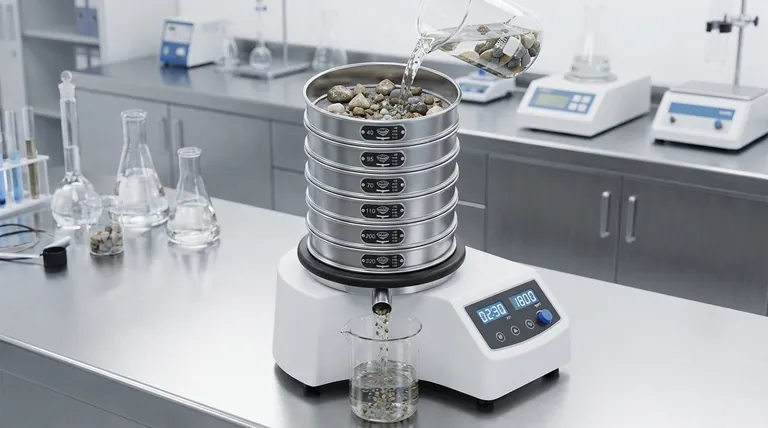
In short, using a sieve to separate a solid from a liquid is a mechanical process that works by passing a mixture through a mesh screen. The liquid and any particles smaller than the mesh openings pass through, while the larger solid particles are trapped and retained by the sieve. This technique is effective only when the solid is undissolved and its particles are visibly larger than the holes in the sieve.
The core principle of sieving is separation based on a simple physical property: particle size. It is a coarse method of filtration designed to catch large, insoluble solids while allowing the liquid to pass freely.
The Core Principle: Separation by Size
How a Sieve Works
A sieve, also known as a strainer or colander in a kitchen context, is simply a barrier with perforations or a mesh of a specific size.
When you pour a solid-liquid mixture onto it, gravity pulls the liquid down through the holes. Any solid particles too large to fit through these holes are left behind.
The Key Requirement: Insolubility and Size
This method only works under two conditions. First, the solid must be insoluble—it cannot be dissolved in the liquid. You cannot sieve salt out of saltwater.
Second, the solid particles must be physically larger than the sieve's openings. If the solid is a fine powder suspended in the liquid, it will likely pass right through with the liquid.
Everyday Analogies
You use this principle frequently. A kitchen colander separating cooked pasta from water is a perfect example of sieving. Similarly, using a tea strainer to keep loose tea leaves out of your cup is another common application.
Sieving vs. Other Separation Methods
Understanding when to use a sieve requires comparing it to other common laboratory and real-world techniques.
Sieving vs. Filtration
Filtration is a more refined version of this concept. It is used to separate very fine, insoluble solid particles from a liquid or gas by passing the mixture through a medium—like filter paper—that has microscopic pores.
Think of sieving as catching rocks, while filtration is like catching sand or dust. A coffee filter, for instance, traps fine coffee grounds that would easily pass through a kitchen sieve.
Sieving vs. Decantation
Decantation is used when a dense, insoluble solid has settled at the bottom of a container due to gravity. The process involves carefully pouring off the liquid, leaving the settled solid behind.
This method relies on density and settling time, not particle size. It's often less precise than sieving, as some solid may get poured off with the liquid.
Sieving vs. Evaporation
Evaporation is used to separate a dissolved solid (a solute) from a liquid (a solvent). By heating the mixture, the liquid turns into a gas and evaporates, leaving the solid crystals behind.
This is the correct method for a mixture like saltwater, where sieving and filtration would be completely ineffective.
Understanding the Limitations
When Sieving Fails: Dissolved Solids
The most significant limitation is that sieving cannot separate dissolved substances. The individual ions or molecules of a dissolved solid, like sugar in water, are far too small to be caught by any physical mesh.
When Sieving is Inefficient: Very Fine Particles
If you are trying to separate a mixture of cloudy water containing fine silt or clay, a sieve will be useless. The particles are too small and will pass through the openings. In this scenario, filtration is the appropriate method.
The Problem of Clogging
For mixtures with a high concentration of solids, the sieve's mesh can quickly become blocked or clogged. This prevents the liquid from passing through efficiently, slowing down or stopping the separation process.
Choosing the Right Separation Method
Selecting the correct technique depends entirely on the physical properties of your mixture.
- If you have large, undissolved solids in a liquid: Use a sieve for a quick and simple separation (e.g., gravel in water).
- If you have very fine, suspended solids in a liquid: Use filtration for a more precise separation (e.g., sand in water).
- If you have a solid that has completely dissolved in a liquid: Use evaporation to recover the solid (e.g., salt in water).
- If you have a dense solid that has settled at the bottom: Use decantation for a quick, less-precise separation (e.g., sediment in aged wine).
By identifying the nature of your mixture first, you can confidently select the most effective method to achieve your goal.
Summary Table:
| Separation Method | Best For | Key Principle |
|---|---|---|
| Sieving | Large, insoluble solids | Particle size (larger than mesh openings) |
| Filtration | Fine, insoluble solids | Particle size (smaller pores in filter paper) |
| Evaporation | Dissolved solids | Boiling point difference (liquid evaporates) |
| Decantation | Dense, settled solids | Density difference (pouring off liquid) |
Need the right equipment for your separation processes? KINTEK specializes in high-quality lab sieves, filtration systems, and consumables designed for accuracy and durability. Whether you're working with coarse materials or fine suspensions, we have the reliable equipment your laboratory needs. Contact our experts today to find the perfect solution for your application!
Visual Guide

Related Products
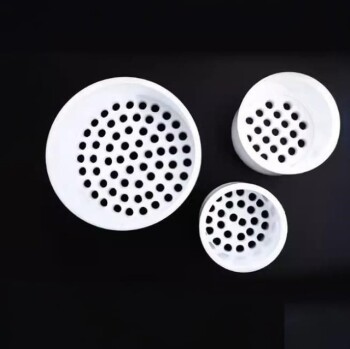
- Custom PTFE Teflon Parts Manufacturer for PTFE Mesh F4 Sieve
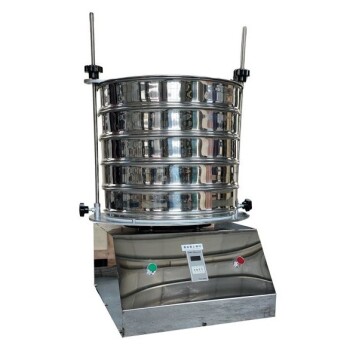
- Laboratory Test Sieves and Sieving Machines
- Laboratory Vibratory Sieve Shaker Machine Slap Vibrating Sieve
- Three-dimensional electromagnetic sieving instrument
- 10L Chilling Circulator Cooling Water Bath Low Temperature Constant Temperature Reaction Bath
People Also Ask
- What is the difference between ASTM standards sieves and is standard sieves? Ensure Compliance for Your Lab
- What is the mesh size of a sieve? A Guide to Particle Size and Sieve Selection
- What are the specific applications of PTFE in micro-batch slug flow systems? Enhance Your Microfluidic Reaction Purity
- How do we select a sieve? A Systems-Based Guide to Accurate Particle Separation
- What materials are required for sieving? Achieve Accurate Particle Size Analysis