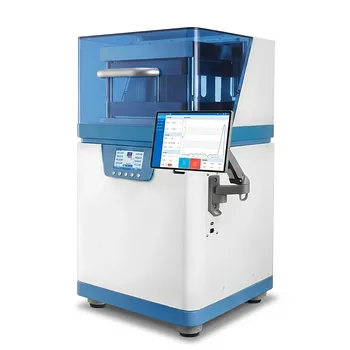
High-pressure reactors and autoclaves create a controlled, sealed environment that elevates internal pressure significantly above atmospheric levels. This unique physical state allows solvents to remain in a liquid phase at temperatures far exceeding their standard boiling points. By manipulating these thermodynamic variables, these vessels facilitate increased reactant solubility, accelerated reaction kinetics, and the synthesis of specialized materials that are impossible to produce under normal laboratory conditions.
High-pressure reactors transform the physical behavior of solvents and reagents by maintaining a high-pressure, high-temperature equilibrium. This environment enables advanced chemical pathways, such as hydrothermal synthesis and supercritical fluid processing, by enhancing molecular diffusion and solubility.
The Mechanics of High-Pressure Synthesis
Overcoming the Atmospheric Boiling Point
The primary function of an autoclave is to provide a sealed high-strength environment that prevents the evaporation of solvents. In a standard open vessel, a solvent cannot exceed its boiling point; however, the sealed design of a reactor forces the solvent to remain liquid at extreme temperatures.
Creating Subcritical and Supercritical States
By precisely managing the pressure-temperature relationship, these reactors can reach subcritical or supercritical fluid environments. In these states, solvents exhibit unique properties, such as lower viscosity and higher diffusivity, which are essential for the rapid rearrangement of precursor ions.
Structural Integrity and Containment
To maintain these conditions, reactors utilize high-strength metal shells and specialized sealing structures. These components are designed to withstand internal forces that would rupture standard glassware, ensuring that the high-energy environment remains stable throughout the reaction.
Impact on Chemical Kinetics and Thermodynamics
Enhanced Solubility and Diffusion
High-pressure environments significantly increase the solubility of transition metal salts and other precursors that are otherwise insoluble. This facilitates a more uniform distribution of reactants, leading to the production of high-purity substances with fewer defects.
Accelerated Reaction Rates
The elevated temperature and pressure increase the molecular collision frequency. By providing more kinetic energy to the system, these reactors allow chemical transformations to occur at a much faster rate than they would at atmospheric pressure.
Directional Crystal Growth
The controlled environment allows for the directional growth of specific crystal planes. This is a critical factor in materials science, as it enables researchers to engineer single-crystal nanostructures with high crystallinity and specific morphologies.
Understanding the Trade-offs
Structural Integrity and Safety Risks
Operating at extreme pressures introduces significant safety risks, such as the potential for mechanical failure or explosions. Reactors must be equipped with pressure relief valves and undergo rigorous testing to mitigate the dangers of overpressurization.
Complexity of Process Control
Achieving experimental reproducibility requires highly precise control systems to manage the interplay between temperature and pressure. Small fluctuations in these variables can lead to vastly different chemical outcomes, making the equipment more complex to operate than standard reactors.
Material Compatibility and Corrosion
Continuous exposure to high-temperature, high-pressure solutions can lead to material degradation of the reactor itself. For example, simulating environments like those found in nuclear reactors (330°C and 150 bar) requires specialized alloys, such as Alloy 690TT, to resist oxidation and stress corrosion.
How to Apply This to Your Project
When utilizing high-pressure reactors, your choice of equipment should align with the specific chemical or material outcome you require.
- If your primary focus is Nanomaterial Morphology: Utilize the hydrothermal synthesis capabilities of an autoclave to control crystal plane growth at lower temperatures.
- If your primary focus is Catalytic Efficiency: Leverage the high molecular collision frequency of high-pressure environments to accelerate catalytic processes and explore new reaction pathways.
- If your primary focus is Material Durability Testing: Use high-pressure reactors to simulate extreme service conditions, such as those found in pressurized water reactors, to evaluate long-term oxidation behavior.
- If your primary focus is Chemical Purity: Rely on the enhanced solubility and diffusion provided by subcritical fluids to ensure the uniform synthesis of high-purity precursors.
By mastering the extreme physical conditions provided by high-pressure reactors, researchers can unlock chemical transformations that define the cutting edge of modern materials science.
Summary Table:
| Physical Condition | Mechanism | Synthesis Benefit |
|---|---|---|
| Elevated Pressure | Prevents solvent evaporation | Maintains liquid phase above standard boiling points |
| High Temperature | Increases molecular kinetic energy | Accelerates reaction rates & collision frequency |
| Fluid State | Reaches Sub/Supercritical states | Enhances diffusivity and reactant solubility |
| Sealed Environment | High-strength containment | Facilitates directional crystal growth & high purity |
| Controlled Equilibrium | Precision thermal management | Enables hydrothermal and specialized material synthesis |
Elevate Your Research with KINTEK’s Precision Engineering
Unlock the full potential of your high-temperature and high-pressure experiments with KINTEK. Whether you are focused on hydrothermal synthesis, catalytic efficiency, or material durability testing, our advanced laboratory solutions are designed to handle the most demanding chemical environments.
Our Expert Solutions Include:
- Synthesis & Processing: Specialized high-temperature high-pressure reactors, autoclaves, and CVD/PECVD systems.
- Material Preparation: High-performance crushing, milling, and hydraulic pellet presses.
- Lab Infrastructure: ULT freezers, electrolytic cells, and essential high-purity ceramics or crucibles.
At KINTEK, we provide more than just equipment; we provide the reliability and safety your breakthrough research deserves. Contact our technical specialists today to find the perfect high-pressure solution tailored to your specific project needs!
References
- Pengxin Li, Zhenya Liu. Non‐precious Metal Cu‐Ni Alloy Nanoparticles Supported on Porous Boron Nitride Fibers as Catalysts for Dehydrogenation from Methanolysis of Ammonia‐Borane**. DOI: 10.1002/slct.202204413
This article is also based on technical information from Kintek Solution Knowledge Base .
Related Products
- Customizable Laboratory High Temperature High Pressure Reactors for Diverse Scientific Applications
- Customizable High Pressure Reactors for Advanced Scientific and Industrial Applications
- Stainless High Pressure Autoclave Reactor Laboratory Pressure Reactor
- Mini SS High Pressure Autoclave Reactor for Laboratory Use
- High Pressure Laboratory Autoclave Reactor for Hydrothermal Synthesis
People Also Ask
- How do high-pressure and high-temperature reactors ensure the effective treatment of lignocellulosic wastewater in WAO?
- What equipment is required for high-pressure high-temperature reactions? Master Extreme Chemistry Safely
- How do you control high pressure in a reactor? A Guide to Safe & Stable Operation
- How does initial oxygen pressure affect the wet oxidation of pharmaceutical sludge? Master Your Oxidation Depth
- Why is argon better than nitrogen for inert atmosphere? Ensure Absolute Reactivity & Stability